Weekly Wisdom: The Memory Arms Race
Why Memory Matters
The memory market has quietly become one of the most important and misunderstood battlegrounds in global technology. What was once a highly cyclical segment of semiconductors is now at the center of the AI revolution. Explosive demand from AI data centers, limited manufacturing capacity, and rapidly rising system complexity have pushed memory pricing and allocation into a new regime.
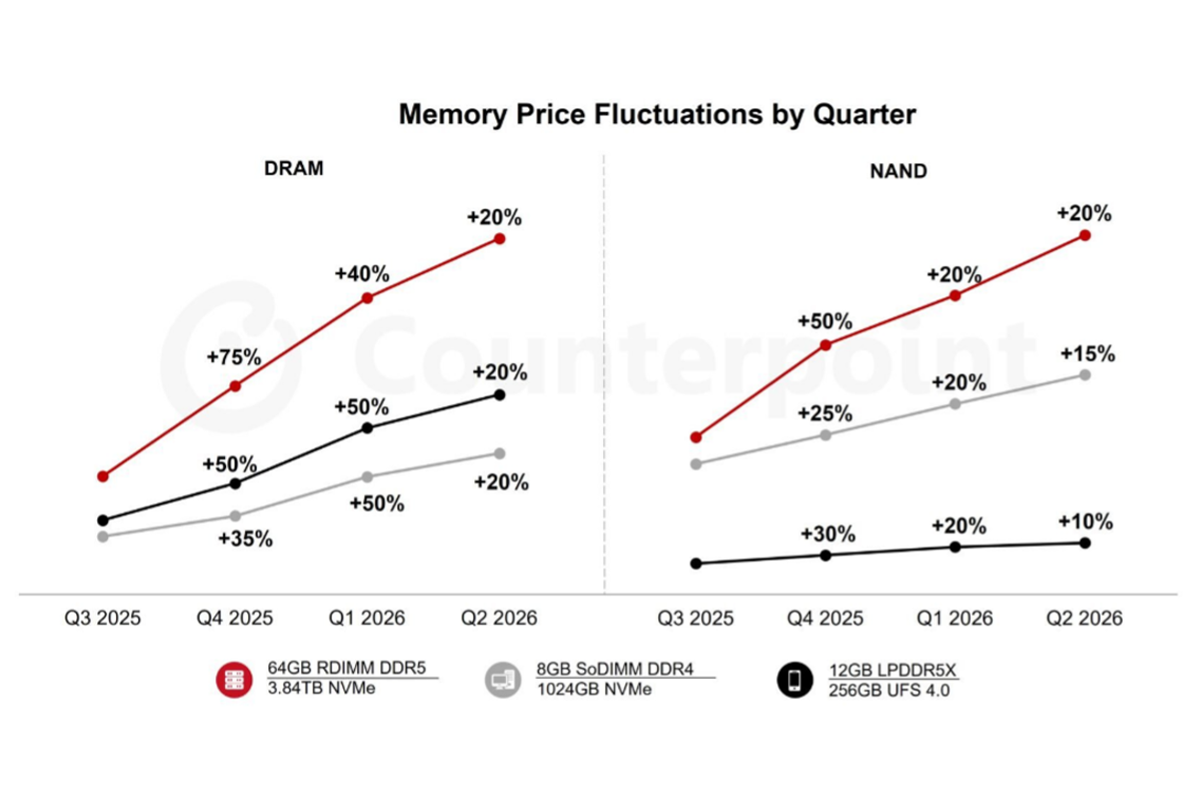
Estimates for memory pricing are moving materially higher, underscoring just how tight supply conditions have become. The primary critical element is DRAM (Dynamic Random Access Memory), which is short-term memory that processors use to actively run programs. The price of a 64GB DRAM module has risen from roughly $255 in Q3 2025 to over $420 today, with estimates pointing toward $700 by March.1 Due to these price hikes, DRAM now represents approximately 12% of the cost to manufacture a Blackwell-class GPU, up from just 6% at Q3 2025 pricing.2 As a result, memory is no longer just another component inside devices; it has become a strategic constraint that is reshaping cost structures, capital spending decisions, and competitive dynamics across semiconductors, cloud infrastructure, and consumer electronics.
Memory Price Forecast Chart3
AI Datacenters Are Crowding Out the Rest of the Market
AI datacenters are expected to consume roughly 70% of global high-end DRAM production in 2026.4 These buyers have deep balance sheets and are securing memory supply years in advance, leaving far less capacity available for PCs, smartphones, autos, and other consumer electronics. Memory prices already rose about 50% in the final three months of 2025 and are expected to climb another 70% in 2026 as shortages persist.5
This shift is forcing strategic decisions across the industry. Micron recently announced it is exiting its nearly 30-year-old Crucial consumer memory business to focus on supplying AI and data center customers. Management cited AI-driven growth in memory and storage demand as the reason for prioritizing larger, faster-growing, and more strategic customers. This move underscores a broader industry reality where capacity is being deliberately reallocated toward AI, a decision that could further tighten supply and push consumer prices higher.
Micron’s recent decision to break ground on a $24 billion advanced wafer fabrication facility in Singapore underscores just how durable Micron believes AI-driven memory demand will be over the long term. Until now, memory producers have avoided meaningful capacity expansion, to preserve pricing power in a supply-constrained market. Micron’s move signals a willingness to invest ahead of demand, which could modestly reduce industry pricing leverage starting in 2027, but should also allow Micron to gain market share and strategic flexibility as AI, data centers, and high-performance storage continue to scale.
The “Memory Wall” and Why It Matters
For decades, semiconductor progress was guided by Moore’s Law, where fitting more transistors onto chips was done to improve performance and reduce cost. In the AI era however, the industry has shifted toward the “Scaling Law,” where performance gains come from larger models, more data, and more computing resources. This shift has exposed a major bottleneck known as the “memory wall” where AI chips have become so powerful that they increasingly sit idle waiting for data to move in and out of memory as there is a gap in technological acceleration.
Over the past two years, AI compute power has increased roughly threefold, while memory bandwidth has grown far more slowly.6 As a result, performance is increasingly constrained by data transfer speeds rather than raw processing power. This imbalance explains why AI leaders are no longer competing solely on compute, but instead on memory bandwidth, data movement, and system-level efficiency.
HBM Ignite a New Memory Supercycle
High Bandwidth Memory (HBM) has emerged as a critical solution to the memory wall. HBM stacks multiple DRAM chips vertically and places them close to processors, dramatically increasing data transfer speeds. As AI models scale and workloads shift from training toward inference, demand for HBM and server-grade DRAM has surged. HBM demand grew more than 130% year over year in 2025 and is expected to rise by over 70% again in 2026, driven by next-generation AI platforms across the industry.7
Because manufacturing capacity is limited, DRAM producers are prioritizing HBM and high-end server memory. This reduces availability for consumer DRAM and reinforces upward pressure on prices across the entire memory stack. These dynamics mark the beginning of a new memory supercycle, one driven by structural AI demand rather than a traditional consumer refresh cycle.
Consumer Electronics Feel the Pressure
The downstream effects of rising memory costs are increasingly visible. Smartphone production, initially expected to be flat, is now projected to decline by 7% year over year, with memory accounting for a growing share of total device costs.8 Even premium manufacturers are being forced to reassess pricing strategies, while lower-end devices are seeing specifications reduced to control costs.
Laptop shipments face similar pressure, with forecasts shifting from modest growth to mid-single-digit declines and potential downside if memory prices remain elevated. Gaming consoles are also impacted, with memory now accounting for as much as 23%–42% of total bill-of-materials costs, significantly compressing margins and limiting promotional flexibility.9
A Structural Shift With Lasting Implications
While rising memory prices challenge hardware manufacturers, they create clear winners elsewhere in the semiconductor ecosystem. Memory producers benefit directly from higher average selling prices and long-term contract visibility. More importantly, increasing memory density and system complexity raise the cost of design errors in advanced chips. These tools allow designers to model, test, and optimize chips before they are manufactured. Companies involved in pre-production chip testing also benefit as customers seek to reduce risk in an environment where every design decision carries greater cost.
The current memory environment represents a structural transformation rather than a temporary dislocation. AI has elevated memory from a commoditized component to a strategic bottleneck, reshaping pricing power and capacity allocation across the industry. AI-driven demand, limited manufacturing expansion, and the growing memory wall have created a durable seller’s market. At the same time, rising memory requirements per chip are increasing system complexity, strengthening the case for companies that enable design, simulation, and testing. These challenges reinforce our conviction that the memory supercycle is still in its early innings, with attractive opportunities extending through 2026.
Stephanie Link’s TV Schedule

[1] Barclays: U.S. Autos & Mobility, as of January 28, 2026
[2] Bloomberg Intelligence, as of January 2026
[3] Counterpoint: Memory Prices Soar by 50% in Q4, as of January 6, 2026
[4] Bloomberg, as of January 2026
[5] TrendForce: Memory Wall Bottleneck, as of January 16, 2026
[6] Wells Fargo: More Dram-A Coming?, as of January 20, 2026
[7] Mizuho 2026 Semiconductor and Automotives Outlook, as of January 16, 2026
[8] TrendForce: Memory Wall Bottleneck, as of January 16, 2026
[9] TrendForce: Memory Wall Bottleneck, as of January 16, 2026
This material is for general information and educational purposes only. Information is based on data gathered from what we believe are reliable sources. It is not guaranteed as to accuracy, does not purport to be complete and is not intended to be used as a primary basis for investment decisions.
Find answers to your questions about Hightower Signature Wealth
Hightower Signature Wealth is a fiduciary wealth management practice that provides investment management, financial planning, estate strategies, insurance, and banking solutions. We work with families, business owners, professionals, women, and retirees across more than 40 offices nationwide. Our advisors take the time to understand your financial priorities, develop a plan around your goals, and adjust that plan as your life and circumstances evolve.
Hightower Signature Wealth provides a broad range of wealth management services designed to address different aspects of your financial life. Our capabilities include investment management, financial planning, retirement planning, estate strategies, insurance and risk management, banking solutions, and charitable giving strategies. By considering these areas together, our advisors can develop a coordinated approach based on your goals, priorities, financial circumstances, and plans for the future.
Hightower Signature Wealth advisors work with a broad range of clients, including women, families, business owners, professionals, retirees, and high-net-worth individuals navigating major life or financial transitions. Rather than applying a generic playbook, each advisor tailors the plan to a client’s specific goals and current stage of life – from early-career decisions to multigenerational wealth transfer.
Yes. Hightower Signature Wealth advisors serve as fiduciaries, which means they are committed to acting in their clients’ interests when providing investment advice. We offer fee-based advisory services, with fees depending on the services provided and the specifics of your relationship. Your advisor will discuss the applicable fee structure with you so you can understand how you are charged and what services are included.
Hightower Signature Wealth has more than 40 offices nationwide, allowing our advisors to serve individuals, families, and organizations across the country. Depending on your location and preferences, you may be able to work with an advisor locally or connect with a team in another market. Visit our Locations page to explore our office locations, learn more about the teams in each market, and find an office near you.
Getting started with Hightower Signature Wealth is simple. Complete our online contact form with some basic information about yourself and what you are looking for, and we’ll connect you with an advisor who can discuss your needs and financial priorities. That initial conversation is an opportunity to learn more about our approach, ask questions, and determine whether working with a Hightower Signature Wealth advisor may be a good fit.
Your first conversation is an opportunity for us to learn more about you, your financial circumstances, and what you hope to accomplish. An advisor may ask about your goals, current investments, family considerations, business interests, and other priorities that could influence your financial plan. You’ll also have an opportunity to ask questions, learn about our approach, and discuss what working together could look like.