Weekly Wisdom Special Edition: Federal Freeze – What the Government Shutdown Means
What Sparked the Shutdown
The recent U.S. government shutdown was triggered by a failure in Congress to pass legislation funding federal agencies into the new fiscal year, which began on October 1st. While the Republican Party currently holds majorities in both the House of Representatives and the Senate, it lacks the 60-vote supermajority required in the Senate to advance a spending bill without bipartisan support. This has given Senate Democrats significant leverage in negotiations, and the two parties remain deeply divided over key budgetary issues, most notably, healthcare funding.
Despite efforts to avoid a shutdown, including a stopgap funding bill that passed in the House, the legislation failed to clear the Senate. Without a new budget in place before the start of the fiscal year, the government was forced to suspend non-essential operations, marking the first shutdown since 2018–2019.
Market Impact: What It Means
Government shutdowns can create uncertainty in financial markets, but historically, their direct impact on stock performance tends to be limited and short-lived. During a shutdown, federal agencies pause non-essential operations, which can temporarily delay key economic data releases and government contracts. While this may disrupt short-term investor sentiment, markets often look through these events, especially when the underlying economic fundamentals remain solid. Investors typically price in the expectation that political gridlock will eventually resolve, especially when there’s no immediate threat to debt servicing or a prolonged economic slowdown.
October has a reputation for being a seasonally weak month, often marked by heightened volatility and investor caution. However, the first half’s weakness can also present opportunities, especially when the broader economic picture shows resilience. Recent data continues to show stable GDP growth, lower unemployment, and easing inflation—factors that support corporate earnings power. As companies begin reporting Q3 earnings, strong results and forward guidance can act as catalysts for a market rebound. In past cycles, early-October drawdowns have frequently given way to rallies once earnings season kicks into gear and fiscal policy concerns recede.
S&P 500 Returns During Government Shutdowns[1]
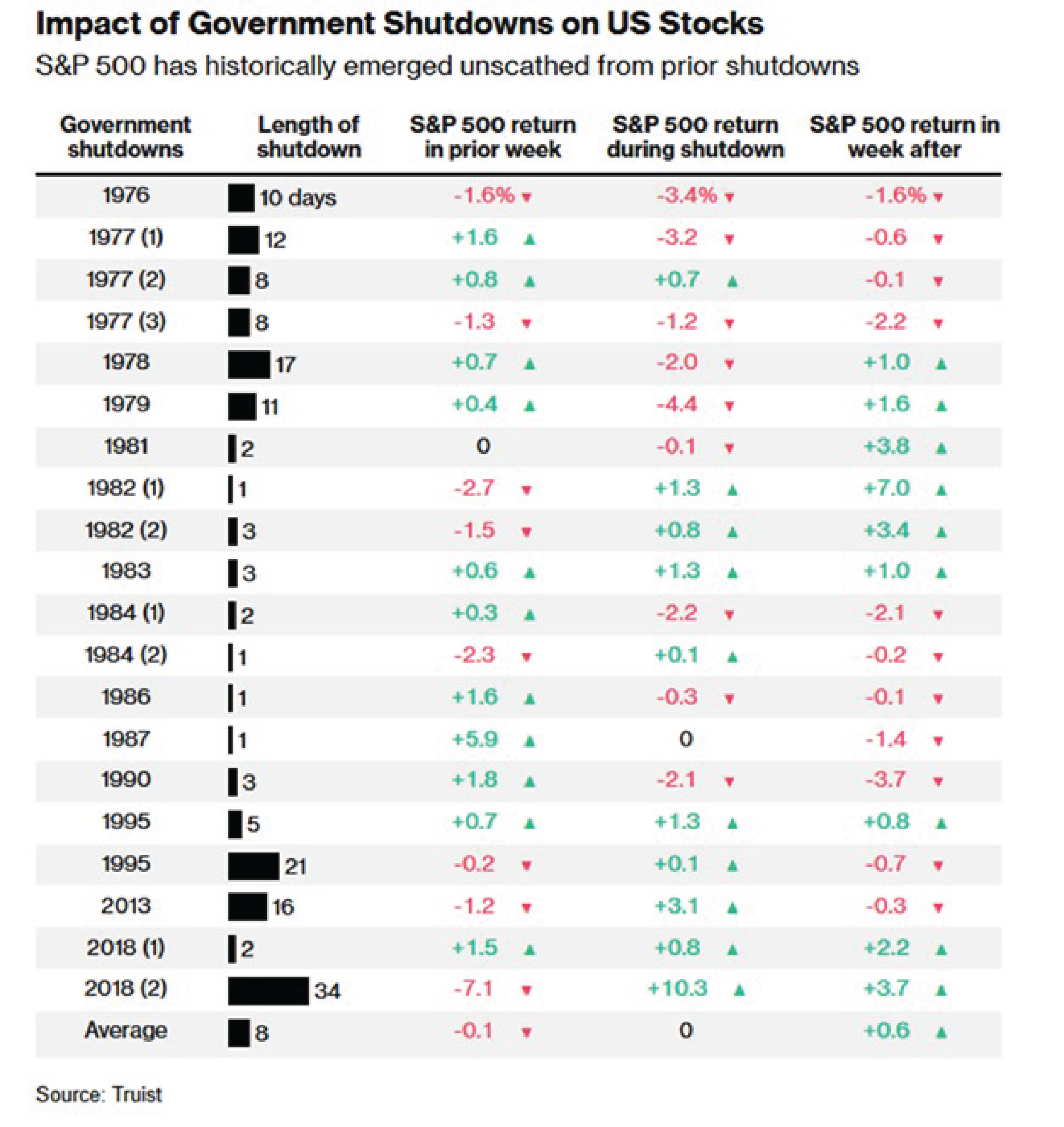
U.S. government shutdowns have had little consistent impact on the S&P 500, with the average return during shutdowns being flat (0.0%) and a slight average gain of +0.6% in the week after. There is no clear correlation between the length of a shutdown and market performance. Longer shutdowns, like the second shutdown in 2018, have sometimes coincided with strong market gains, while shorter ones have seen both gains and losses. More recent shutdowns appear to have had even less negative effect, suggesting that markets have become more resilient or less reactive to political disruptions of this kind.
Future Outlook
Looking ahead, analysts estimate that each week the shutdown continues, economic growth could be reduced by approximately 0.1 to 0.2 percentage points. However, much of that lost output may be recovered once the government reopens, as has often been the case following past shutdowns.
The stage is set for a potentially strong Q4. Historically, the final quarter tends to deliver positive returns, especially when supported by solid earnings per share (EPS) growth and improving macro conditions. If Congress resolves the shutdown swiftly and economic data remains robust, investors may shift focus back to fundamentals like corporate profitability and consumer strength. With valuations now more reasonable following recent pullbacks, and the Federal Reserve nearing the end of its tightening cycle, risk appetite could return. This would support a classic year-end rally as institutional investors reposition for 2026 and seek to lock in gains before the close of the calendar year.
[1] Truist: As of October 2025
This material is for general information and educational purposes only. Information is based on data gathered from what we believe are reliable sources. It is not guaranteed as to accuracy, does not purport to be complete and is not intended to be used as a primary basis for investment decisions.
Find answers to your questions about Hightower Signature Wealth
Hightower Signature Wealth is a fiduciary wealth management practice that provides investment management, financial planning, estate strategies, insurance, and banking solutions. We work with families, business owners, professionals, women, and retirees across more than 40 offices nationwide. Our advisors take the time to understand your financial priorities, develop a plan around your goals, and adjust that plan as your life and circumstances evolve.
Hightower Signature Wealth provides a broad range of wealth management services designed to address different aspects of your financial life. Our capabilities include investment management, financial planning, retirement planning, estate strategies, insurance and risk management, banking solutions, and charitable giving strategies. By considering these areas together, our advisors can develop a coordinated approach based on your goals, priorities, financial circumstances, and plans for the future.
Hightower Signature Wealth advisors work with a broad range of clients, including women, families, business owners, professionals, retirees, and high-net-worth individuals navigating major life or financial transitions. Rather than applying a generic playbook, each advisor tailors the plan to a client’s specific goals and current stage of life – from early-career decisions to multigenerational wealth transfer.
Yes. Hightower Signature Wealth advisors serve as fiduciaries, which means they are committed to acting in their clients’ interests when providing investment advice. We offer fee-based advisory services, with fees depending on the services provided and the specifics of your relationship. Your advisor will discuss the applicable fee structure with you so you can understand how you are charged and what services are included.
Hightower Signature Wealth has more than 40 offices nationwide, allowing our advisors to serve individuals, families, and organizations across the country. Depending on your location and preferences, you may be able to work with an advisor locally or connect with a team in another market. Visit our Locations page to explore our office locations, learn more about the teams in each market, and find an office near you.
Getting started with Hightower Signature Wealth is simple. Complete our online contact form with some basic information about yourself and what you are looking for, and we’ll connect you with an advisor who can discuss your needs and financial priorities. That initial conversation is an opportunity to learn more about our approach, ask questions, and determine whether working with a Hightower Signature Wealth advisor may be a good fit.
Your first conversation is an opportunity for us to learn more about you, your financial circumstances, and what you hope to accomplish. An advisor may ask about your goals, current investments, family considerations, business interests, and other priorities that could influence your financial plan. You’ll also have an opportunity to ask questions, learn about our approach, and discuss what working together could look like.