Weekly Wisdom: Resilient Banks and Improving Fundamentals
Stronger Bank Earnings Could Shift Sentiment
Bank stocks have lagged year-to-date, but Q1 2026 earnings are beginning to shift the narrative. Across the major banks, results broadly came in ahead of expectations on key profitability metrics, particularly net interest income (NII), while guidance remained stable. This combination of better-than-expected earnings and steady outlooks has the potential to improve investor sentiment and support broader market stabilization in the weeks ahead.
Performance across institutions highlighted resilience. Bank of America delivered a strong quarter with net income up +21% year-over-year, driven by higher NII and operating leverage, alongside solid growth in consumer banking and investment banking activity.1 Morgan Stanley stood out with one of the strongest reports, posting record revenues and a +31% increase in EPS, supported by strength in trading, investment banking, and wealth management.2 Goldman Sachs also produced solid results, with EPS up +24% year-over-year and strong advisory and equities trading performance.3 Additionally, while Wells Fargo delivered a mixed quarter, with some pressure on margins due to higher deposit costs, they maintained full-year guidance and continued to show solid loan and deposit growth. Importantly, stability in guidance across the group reinforces the view that the earnings power of the sector remains intact.
Lending Activity and Economic Momentum Remain Positive
First quarter commentary provided encouraging insight into lending activity and the broader economic backdrop. Loan growth trends were positive across multiple institutions, with Bank of America reporting loan growth of +9% and continued strength in consumer spending, while Wells Fargo saw total loans increase +10% year-over-year, driven by commercial and industrial as well as consumer lending.4 Morgan Stanley and Goldman Sachs also pointed to continued expansion in lending balances, with Morgan Stanley’s lending balances increasing by $5 billion quarter-over-quarter to $186 billion5 and Goldman Sachs reporting loan growth of +20% year-over-year.6
Consumer activity remains a key pillar of strength, supported by robust transactions and market-driven flows across platforms. Bank of America reported credit and debit card spend up +7% year-over-year, reflecting continued strength in household consumption.7 Wells Fargo also saw credit card revenue increase by +5% year-over-year, driven by higher purchase volumes and new account growth.8 At the same time, there are early signs of divergence at the lower end of the consumer spectrum. Wells Fargo noted some financial stress among lower-income customers and modest increases in credit card charge-offs, although overall credit performance remains stable. Taken together, the data suggests a still healthy but gradually normalizing credit environment.
Besides traditional card activity, capital markets and wealth channels also point to strong client engagement. Morgan Stanley generated $118 billion in net new assets, with $53.7 billion in fee-based asset flows, underscoring elevated transaction activity and client deployment of capital.9 Goldman Sachs saw $62 billion in net inflows into assets under supervision and highlighted a +20% year-over-year increase in loans, alongside strong client financing activity amid market volatility.10 Together, these data points reinforce a backdrop of healthy transaction volumes, active client engagement, and sustained economic momentum.
Credit Conditions Stable with Areas to Watch
Credit quality across the sector remains broadly stable, with several banks reporting improving or steady trends. Bank of America saw declines in net charge-offs, delinquencies, and non-performing loans year-over-year, alongside lower provisions for credit losses. Morgan Stanley also reported a meaningful decline in provisions, down -27% year-over-year, indicating limited stress in its portfolios.11 While Wells Fargo reported a +21% increase in loan loss provisions, they highlighted some pressure in commercial and industrial portfolios with higher consumer charge-offs.12 However, these developments remain contained and do not yet point to systemic deterioration.
Private credit exposure continues to be an area of focus. Most institutions emphasized manageable exposure levels, highlighting the importance of differentiating risk profiles across banks. For a more in-depth review of the current trends in private credit, we have related commentary available in our Private Credit Update. Despite private credit headlines, overall, the financial sector continues to demonstrate solid underwriting discipline, with credit trends reflecting normalization rather than stress.
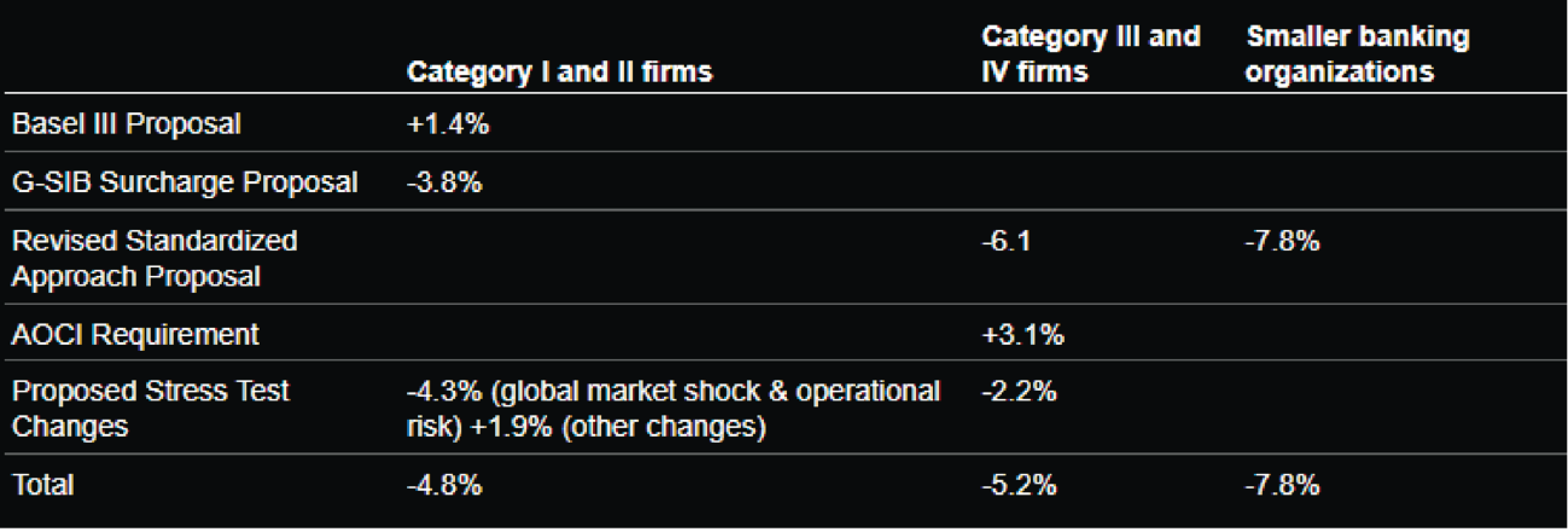
Proposed Capital Requirements Impact Chart13
Catalysts Emerging: Basel III and Regulatory Tailwinds
A key emerging catalyst for the banking sector is the evolving regulatory landscape. U.S. regulators are moving toward easing capital requirements, with proposed changes expected to reduce common equity capital requirements by approximately 4.8% for large banks, and up to 7.8% for smaller institutions.14 This includes adjustments to the supplementary leverage ratio, effectively freeing up capital for lending, share repurchases, and dividends.
Management teams are already signaling optimism around these changes. Bank of America expects reductions in overall capital requirements, while Morgan Stanley views Basel III and G-SIB rule changes as modestly positive. Goldman Sachs also expressed encouragement regarding the direction of regulatory reforms. In addition, recent Federal Reserve H.8 data aligns with the trends seen in earnings, pointing to continued growth in loans and deposits across the system, reinforcing a constructive backdrop for traditional lenders. Together, easing regulatory constraints and steady balance sheet growth creates a favorable environment for banks to expand lending and improve returns.
Overall, Q1 2026 earnings reinforced the fundamental strength of the banking sector. Despite lagging performance year-to-date, improving earnings, stable guidance, and constructive lending trends suggest the potential for a shift in sentiment. With credit conditions remaining stable and regulatory tailwinds emerging, banks are increasingly well-positioned to support economic growth and participate in a broader market recovery.
Stephanie Link’s TV Schedule

[1] Bank Of America Q1 26’ Earnings Call, as of April 15, 2026
[2] Morgan Stanley Q1 26’ Earnings Call, as of April 15, 2026
[3] Goldman Sachs Q1 26’ Earnings Call, as of April 13, 2026
[4] Bank Of America Q1 26’ Earnings Call, as of April 15, 2026
[5] Morgan Stanley Q1 26’ Earnings Call, as of April 15, 2026
[6] Goldman Sachs Q1 26’ Earnings Call, as of April 13, 2026
[7] Bank Of America Q1 26’ Earnings Call, as of April 15, 2026
[8] Wells Fargo Q1 26’ Earnings Call, as of April 14, 2026
[9] Morgan Stanley Q1 26’ Earnings Call, as of April 15, 2026
[10] Goldman Sachs Q1 26’ Earnings Call, as of April 13, 2026
[11] Morgan Stanley Q1 26’ Earnings Call, as of April 15, 2026
[12] Wells Fargo Q1 26’ Earnings Call, as of April 14, 2026
[13] Bloomberg News: as of March 19, 2026
[14] Bloomberg News: as of March 19, 2026
This material is for general information and educational purposes only. Information is based on data gathered from what we believe are reliable sources. It is not guaranteed as to accuracy, does not purport to be complete and is not intended to be used as a primary basis for investment decisions.
Find answers to your questions about Hightower Signature Wealth
Hightower Signature Wealth is a fiduciary wealth management practice that provides investment management, financial planning, estate strategies, insurance, and banking solutions. We work with families, business owners, professionals, women, and retirees across more than 40 offices nationwide. Our advisors take the time to understand your financial priorities, develop a plan around your goals, and adjust that plan as your life and circumstances evolve.
Hightower Signature Wealth provides a broad range of wealth management services designed to address different aspects of your financial life. Our capabilities include investment management, financial planning, retirement planning, estate strategies, insurance and risk management, banking solutions, and charitable giving strategies. By considering these areas together, our advisors can develop a coordinated approach based on your goals, priorities, financial circumstances, and plans for the future.
Hightower Signature Wealth advisors work with a broad range of clients, including women, families, business owners, professionals, retirees, and high-net-worth individuals navigating major life or financial transitions. Rather than applying a generic playbook, each advisor tailors the plan to a client’s specific goals and current stage of life – from early-career decisions to multigenerational wealth transfer.
Yes. Hightower Signature Wealth advisors serve as fiduciaries, which means they are committed to acting in their clients’ interests when providing investment advice. We offer fee-based advisory services, with fees depending on the services provided and the specifics of your relationship. Your advisor will discuss the applicable fee structure with you so you can understand how you are charged and what services are included.
Hightower Signature Wealth has more than 40 offices nationwide, allowing our advisors to serve individuals, families, and organizations across the country. Depending on your location and preferences, you may be able to work with an advisor locally or connect with a team in another market. Visit our Locations page to explore our office locations, learn more about the teams in each market, and find an office near you.
Getting started with Hightower Signature Wealth is simple. Complete our online contact form with some basic information about yourself and what you are looking for, and we’ll connect you with an advisor who can discuss your needs and financial priorities. That initial conversation is an opportunity to learn more about our approach, ask questions, and determine whether working with a Hightower Signature Wealth advisor may be a good fit.
Your first conversation is an opportunity for us to learn more about you, your financial circumstances, and what you hope to accomplish. An advisor may ask about your goals, current investments, family considerations, business interests, and other priorities that could influence your financial plan. You’ll also have an opportunity to ask questions, learn about our approach, and discuss what working together could look like.