Weekly Wisdom: Higher Yields, Stronger Foundations
The Constructive Outlook
September has long held the reputation of being a weak month for U.S. equities. On average, the S&P 500 has historically declined 2% during this month, making it a period where investor sentiment often turns cautious. However, this seasonal weakness is not necessarily a cause for concern and if we see similar action we are buyers, as we believe the 4th quarter setup is strong into the end of the year.
Despite the potential for short-term volatility, the broader market remains resilient. The S&P 500 is currently up nearly ~30% from its April lows, and a modest pullback in the coming weeks would be a healthy development. Rather than signaling trouble, such digestion often creates opportunities to buy into weakness. The outlook for the fourth quarter is increasingly constructive, supported by strong economic fundamentals, encouraging business investment, and emerging strength in sectors outside of technology.
One of the key reasons for optimism is the strength of the U.S. economy. The Atlanta Fed’s GDPNow model currently estimates third-quarter GDP growth at 3.5%, which, while not an absolute measure, is a strong indication of underlying momentum.
Consumers, who account for nearly 70% of U.S. economic activity, continue to spend. Back-to-school shopping trends remain robust, and recent data shows personal income rose by 0.4% in July, while personal spending increased by 0.5%. Weekly jobless claims came in at 229k, well below the recessionary threshold of 350k-375k and even below the cautionary level of 260k. Wages are growing at an annualized rate of 5%, and inflation, while slightly sticky at 2.5% to 3%, is far more manageable than the 9% peak seen three years ago. Importantly, this inflation is being driven by growth rather than stagnation.
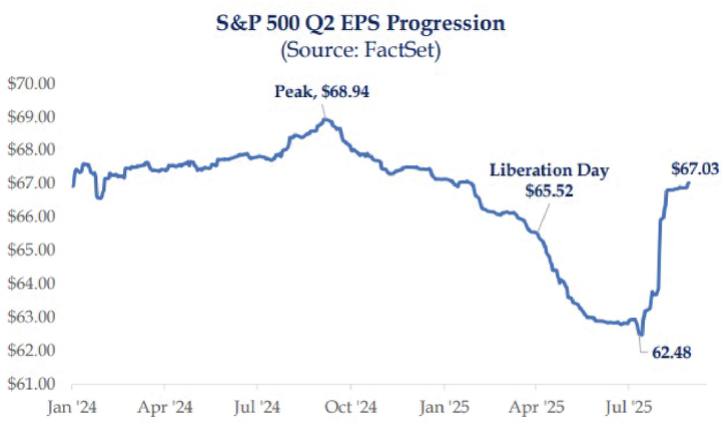
Corporate earnings have also exceeded expectations. With most companies having reported, average earnings growth came in at ~11%, more than double the 5% forecast. Revenue growth, expected to be in the low single digits, surprised to the upside at around 6%, reflecting the strength of the underlying economy.
Business investment is another pillar of the bullish case. Durable goods orders excluding transportation rose by 1.1% month-over-month, and real imports of capital goods are up 13% year-over-year. These figures suggest that companies are investing not just in AI or reshoring initiatives, but across a broad spectrum of capital needs.
The PMI composite index, which combines services and manufacturing, climbed to 55.4 in August, its highest level this year. Manufacturing posted its best reading since 2022. Globally, China’s economy is showing signs of recovery. The latest China Beige Book data indicates improving demand across sectors, with factory activity expanding at its fastest pace in five months.[1]
Sector rotation is also playing a role in shaping the market’s trajectory. Investors are increasingly looking beyond technology to areas that are more attractively valued. Banks, for instance, are benefiting from a steepening yield curve, which improves their lending margins. Recent deregulation has eased capital requirements, allowing banks to expand their loan books more aggressively. M&A activity is surging, with $2.6 trillion in deals completed year-to-date. This represents a 40% increase globally and a staggering 102% increase in North America compared to last year. One of our newest positions has been the purchase of Capital One (COF), on the resilient consumer and the benefits and possible re-rating of its earnings multiple owing to the $51B purchase of Discover Financial, which closed in July of this year.
Meanwhile, the copper market is tightening amid rising global demand. If you believe in the long-term growth of AI and data centers, then you must also believe in the need for a more robust electrical grid, and that grid requires copper. Housing is also showing signs of improvement, with homebuilder stocks up over ~20% following strong earnings. If mortgage rates ease toward 6%, it could unlock significant pent-up demand. Copper, being the number one commodity used in home construction, stands to benefit from this trend.
Chart 1: S&P 500 Q2 EPS Progression[2]
Higher Yields Reflecting Growth
While inflation remains slightly sticky in the 2.5% to 3% range, it is a far cry from the 9% peak seen three years ago. More importantly, the current inflationary environment is not being driven by cost pressures or supply chain disruptions, but rather by strong economic growth. This distinction is critical. When inflation is a byproduct of growth, rising wages, increased consumer spending, and business investment reflects a healthy, expanding economy rather than one overheating or stagnating.
This dynamic is playing out in the bond market. On Tuesday, the 30-year Treasury yield rose to 4.96%, approaching the psychologically important 5% level, while 10-year yields also moved higher. Investors have repeatedly asked why bond yields are rising despite inflation being relatively contained. The answer lies in two key developments.
First, the Atlanta Fed’s GDPNow model is tracking third-quarter GDP growth at 3.5%, an upward revision that signals firming economic momentum. Second, a recent ruling under the International Emergency Economic Powers Act (IEEPA) suggests that tariff revenues may be less available to offset fiscal expansion.
The bottom line is that yields are rising not because inflation is spiraling out of control, but because growth expectations are being revised higher. In this context, higher yields are a reflection of investor confidence in the economy’s ability to sustain expansion, not a signal of monetary policy failure. This is a fundamentally different environment than the one we faced in 2022, when yields surged in response to runaway inflation and aggressive Fed tightening.
Looking ahead, Friday’s Nonfarm Payrolls report will be a key swing factor for both yields and equity market internals. With earnings season complete, investors will certainly be more focused on macroeconomic data.
Ultimately, the rise in yields is not a warning sign. It’s a reflection of resilience. As long as inflation remains anchored and growth continues, the bond market will adjust accordingly. For investors, this means staying focused on the quality of growth, not just the level of rates.
[1] CNBC, As of August 2025.
[2] Strategas/FactSet, As of August 2025.
This material is for general information and educational purposes only. Information is based on data gathered from what we believe are reliable sources. It is not guaranteed as to accuracy, does not purport to be complete and is not intended to be used as a primary basis for investment decisions.
Find answers to your questions about Hightower Signature Wealth
Hightower Signature Wealth is a fiduciary wealth management practice that provides investment management, financial planning, estate strategies, insurance, and banking solutions. We work with families, business owners, professionals, women, and retirees across more than 40 offices nationwide. Our advisors take the time to understand your financial priorities, develop a plan around your goals, and adjust that plan as your life and circumstances evolve.
Hightower Signature Wealth provides a broad range of wealth management services designed to address different aspects of your financial life. Our capabilities include investment management, financial planning, retirement planning, estate strategies, insurance and risk management, banking solutions, and charitable giving strategies. By considering these areas together, our advisors can develop a coordinated approach based on your goals, priorities, financial circumstances, and plans for the future.
Hightower Signature Wealth advisors work with a broad range of clients, including women, families, business owners, professionals, retirees, and high-net-worth individuals navigating major life or financial transitions. Rather than applying a generic playbook, each advisor tailors the plan to a client’s specific goals and current stage of life – from early-career decisions to multigenerational wealth transfer.
Yes. Hightower Signature Wealth advisors serve as fiduciaries, which means they are committed to acting in their clients’ interests when providing investment advice. We offer fee-based advisory services, with fees depending on the services provided and the specifics of your relationship. Your advisor will discuss the applicable fee structure with you so you can understand how you are charged and what services are included.
Hightower Signature Wealth has more than 40 offices nationwide, allowing our advisors to serve individuals, families, and organizations across the country. Depending on your location and preferences, you may be able to work with an advisor locally or connect with a team in another market. Visit our Locations page to explore our office locations, learn more about the teams in each market, and find an office near you.
Getting started with Hightower Signature Wealth is simple. Complete our online contact form with some basic information about yourself and what you are looking for, and we’ll connect you with an advisor who can discuss your needs and financial priorities. That initial conversation is an opportunity to learn more about our approach, ask questions, and determine whether working with a Hightower Signature Wealth advisor may be a good fit.
Your first conversation is an opportunity for us to learn more about you, your financial circumstances, and what you hope to accomplish. An advisor may ask about your goals, current investments, family considerations, business interests, and other priorities that could influence your financial plan. You’ll also have an opportunity to ask questions, learn about our approach, and discuss what working together could look like.