Weekly Wisdom: Enterprise AI and Cyber Security Tailwinds
Enterprise AI Early Innings
AI and cybersecurity remain strong tailwinds for enterprise technology, driving innovation, adoption, and multi-year growth opportunities. However, enterprise adoption is still in the early stages. 98% of Fortune 500 companies have experimented with generative AI, yet only 26% have begun actual deployment at scale. At the same time, roughly 85% of AI traffic remains consumer-driven, emphasizing the large untapped potential for enterprise-specific models and applications.[1] This early stage of adoption creates a substantial runway for growth across infrastructure, software, consulting, and cybersecurity, as companies focus on operationalizing AI efficiency, improving productivity, and managing security risks at scale.
IBM’s hybrid cloud and AI strategy illustrates how an enterprise can capitalize on this early-stage adoption.
- The Granite 7b model demonstrates a combination of cost efficiency and strong performance, addressing enterprise concerns around scaling AI securely and affordably. IBM highlighted that 70% of Fortune 500 companies are already running hybrid cloud, and that 95% of enterprise workloads are expected to run on containerized data models.
- WatsonX software supports enterprises by managing data, governance, and AI lifecycle needs, helping clients deploy AI across workflows safely.
- Red Hat continues to see double-digit growth, with containerized applications projected to become standard across 95% of enterprises by 2029.
- IBM Z mainframes are growing 70% year-over-year and now power AI model execution on transactional workloads without external servers, while automation revenue increased 14%, reflecting strong adoption by clients seeking efficiency.
Software now drives nearly 45% of IBM’s revenue, and the HashiCorp acquisition is expected to continue adding strength to IBM’s software market share.
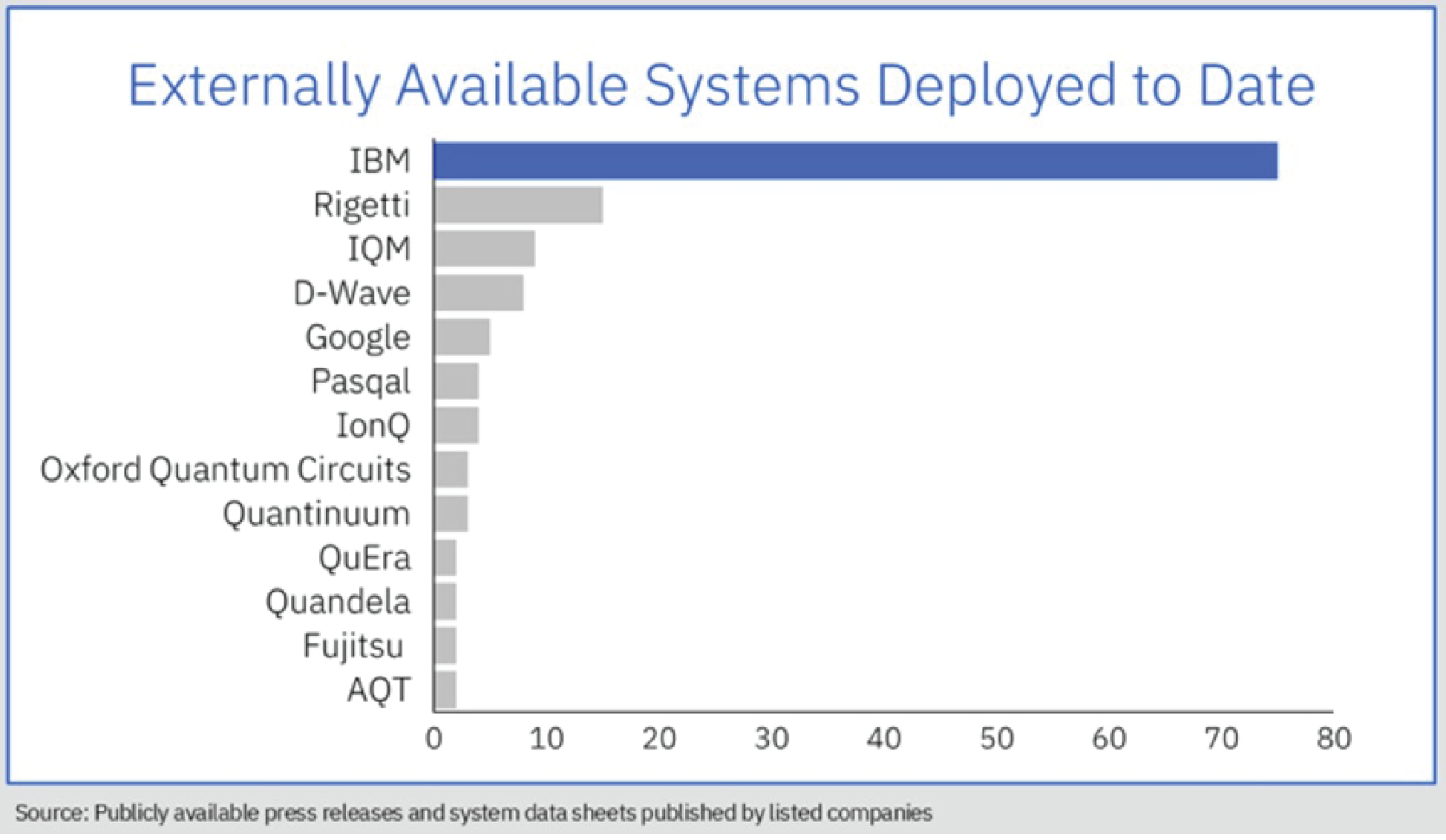
Quantum computing remains a long-term growth opportunity, totaling a potential market opportunity of $500 billion.[2] To take advantage, IBM is in production of 75 quantum computers, more than the entire industry combined. This, along with their Qiskit software, had Quantum pass $1 billion in bookings. With free cash flow at a record $4.8 billion, IBM has increased flexibility for M&A, R&D, and capital allocation.
Chart 1: Deployed Quantum Computing Systems[3]
Platformization is Winning
Palo Alto Networks (PANW) is similarly positioned to benefit from the early stages of enterprise AI adoption. Its platformization strategy is demonstrating stickiness, with 1,400 completed with a target of 2,500–3,500 by FY30. Large Q4 bookings were driven by network security, SASE, and AI-enabled products, and enterprise adoption trends are accelerating. The CyberArk acquisition strengthens PANW’s platform by expanding identity security capabilities, a critical area given that 89% of breaches involve credential theft, now amplified by AI agents. Palo Alto’s XSIAM product has doubled year-over-year, with over 60% of customers reporting response times under ten minutes, and Cortex grew 30% year-over-year.
The broader enterprise ecosystem remains in the early innings of AI adoption, creating opportunities across software, consulting, infrastructure, and cybersecurity. Companies are moving from experimentation toward full deployment to unlock productivity gains, optimize operations, and improve governance. IBM notes that only 6% of code is currently written by generative AI, expected to rise above 25% as enterprises scale their use.
Similarly, PANW sees growing demand for AI-enabled identity security as organizations confront threats from AI-driven non-human agents. The predominance of consumer AI traffic underscores that enterprise-specific AI applications are still emerging, which presents a multi-year opportunity for companies providing the tools, infrastructure, and services necessary for safe, scalable deployment. Even operational technology providers supporting AI-intensive workloads, whether through automation or efficient resource utilization, are positioned to capture growth as enterprises seek to integrate AI into their core operations.
AI Coding is Growing
The rise of AI-assisted coding offers signals that enterprises are starting to move beyond experimentation. Robinhood now generates over 50% of its new code through AI tools, with CEO Vlad Tenev noting that human-written code is increasingly in the minority. Coinbase has AI writing 40% of its daily code and expects that figure to surpass 50% by October, while American Express has equipped all 8,500 of its engineers with GitHub Copilot. Microsoft and Google each report that around 30% of their code is AI-generated, and both see this number rising.
These developments mark a major shift in how software is created, enabling engineers to move faster and focus on higher-value work. At the same time, they highlight a growing reliance on AI tools that are rewriting the software development process. Nvidia’s Rubin CPX GPU launch underscores how infrastructure is evolving to meet this demand, offering massive context capabilities that support million-token coding and other complex workloads. This combination of adoption and hardware innovation suggests a step-change in enterprise software productivity, with AI coding assistants now embedded deeply across both fintech and big tech workflows.
Looking forward, hybrid cloud, AI, platform-based security, and automation continue to support durable growth across the enterprise technology landscape. As enterprises transition from experimentation to full-scale AI deployment, investors should view any near-term volatility as a potential opportunity to gain exposure to companies driving the evolution of enterprise AI and cybersecurity. Adoption is still early, the growth runway remains substantial, and platform-based strategies are creating recurring revenue streams and deeper customer engagement that will support long-term growth.
[1] Source: Palto Alto, as of September 2025
[2] Source: IBM, as of August 2025
[3] Source: IBM, as of February 2025.
This material is for general information and educational purposes only. Information is based on data gathered from what we believe are reliable sources. It is not guaranteed as to accuracy, does not purport to be complete and is not intended to be used as a primary basis for investment decisions.
Find answers to your questions about Hightower Signature Wealth
Hightower Signature Wealth is a fiduciary wealth management practice that provides investment management, financial planning, estate strategies, insurance, and banking solutions. We work with families, business owners, professionals, women, and retirees across more than 40 offices nationwide. Our advisors take the time to understand your financial priorities, develop a plan around your goals, and adjust that plan as your life and circumstances evolve.
Hightower Signature Wealth provides a broad range of wealth management services designed to address different aspects of your financial life. Our capabilities include investment management, financial planning, retirement planning, estate strategies, insurance and risk management, banking solutions, and charitable giving strategies. By considering these areas together, our advisors can develop a coordinated approach based on your goals, priorities, financial circumstances, and plans for the future.
Hightower Signature Wealth advisors work with a broad range of clients, including women, families, business owners, professionals, retirees, and high-net-worth individuals navigating major life or financial transitions. Rather than applying a generic playbook, each advisor tailors the plan to a client’s specific goals and current stage of life – from early-career decisions to multigenerational wealth transfer.
Yes. Hightower Signature Wealth advisors serve as fiduciaries, which means they are committed to acting in their clients’ interests when providing investment advice. We offer fee-based advisory services, with fees depending on the services provided and the specifics of your relationship. Your advisor will discuss the applicable fee structure with you so you can understand how you are charged and what services are included.
Hightower Signature Wealth has more than 40 offices nationwide, allowing our advisors to serve individuals, families, and organizations across the country. Depending on your location and preferences, you may be able to work with an advisor locally or connect with a team in another market. Visit our Locations page to explore our office locations, learn more about the teams in each market, and find an office near you.
Getting started with Hightower Signature Wealth is simple. Complete our online contact form with some basic information about yourself and what you are looking for, and we’ll connect you with an advisor who can discuss your needs and financial priorities. That initial conversation is an opportunity to learn more about our approach, ask questions, and determine whether working with a Hightower Signature Wealth advisor may be a good fit.
Your first conversation is an opportunity for us to learn more about you, your financial circumstances, and what you hope to accomplish. An advisor may ask about your goals, current investments, family considerations, business interests, and other priorities that could influence your financial plan. You’ll also have an opportunity to ask questions, learn about our approach, and discuss what working together could look like.