Weekly Wisdom: Deregulation and Renewed Momentum for Banks
Deregulation Gains Momentum for Banks
We have talked and written about the upcoming deregulation that is coming for the U.S. economy, and specifically the financial services industry. It’s one of the reasons we are overweight relative to our benchmarks – in addition to benefiting from a stronger economy, higher Net Interest Income (NII), M&A, and capital activity. Last week, U.S. bank regulation took a meaningful step toward a more flexible framework as the Office of the Comptroller of the Currency (OCC), and the FDIC formally withdrew the 2013 guidance on leveraged lending. The change allows banks to define leveraged loans internally and manage risk under general safe and sound lending standards. This marks another notable milestone in the broader deregulatory shift already underway, following recent changes to stress testing, CFPB oversight, acquisition approvals, and financial institution ratings. Regulators have acknowledged that banks have steadily lost share of corporate lending to non-bank competitors, including private credit and institutional leveraged loan markets. Since 1997, institutional leveraged loans have grown at a 12.3% annual rate, compared with 5.5% for bonds and just 3.4% for bank lending, leaving banks’ share of non-financial corporate debt at 13% by the first half of 2025, down from 22% in 1997.1 The rollback of this guidance is designed to restore bank participation in corporate credit, particularly in commercial and industrial lending, and should support loan growth as banks regain flexibility in underwriting and portfolio construction.
Loan Growth Turns a Corner
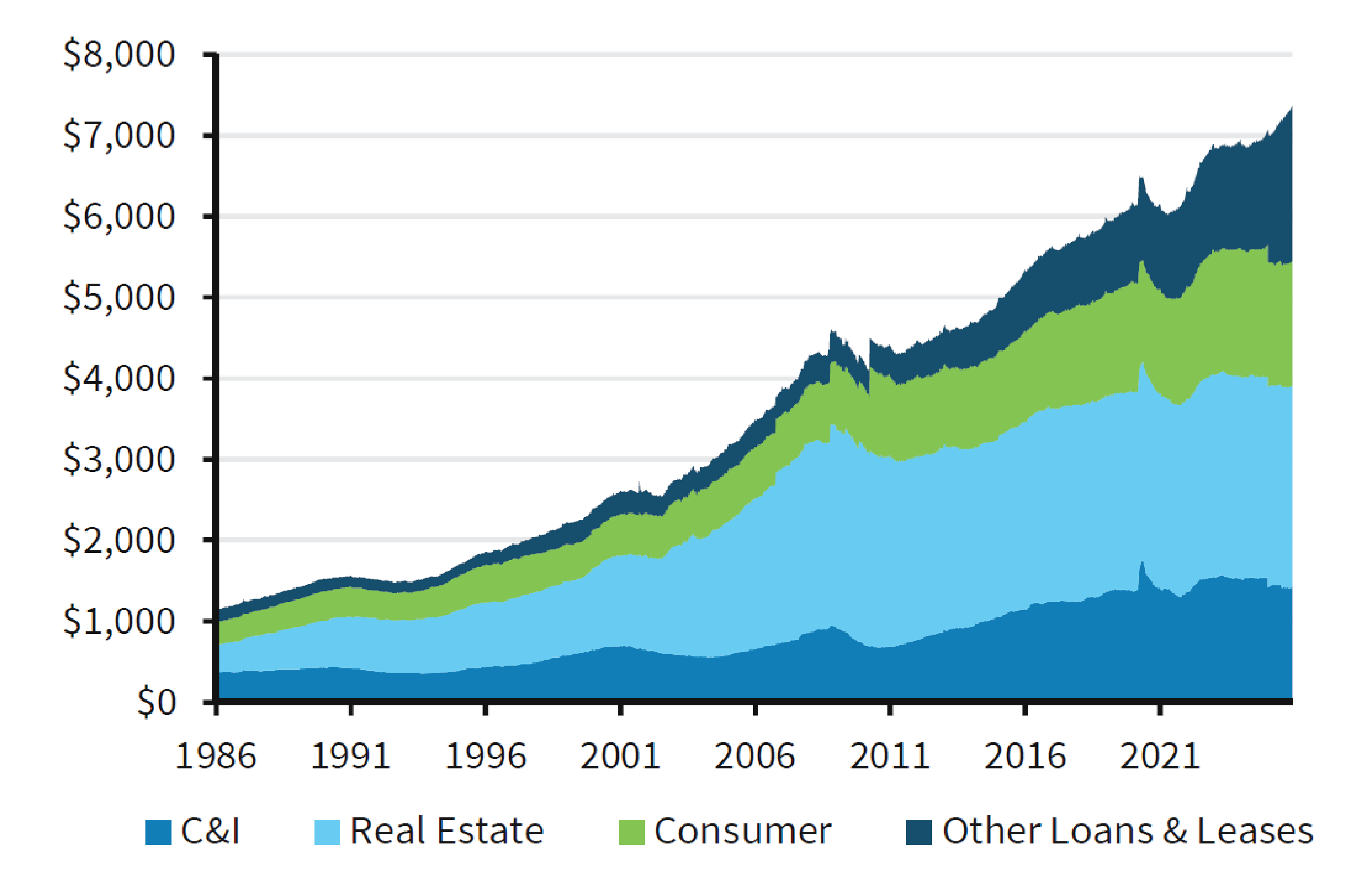
Against this backdrop, credit data are beginning to improve. Weekly H.8 data now show seven consecutive weeks of loan growth, the longest such streak since the second quarter of 2022.2 This improvement is consistent with quarterly balance sheet trends at large banks, where total loans increased 1.4% quarter over quarter as of late November, following positive growth in both the second and third quarters.3 While commercial and industrial lending has been uneven over the past year, the regulatory shift on leveraged lending increases the likelihood that activity stabilizes and improves as we move into 2026. Importantly, this early loan growth is occurring alongside relatively stable deposit trends and conservative balance sheet positioning, suggesting banks are entering the next phase of the cycle with both capacity and discipline.
Loan and Lease Growth and Composition Trends Chart4
Capital Markets and M&A Activity Reaccelerate
Capital markets activity is showing renewed momentum, particularly in mergers and acquisitions. In North America banking M&A, 47 deals have been completed year to date, with an additional 96 transactions currently pending, making total deal activity up 96% year over year. The value of these announced transactions totals $46.2B. These figures point to a meaningful reacceleration in strategic activity as regulatory clarity improves and confidence returns to boardrooms. As balance sheet constraints ease and financing conditions stabilize, we expect advisory pipelines to remain active, supporting a gradual recovery in fee income for banks with strong capital markets franchises.
Yield Curve Steepening, Valuation, and Earnings Leverage
From an earnings perspective, the macro backdrop remains constructive. The yield curve has continued to steepen, with the two-year to ten-year Treasury spread now firmly positive, a dynamic that supports net interest income and net interest margin expansion. Large banks continue to operate with loan-to-deposit ratios near historical norms, providing flexibility to grow assets without materially increasing funding costs. Credit quality remains stable, with loan loss reserve ratios declining only modestly and capital levels remaining sound.
Valuations remain reasonable when viewed in the context of improving fundamentals and deregulation tailwinds. Bank of America, Wells Fargo, and Citigroup trade at 1.4x, 1.7x, and 1.0x book respectively, reflecting improving conditions. Among capital markets–oriented franchises like Goldman Sachs, Morgan Stanley, and JPMorgan, they trade at 2.5x, 2.8x, and 2.5x book respectively.5 When viewed against the potential for renewed loan growth, stronger capital markets and M&A activity, and incremental benefits from deregulation, we believe the valuation backdrop continues to support a constructive and bullish outlook for the banking sector heading into 2026.
Stephanie Link’s TV Schedule:

[1] JP Morgan, as of December 2025
[2] Federal Reserve Board, as of December 2025
[3] Barclays, as of December 2025
[4] FRED, as of December 2025
[5] Bloomberg, as of December 2025
This material is for general information and educational purposes only. Information is based on data gathered from what we believe are reliable sources. It is not guaranteed as to accuracy, does not purport to be complete and is not intended to be used as a primary basis for investment decisions.
Find answers to your questions about Hightower Signature Wealth
Hightower Signature Wealth is a fiduciary wealth management practice that provides investment management, financial planning, estate strategies, insurance, and banking solutions. We work with families, business owners, professionals, women, and retirees across more than 40 offices nationwide. Our advisors take the time to understand your financial priorities, develop a plan around your goals, and adjust that plan as your life and circumstances evolve.
Hightower Signature Wealth provides a broad range of wealth management services designed to address different aspects of your financial life. Our capabilities include investment management, financial planning, retirement planning, estate strategies, insurance and risk management, banking solutions, and charitable giving strategies. By considering these areas together, our advisors can develop a coordinated approach based on your goals, priorities, financial circumstances, and plans for the future.
Hightower Signature Wealth advisors work with a broad range of clients, including women, families, business owners, professionals, retirees, and high-net-worth individuals navigating major life or financial transitions. Rather than applying a generic playbook, each advisor tailors the plan to a client’s specific goals and current stage of life – from early-career decisions to multigenerational wealth transfer.
Yes. Hightower Signature Wealth advisors serve as fiduciaries, which means they are committed to acting in their clients’ interests when providing investment advice. We offer fee-based advisory services, with fees depending on the services provided and the specifics of your relationship. Your advisor will discuss the applicable fee structure with you so you can understand how you are charged and what services are included.
Hightower Signature Wealth has more than 40 offices nationwide, allowing our advisors to serve individuals, families, and organizations across the country. Depending on your location and preferences, you may be able to work with an advisor locally or connect with a team in another market. Visit our Locations page to explore our office locations, learn more about the teams in each market, and find an office near you.
Getting started with Hightower Signature Wealth is simple. Complete our online contact form with some basic information about yourself and what you are looking for, and we’ll connect you with an advisor who can discuss your needs and financial priorities. That initial conversation is an opportunity to learn more about our approach, ask questions, and determine whether working with a Hightower Signature Wealth advisor may be a good fit.
Your first conversation is an opportunity for us to learn more about you, your financial circumstances, and what you hope to accomplish. An advisor may ask about your goals, current investments, family considerations, business interests, and other priorities that could influence your financial plan. You’ll also have an opportunity to ask questions, learn about our approach, and discuss what working together could look like.