Weekly Wisdom: Fed Delivers Dovish Pivot
Fed Lowers Rates Amid Strong Growth
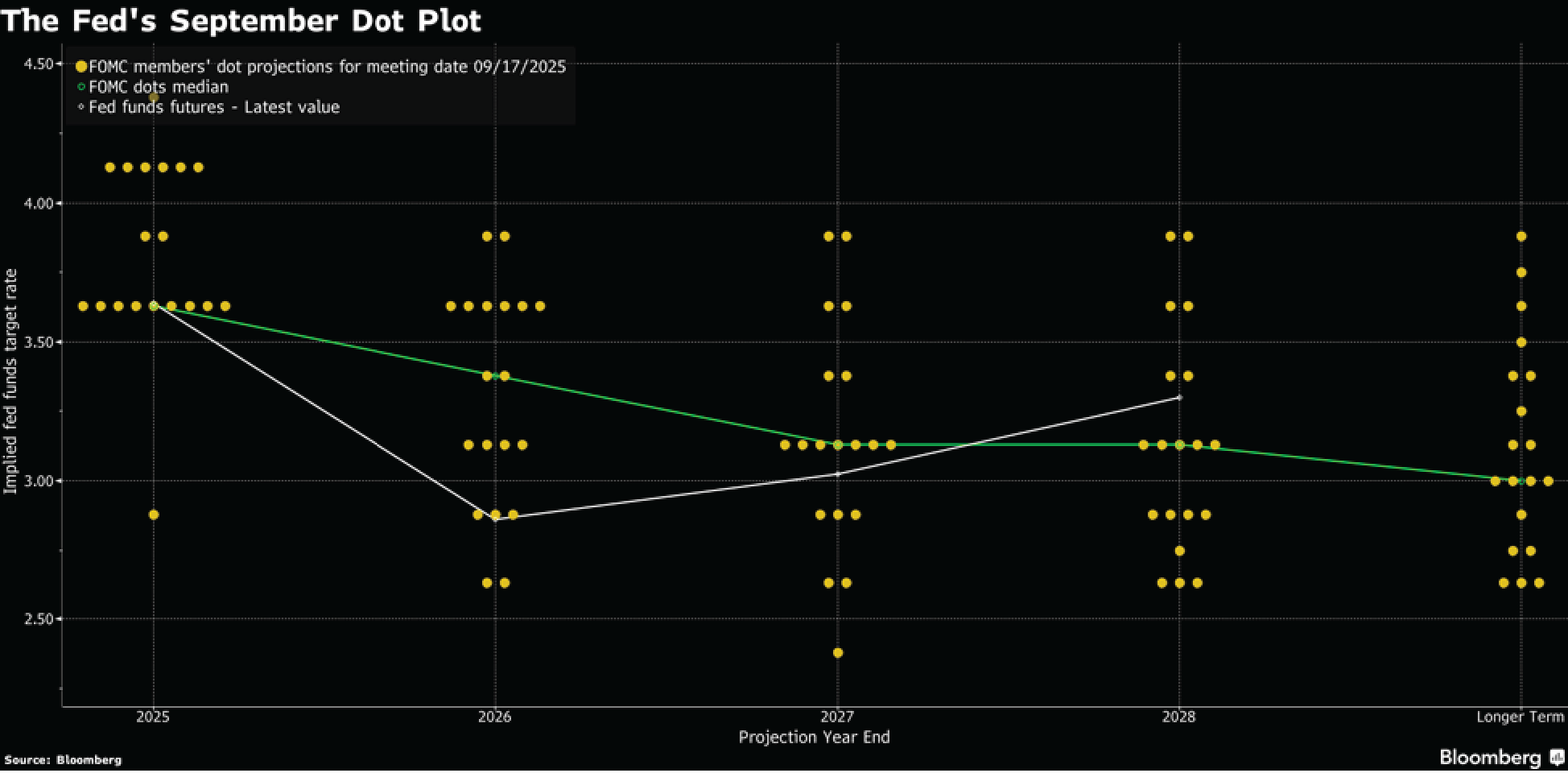
In a widely anticipated move, the Federal Reserve cut its benchmark interest rate by 25 basis points to a range of 4.00%–4.25% at the conclusion of its Sept. 17 FOMC meeting, marking the first cut in nine months. The Committee vote highlights a dovish tilt with one member opposed to any cut, one dissented for a 50-basis-point cut, six preferred no further cuts, nine supported two additional cuts, and one favored five more cuts. The Fed lowering rates in the face of strong economic growth, additionally proved bullish as the majority of the Fed is inclined toward additional easing.
The Fed’s move signals a departure from the restrictive policies of recent years and introduces a new phase that could reinvigorate rate-sensitive sectors such as housing, automotive, and consumer lending. The Fed’s move now points to a median federal funds rate of 3.6% by year-end, lower than the 3.9% projected in June. Chair Jerome Powell emphasized a cautious, data-driven approach, stressing that policy decisions remain independent and not political. Importantly, the cut was framed as a risk management decision rather than a sign of urgent weakness, reinforcing the Fed’s intent to support the expansion while guarding against emerging downside risks.
Chart 1: Fed Dot Plot[1]
Inflation, Unemployment, and Shifting
Powell underscored that the Fed remains fully committed to its dual mandate of price stability and maximum employment. However, he acknowledged that the balance of risks has shifted. Inflation remains “somewhat elevated,” with median PCE projected at 3.1% in 2025, falling to 2.6% in 2026 and gradually aligning with the 2% target. Tariffs are contributing to higher goods prices, but much of the burden is being absorbed by firms, and the Fed views this as a one-time effect rather than a persistent inflationary driver.
Meanwhile, labor market conditions are softening. Job gains are slowing, and unemployment has begun edging higher. Wage growth is moderating, though it remains above inflation. Both labor supply and demand are softening, with immigration slowing and job creation dipping below breakeven. The Fed projects unemployment to reach 4.4% in 2026 before gradually declining. Against this backdrop, Powell made clear that the downside risk from rising unemployment now outweighs the risk of persistent inflation, and this rate drop serves as risk management geared toward preventing labor market deterioration.
Market Performance and Volatility
Despite the dovish rate cut, the S&P 500 traded flat following the announcement. Investors are weighing the bullish implications of Fed easing against the reality that the index has already surged 32% from its April 8th lows, leaving much of the good news priced in. September is historically the most volatile month, averaging a 2% decline, but we view any near-term volatility as an opportunity to buy into weakness.
GDP growth, which expanded 2.5% last year, is expected to moderate to about 1.5% this year. Business investment, however, continues to pick up, led by AI-related infrastructure buildout, while consumer demand remains narrow but stronger than anticipated. Housing remains the weakest sector, with affordability challenges and mortgage rates still serving as a key channel for Fed policy transmission. These crosscurrents reinforce why the Fed is leaning into a risk management strategy, providing support while conditions remain resilient but vulnerable to further downside.
Global Central Bank Strength
The Fed’s dovish pivot is being reinforced by central banks abroad. Europe and China are also easing policy, and their stock markets are reflecting the improving backdrop. The Euro STOXX 50 Index has climbed approximately 10.88% year-to-date, while the Shanghai Composite Index has advanced about 17.44% year-to-date[2]. This synchronized global policy support is an additional tailwind for risk assets, adding conviction to the bullish case.
Fed Independence
The Fed’s risk-managed cut, combined with its recognition that the downside risk to employment now outweighs inflation, marks a turning point in policy emphasis while staying true to its dual mandate. With inflation risks easing, unemployment emerging as the Fed’s key focus, and global central banks aligned in easing policy, the overall backdrop remains constructive for equities. While near-term volatility is likely, the setup for a broad-based year-end rally remains intact, offering investors opportunities to lean into pullbacks and position for strength into 2026
[1] Bloomberg, As of September 2025
[2] Bloomberg, as of September 2025
This material is for general information and educational purposes only. Information is based on data gathered from what we believe are reliable sources. It is not guaranteed as to accuracy, does not purport to be complete and is not intended to be used as a primary basis for investment decisions.
Find answers to your questions about Hightower Signature Wealth
Hightower Signature Wealth is a fiduciary wealth management practice that provides investment management, financial planning, estate strategies, insurance, and banking solutions. We work with families, business owners, professionals, women, and retirees across more than 40 offices nationwide. Our advisors take the time to understand your financial priorities, develop a plan around your goals, and adjust that plan as your life and circumstances evolve.
Hightower Signature Wealth provides a broad range of wealth management services designed to address different aspects of your financial life. Our capabilities include investment management, financial planning, retirement planning, estate strategies, insurance and risk management, banking solutions, and charitable giving strategies. By considering these areas together, our advisors can develop a coordinated approach based on your goals, priorities, financial circumstances, and plans for the future.
Hightower Signature Wealth advisors work with a broad range of clients, including women, families, business owners, professionals, retirees, and high-net-worth individuals navigating major life or financial transitions. Rather than applying a generic playbook, each advisor tailors the plan to a client’s specific goals and current stage of life – from early-career decisions to multigenerational wealth transfer.
Yes. Hightower Signature Wealth advisors serve as fiduciaries, which means they are committed to acting in their clients’ interests when providing investment advice. We offer fee-based advisory services, with fees depending on the services provided and the specifics of your relationship. Your advisor will discuss the applicable fee structure with you so you can understand how you are charged and what services are included.
Hightower Signature Wealth has more than 40 offices nationwide, allowing our advisors to serve individuals, families, and organizations across the country. Depending on your location and preferences, you may be able to work with an advisor locally or connect with a team in another market. Visit our Locations page to explore our office locations, learn more about the teams in each market, and find an office near you.
Getting started with Hightower Signature Wealth is simple. Complete our online contact form with some basic information about yourself and what you are looking for, and we’ll connect you with an advisor who can discuss your needs and financial priorities. That initial conversation is an opportunity to learn more about our approach, ask questions, and determine whether working with a Hightower Signature Wealth advisor may be a good fit.
Your first conversation is an opportunity for us to learn more about you, your financial circumstances, and what you hope to accomplish. An advisor may ask about your goals, current investments, family considerations, business interests, and other priorities that could influence your financial plan. You’ll also have an opportunity to ask questions, learn about our approach, and discuss what working together could look like.