Update on the Economy and Markets: October 2026
By PJ Williams, CFA
Director, Investments
Overview
During the month of September, the Fed hiked rates, Treasury yields and mortgage rates spiked, the price of diesel gas surpassed $6 per gallon, the Ukraine and Iran wars continued to escalate, and some of the tech titans signaled alarms surrounding the risk of AI. Despite these headwinds, however, U.S. equity markets treaded water with investors looking past these near-term issues and instead focusing on corporate earnings growth amidst a decent economic backdrop.
Bond investors, on the other hand, continued to experience negative performance given rising interest rates. Note that bond prices necessarily fall when interest rates rise and suddenly become a viable option relative to stocks.
Inflation concerns also intensified during the month as energy prices rose, putting further pressure on consumer sentiment, which dropped to its lowest level in four months. Rising prices are the one thing that literally all Americans notice, especially those in lower income/wealth brackets. Cost of living concerns will definitely be on the minds of voters as we approach midterm elections next month. Beyond affordability and the typical issues on the ballot, other topics that will be top of mind for many voters include the war with Iran, data centers, and AI.
Another key event that took place in late September was the state visit by China’s President Xi Jinping. Two of the main topics discussed during the visit were AI and the war with Iran. It does not appear there were any concrete decisions or agreements made in either of these issues, but the two countries did agree to a two-month extension of their bilateral trade agreement as the two sides try to reach a broader trade agreement. The new date is now January 2027. It seems clear that both China and the United States believe they need to find a way to work together on AI as each agreed to establish a means of communicating AI-related incidents and military crisis.
Fed Hikes Rates as Expected
Given rising inflation pressures resulting from the wars in Ukraine and Iran, as well as previous rhetoric from Fed governors, the market had expected the Fed to raise rates in September. Expectations became reality when the Fed announced its quarter percentage rate hike following a unanimous vote. During his prepared remarks, Chairman Warsh stated: “Economic activity is expanding at a solid pace. While uncertainty remains elevated—owing, in part, to geopolitical developments—domestic spending has been resilient. Productivity growth—strong; and capital investment is robust. Job gains have kept pace with the workforce, and the unemployment rate has changed little. But inflation remains elevated. Today’s policy action will support a timelier return to the Committee’s 2 percent goal. This Committee will deliver price stability. Now I’ll get into some further detail. Our decision comes at a time when the American economy appears to be strengthening. New hiring, private-sector earnings, business capital investment—each of these markers has improved in recent months and is pointing in a good direction. Credit flows have been robust, particularly for businesses. And, as I said at the policy symposium in Jackson Hole, I would be hard pressed to describe broad financial conditions as restrictive. This view was widely shared by the Committee. So we removed a dose of accommodation. Consider the geopolitical landscape of shocks and uncertainty, and you begin to appreciate the resilience of the U.S. economy.” 1
President Trump expressed confidence in Warsh despite the rate hike. As we have discussed previously, Warsh is in a difficult position given the Trump administration’s desire for lower rates conflict with the economic data and the beliefs of the majority of voting Fed governors. At this time, the market and most of the Fed members expect one or two more rate hikes prior to yearend. As was observed following the September hike, if the market is anticipating a hike that comes to fruition, it is likely it would have already priced it in, so the reaction might be muted unless the commentary from Warsh deviates from expectations.
Bond Market
Fixed income experienced volatility during September as rates spiked. The yield on five- and ten-year treasuries jumped to 5.1% and 5.3%, respectively. These were the highest levels since 2007. As discussed last month, when U.S. debt surpassed $40 trillion, Treasury Secretary Bessent announced plans to buy back long-term debt and replace it with short term debt to lower the borrowing costs of the U.S. This tactic initially calmed the market, but it was short lived. During September, the selloff in the bond markets accelerated as rates surged higher. Bessent again attempted to calm the markets and put a lid on yields when he said “I have asymmetric information. I am the house now. And you can bet against me if you want.” 2
These comments did little to quell the concerns of bond investors. As we have discussed before, the Fed has significant influence over short-term bond yields because the rate it sets is an overnight lending rate. The Fed and Treasury have less influence over long-term bond yields which are dictated by market participants. In short, bond investors are expressing their concern for the U.S. fiscal situation and inflation by demanding rates higher. The U.S. bond market has now been in a drawdown (peak to trough decline) for six years, by far the longest period on record.
In his September memo, Howard Marks, Co-Chairman of Oaktree Capital, commented on the Treasury’s actions. “I view this action as an attempt to improve the interest-rate picture cosmetically. It may constitute a response to the effects of rising rates enumerated above, but it can’t be described as solving the underlying problem. First, any effect may be temporary. All else equal, you can raise the price of something by buying it, or you can make the price of something decline by selling it. But the impact of your actions may be fleeting, and once you stop, the market is likely to go back to doing what it would have done if you hadn’t intervened. My vision is of a column of water in the ocean. Its upward thrust can keep a ball suspended above the surface for as long as it continues. But as soon as the water stops being pumped upward, the ball will fall.” 3
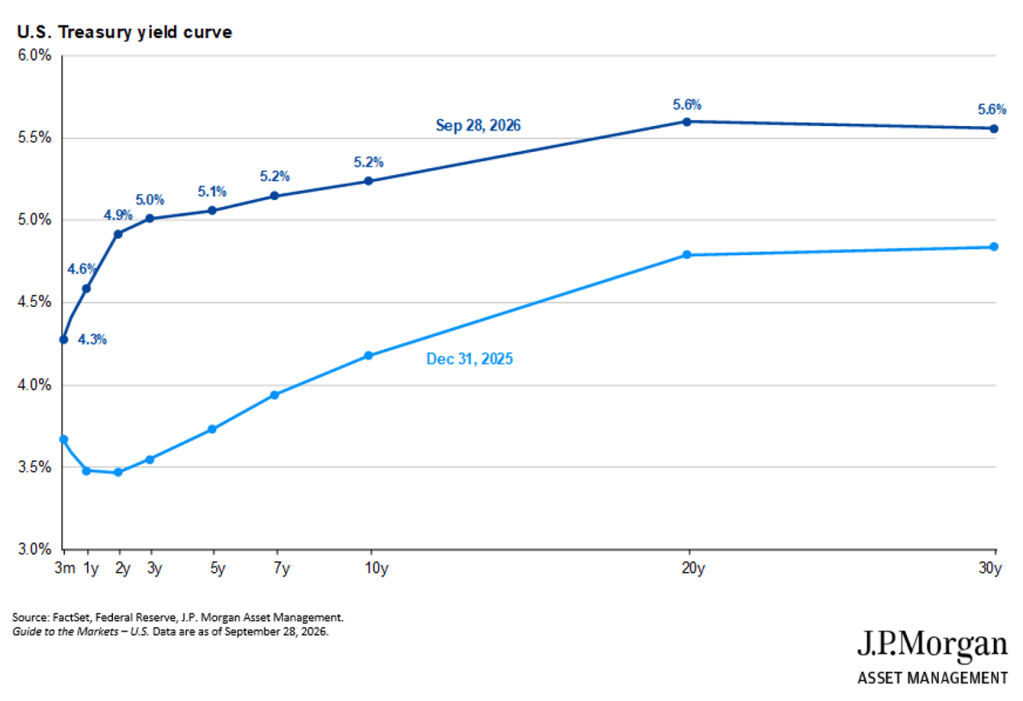
Mortgage rates have also moved higher with the interest rate for a 30-year mortgage rising above 7.5%. This is clearly a headwind for the housing market, and there is no clear path in the near-term for mortgage rates or treasury yields to move materially lower outside of an economic slowdown which would also negatively affect risk assets.
U.S. Corporate Earnings
According to FactSet, as of September 25th, “For Q3 2026, the estimated (year-over-year) earnings growth rate for the S&P 500 is 29.1%. If 29.1% is the actual growth rate for the quarter, it will mark the third-straight quarter of earnings growth above 25% for the index. Heading into the final days of the quarter, analysts and companies have been more optimistic than normal in their earnings outlooks for the third quarter. As a result, estimated earnings for the S&P 500 for the third quarter are higher today compared to expectations at the start of the quarter.” 4
Earnings growth is being driven by both top-line revenue growth and margin expansion. Profit margins are at near all-time highs for the S&P 500 because of improving automation, pricing power for the largest companies, and improved productivity which may continue because of AI. Additionally, many of the largest companies are highly scalable, meaning they do not need to add to labor costs as revenue grows.
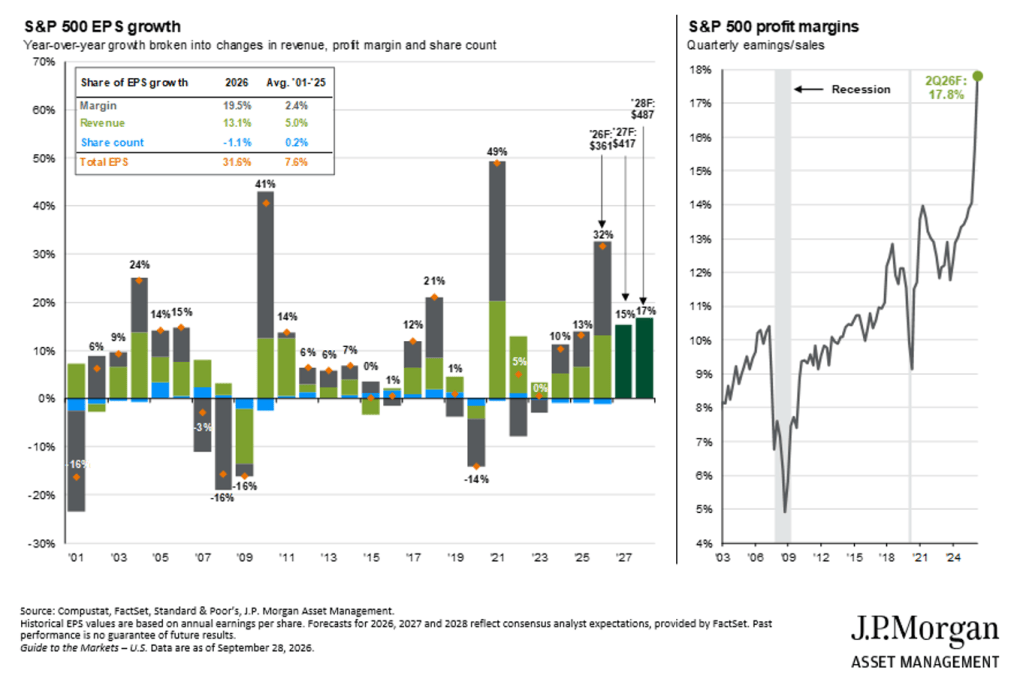
Also, as discussed in previous commentaries, despite the strong performance of U.S. equity markets so far in 2026, rising rates and bond yields have moved valuations lower. As mentioned above, investors are looking past the current headwinds for risk assets to this upcoming earnings season. If earnings fail to meet expectations, there could be a quick pullback in markets as they hit an air pocket.
Midterms
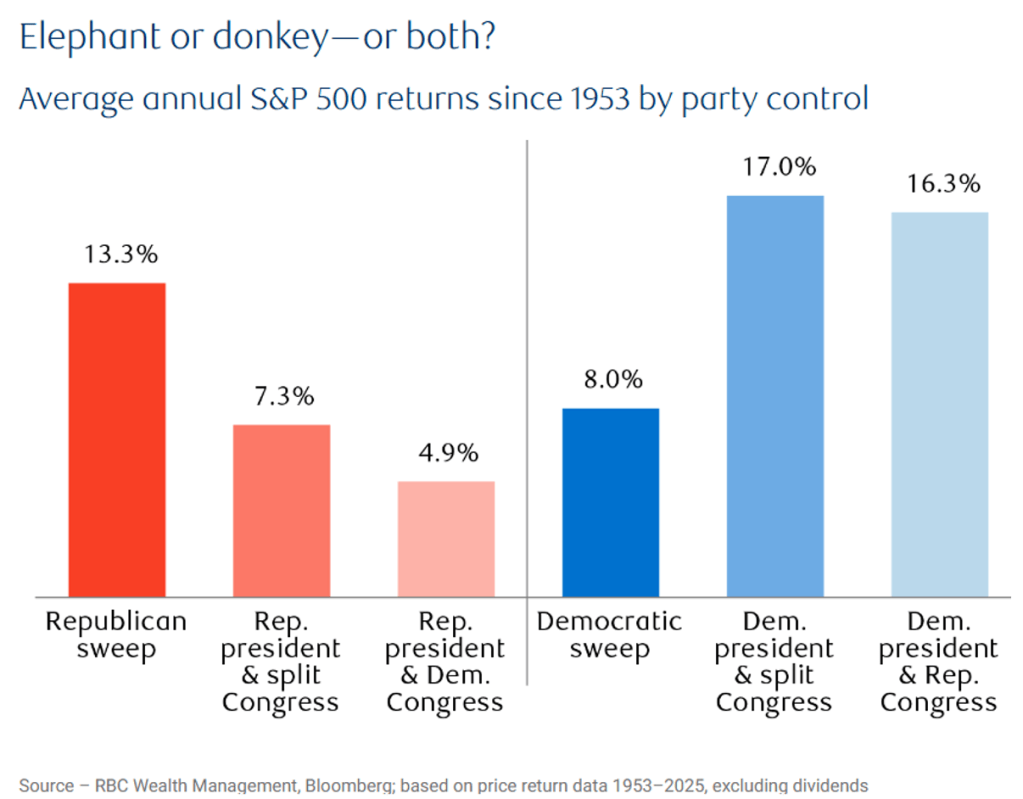
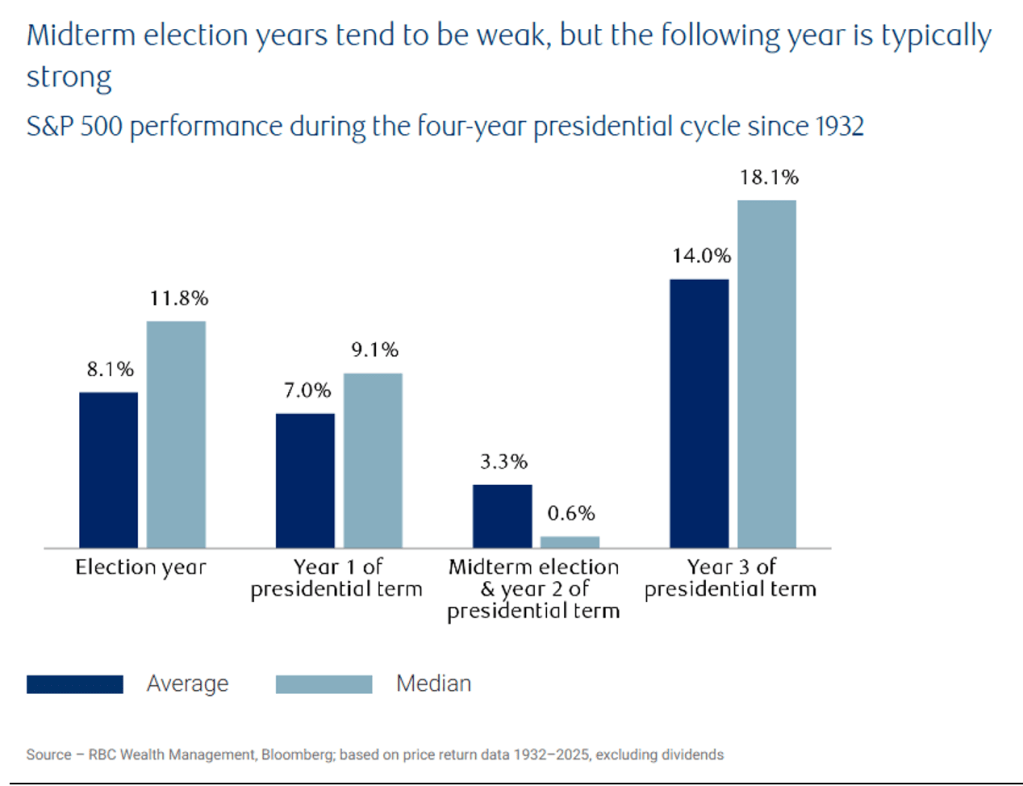
Midterm elections are less than five weeks away. The early polls and prediction markets are predicting a blue wave with the Democrats taking both the House and Senate. At this time, it appears the Senate will be the more competitive of the two chambers of Congress. Affordability concerns alongside the war in Iran are top of mind for voters. If the Democrats do take control of Congress, or even just one chamber, it is likely the government will face gridlock over the next two years. There are many who believe gridlock is a tailwind for markets, but historic data shows us that the reality of history is more nuanced than that.
The charts below show that year three of a presidential term has historically been the best performing for the stock market. However, a split or Democratic Congress with a Republican President has historically been the lowest performing context for the equity markets. Ironically, this has not been the case in the reverse scenario with a Democratic President and a split or Republican-led Congress.
Ultimately, corporate earnings, Federal Reserve monetary policy, and the economy will drive markets. Corporate earnings are the key long-term driver of stock returns, but Fed policy that restricts economic growth could become a headwind that causes investors to pause.
Geopolitics
While discussions between the U.S. and China appear to have been at least slightly positive for the relationship, ongoing discussions with various counterparts to end the wars in Iran and Ukraine appear to be making little progress. In prepared remarks before the U.N., President Trump questioned whether he should “annihilate the Islamic Republic and do it quickly, never giving them a chance to kill and destroy people and countries again?” 5 Iran has pushed back on Trump’s threats with Major General Mohsen Rezaei, the head of Iran’s influential Supreme National Security Council, stating during a conversation with Azerbaijan’s deputy prime minister that: “We stated our conditions, but Trump is incapable of decision-making… Trump is trapped in a quagmire where he can neither negotiate nor fight.” 6
As the war drags on, it appears neither side can find a desirable offramp with the Strait of Hormuz remaining a key point of disagreement. Oil prices continue to react to each headline about progress or lack there-of in negotiations. Adding to the energy crisis, the conflict between Saudia Arabia and the Iran-backed Houthis escalated during September. Saudia Arabia temporarily shutdown a vital crude oil pipeline following a drone attack on the infrastructure, although operations have partially resumed. If oil prices remain at current levels or rise further, it will put further upward pressure on global inflation.
The war in Ukraine is also creating inflation pressures on wheat and gas. Both Ukraine and Russia have escalated attacks in recent months, striking deeper into each country and hitting energy infrastructure. Ukrainian President Volodymyr Zelensky addressed the United Nations last month and reiterated that Ukraine is not ready to concede territory during any peace negotiations. It appears Putin will continue to force the issue and send more troops to the frontlines even as the casualty toll rises.
Markets
- U.S. equities were flat during September despite the markets facing headwinds from rising oil prices and bond yields. The S&P 500 fell 0.35% during the month, bringing its year-to-date (YTD) return to 12.7%. International stocks were down 3% during the month but were up 14% YTD through July.
- As highlighted above, the yield on the 10-year treasury spiked during the month. The 10-year yield closed September at 5.29% after hitting an intraday high of 5.34% late in the month. The 30-year closed the month at 5.64%. September gave investors Treasury yields that had not been observed since 2002.
Economic Trends
- In the final reading of Q2 U.S. GDP growth, real GDP grew at 2.2%. This revision was a 0.7% increase from the previous estimate. The stronger estimate reflected upward revisions to investment, consumer spending, and government spending.
- Headline inflation remained at 3.4% in August as core inflation fell slightly from 2.5% to 2.4%. As a result of the ongoing wars, gasoline prices rose 27.4% year-over-year, and fuel oil prices increased 52%. Early forecasts for the September inflation rate expect a rise in inflation.
- Consumer sentiment drops to a four-month low. The University of Michigan’s consumer sentiment index fell to its lowest level in four months at 48.1 in September. Views of personal finances deteriorated, while inflation concerns continued to intensify. The short-term outlook for business conditions weakened sharply amid renewed concerns that elevated fuel prices and trade disputes could weigh down the economy.
Our Team’s Take:
With one 2026 rate hike in the rearview mirror, investors will focus on the potential for additional rate hikes during the fourth quarter along with new developments in the war with Iran and its continued impact on gasoline prices.
We continue to focus on diversification across asset classes, including private alternatives such as infrastructure, real estate, private equity, and private credit. Public stock valuations are elevated relative to history, but strong earnings growth and a decent economy continue to provide support for stock markets. Eventually, AI productivity growth should help maintain strong profit margins; however, markets continue to punish stocks that fall short of lofty expectations. We therefore believe continued turbulence is likely.
As we continue to reiterate, it is imperative for clients to be invested in the correct risk-tolerance for their own personal situations. If you have concerns, please do not hesitate to reach out to your wealth advisor.
1 https://www.federalreserve.gov/mediacenter/files/FOMCpresconf20260916.pdf, September 16, 2026.
2 https://www.reuters.com/markets/econ-world/playing-game-2026-09-10/, September 10, 2026.
3 https://privatewealth.brookfield.com/sites/default/files/2026-09/Memo-From-Howard-Marks-Shall-We-Repeal-Laws-of-Economics-Part-III.pdf, September 22, 2026.
4 https://advantage.factset.com/hubfs/Website/Resources%20Section/Research%20Desk/Earnings%20Insight/EarningsInsight_092526.pdf, September 25, 2026.
5 https://www.bbc.com/news/articles/c52e0ywl9pr7o, September 23, 2026.
6 https://www.cbsnews.com/live-updates/iran-war-us-trump-talks-strait-of-hormuz/, September 29, 2026.
This material is for general information and educational purposes only. Information is based on data gathered from what we believe are reliable sources. It is not guaranteed as to accuracy, does not purport to be complete and is not intended to be used as a primary basis for investment decisions.
Find answers to your questions about Hightower Signature Wealth
Hightower Signature Wealth is a fiduciary wealth management practice that provides investment management, financial planning, estate strategies, insurance, and banking solutions. We work with families, business owners, professionals, women, and retirees across more than 40 offices nationwide. Our advisors take the time to understand your financial priorities, develop a plan around your goals, and adjust that plan as your life and circumstances evolve.
Hightower Signature Wealth provides a broad range of wealth management services designed to address different aspects of your financial life. Our capabilities include investment management, financial planning, retirement planning, estate strategies, insurance and risk management, banking solutions, and charitable giving strategies. By considering these areas together, our advisors can develop a coordinated approach based on your goals, priorities, financial circumstances, and plans for the future.
Hightower Signature Wealth advisors work with a broad range of clients, including women, families, business owners, professionals, retirees, and high-net-worth individuals navigating major life or financial transitions. Rather than applying a generic playbook, each advisor tailors the plan to a client’s specific goals and current stage of life – from early-career decisions to multigenerational wealth transfer.
Yes. Hightower Signature Wealth advisors serve as fiduciaries, which means they are committed to acting in their clients’ interests when providing investment advice. We offer fee-based advisory services, with fees depending on the services provided and the specifics of your relationship. Your advisor will discuss the applicable fee structure with you so you can understand how you are charged and what services are included.
Hightower Signature Wealth has more than 40 offices nationwide, allowing our advisors to serve individuals, families, and organizations across the country. Depending on your location and preferences, you may be able to work with an advisor locally or connect with a team in another market. Visit our Locations page to explore our office locations, learn more about the teams in each market, and find an office near you.
Getting started with Hightower Signature Wealth is simple. Complete our online contact form with some basic information about yourself and what you are looking for, and we’ll connect you with an advisor who can discuss your needs and financial priorities. That initial conversation is an opportunity to learn more about our approach, ask questions, and determine whether working with a Hightower Signature Wealth advisor may be a good fit.
Your first conversation is an opportunity for us to learn more about you, your financial circumstances, and what you hope to accomplish. An advisor may ask about your goals, current investments, family considerations, business interests, and other priorities that could influence your financial plan. You’ll also have an opportunity to ask questions, learn about our approach, and discuss what working together could look like.