Frequently Asked Questions (FAQ) – September 2026
Dennis Stearns, CFP®, ChFC, MS
Wealth Advisor, Managing Director
Q: Is the long-awaited National Debt reckoning finally here? When we passed $40 trillion in debt, the treasury bond market went into disarray, requiring intervention by the U.S. Treasury!
A: A combination of rising U.S. government debt, higher inflation caused by the Iran War, and increased demand from large companies borrowing money to finance their AI buildout has indeed caused long-term borrowing rates to rise. In fact, the 30-year Treasury bond hit multi-year highs as bond investors demanded more interest given these fears. The “bond vigilantes” discussed in previous newsletters are a powerful force – when they issue a vote of no confidence on government policy, looking through government attempts to “fix” a problem, they can meaningfully drive interest rates up.
Treasury Secretary Scott Bessent recently announced a plan to at least double the size of long-term government bond buybacks (from $2 billion to $4 billion per cycle). In this fashion, the government effectively increased demand and pulled yields down. While the move provided temporary relief, bond yields quickly rebounded toward their previous highs, showing how hard it is to fight market forces with $40 trillion in accumulated debt. Scott Bessent is no stranger to these issues. He taught economic and financial history as an adjunct professor at Yale University from 2006 to 2010. This included teaching Twentieth Century Financial Booms and Busts.
Bessent was able to sooth the savage beast (bond vigilantes) in April, 2025 when they violently reacted to the first tariff plan sending interest rates up and causing a $10 trillion correction in global stocks. Bessent led the plan to walk the tariff strategy back enough to settle interest rates down, causing a rapid recovery in stocks and lower interest rates.
Note that Janet Yellen, Treasury Secretary in the last administration, ran into a similar problem during her tenure, although with a different set of issues that upset the bond market, which is 3X the size of the stock market. She also was unable to pull down bond yields as post-Covid inflation spiked and the government overreacted (to the chagrin of bond investors) with too much government money injected into the economy.
Annual interest payments on the debt now exceed $1.2 trillion, making interest expense the government’s second-largest outflow behind Social Security. The problem is structural, driven by aging demographics, not enough tax revenue to cover entitlement programs, and “unscheduled” spending that happens when we have a crisis (like Covid) or a war (like Iran), or rising defense spending, including cybersecurity, to counter future threats.
Our Signature Wealth NC Team’s Take: This is a flashing yellow warning sign, not a “game over” moment. It took almost 200 years for U.S. national debt to reach $1tn for the first time. We reached that milestone back in 1981 and it was treated as a wake-up call. President Ronald Reagan told the nation at the time, ‘If we as a nation needed a warning, let that be it’. Politicians hit the snooze button on many occasions since.
Jumping to America’s 250th year, we are spending more than $1tn a year just on the interest associated with our debt. The U.S.’s position as the world’s largest economy and the U.S. dollar being the world’s reserve currency gives the U.S. a much longer runway to fiscally misbehave than other countries. Our debt-to-GDP ratio remains a critical measure – as long as the economy grows in proportion to the nation’s debt, a crisis will be averted. This is Secretary Bessent’s strategy – grow the U.S. economy by any means since he has low confidence that Congress will reign in spending anytime soon. The Iran War was an unexpected monkey wrench in his plan, and he has signaled he will do whatever is necessary to keep interest rates from climbing too high or staying too high for too long. So far, the bond vigilantes are not cooperating with his strategy, demanding higher rates and more fiscal prudence from the U.S. government.
Fortunately, core inflation (excluding energy) has been settling down more recently as opposed to adding to the perfect storm Bessent is facing. It is also fortunate that Chinese ownership of U.S. treasuries has fallen dramatically in the last decade given the Iran war and China’s support of the Iranians. The Eurozone is now the #1 owner of our debt.
Rather than creating a sudden, dramatic financial reckoning, we view all the factors in play as a slow-moving squeeze that will gradually increase borrowing costs for everyday Americans on mortgages and car loans. Since the endgame for the Iran War remains murky, it is hard to say for sure that interest rates will calm in the coming months.
Our investment strategy continues to underweight bonds and use other bond-like asset classes to help shield our clients from the current bond market volatility. We remain on high alert as we consider how all investment and financial planning areas might be impacted in this environment.
Q: You’ve discussed previously how much money is required to adequately fund a college education. The answer depends of course on whether the college is a public or private one and how much we want our kids to have “skin in the game”. With AI changing the career picture, should we think about the idea of college differently now?
A: College education in 10 years will still be highly relevant in certain AI-resilient careers. Forbes analyzed 7 AI – resilient future career paths: Nursing, special education, occupational therapy, physical therapy, civil engineering, speech-language pathology and construction management. They determined that these skills will still be most valued as the age of disruption accelerates:
- Complex, contextual judgment: They require decisions that integrate multiple factors, ethical considerations, and contextual nuances that AI cannot fully assess.
- Human connection and empathy: They involve building relationships, reading emotional cues, and providing care and support in ways that technology cannot replicate.
- Physical presence and manipulation: Many require hands-on assessment, treatment, or construction that cannot be performed remotely by AI systems.
- Adaptive creativity: These professionals must continuously adjust their approaches based on real-time feedback and changing conditions.
- Ethical reasoning: They involve navigating complex ethical dilemmas that require human values and judgment.
Artificial Intelligence isn’t the only thing to consider in future college prep for your children.
Ask anyone under 30 whether college is worth the investment of time and money. The majority in recent surveys say the cost is too high and many degrees have diminished lifetime earnings potential. Ask most employers and they will say it’s still very important to have a degree to get a foot in the door at their company or organization. Gallup and the Lumina Foundation found only 38% of Americans have “a great deal” or “quite a lot” of confidence in higher education in 2026, down from 42% last year and 57% in 2015.
By political party, the results are striking.

Source: Gallup, all data as of 7/13/2026.
Another survey by Credible found Americans split almost evenly, 52-48, on whether a degree is worth the cost, and 44% of grads aren’t convinced their own degree paid off. An amazing 45% said their education didn’t deliver a good return. The same survey found 58% see college as a luxury, not a necessity, and 58% don’t think it prepares students for career success. As we note later, beyond career success, a good education can provide the foundation for a well informed citizen.

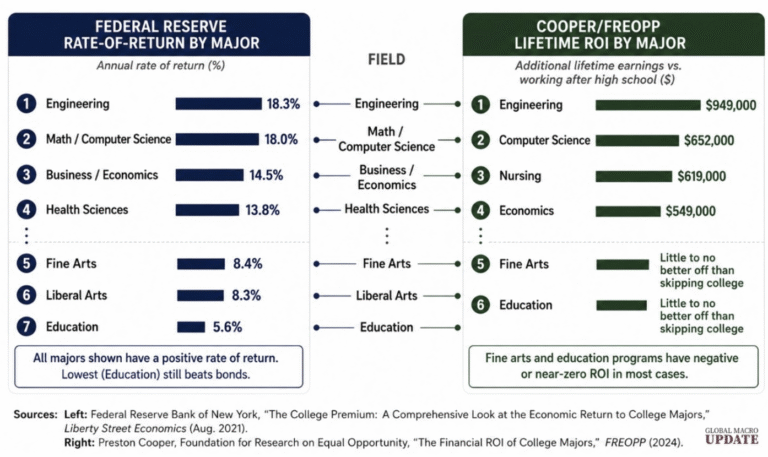
Preston Cooper at the Foundation for Research on Equal Opportunity modeled 53,000 individual programs and found the median bachelor’s degree still has a positive $160,000 return over the cost of a 4-year degree over a lifetime. Engineering leads at a $949,000 return over cost, with computer science, nursing, and economics all clearing well over $500,000. Computer science is considered “at risk” in 10 years as a good return. Fine arts and education sit at the bottom, leaving graduates little better off than if they’d skipped college entirely.
The Federal Reserve studied the return on investment on a college degree and determined the return has been pretty good: Engineering again led the degree ROI at 18.3%, math and computer science at 18.0%, business,economics, and health sciences close behind. Fine arts, liberal arts, and education land at the bottom. Education was last at 5.6%.
It is interesting to note where they disagree: The Fed still calls the bottom-ranked majors a “sound investment” for the typical student.
Forty-three percent of Gen Z say they plan to start a business in 2026, ahead of every other generation. Entrepreneurship is becoming a default option, not a fallback. Unfortunately, not every aspiring business owner has the right stuff to pull it off sustainably, even with business coaches and AI enhanced help. Among people who just graduated: 38% are considering starting a business, 32.5% are weighing gig work, 28% are exploring freelance.
The new paradigm – 60% of new business owners used artificial intelligence to launch a business in 2025, double the rate two years prior. 43% of Gen Z report entrepreneurial intent, against 39% of millennials and 21% of Gen X. In our Ninja Entrepreneur book research, we found a huge increase in the growth of lean businesses launched by age 20 somethings all the way up to age 50 somethings, usually designed up front with less capital and fewer employees per dollar of revenue than in the past.
Another factor: Special skill certificates and short-term credentials are growing fast, and Washington is now subsidizing them the way it once subsidized bachelor’s degrees.
Our Signature Wealth NC Team’s Take: Ten years is a long time before college even begins to predict how AI will impact future careers. Optionality may be key here as how you and your child use your precious education funds is likely to become more clear as the impacts of the age of disruption emerge.
It’s important to remember that the value of education goes beyond earning a paycheck. Many Americans believe a good education is worthwhile in and of itself. It is widely known, for example, that education plays a vital role in confidence, health outcomes and general life satisfaction. Higher education done well improves cognitive function and the ability to think critically. Finally, education helps individuals become more informed citizens and voters. Beyond the all important work force, the United States also needs a well-informed, well-educated citizenry.
We believe it’s prudent to continue funding 529 plans given the tax-free earnings that can be used to pay for college, whether in its current form or in a hybrid form that is likely to develop. Trade schools are already included in eligible 529 expenses. We predict that the options a 529 can fund with tax free dollars will expand as the government realizes how much training for new careers is changing. And that education nestegg could fund special training inside or outside a traditional university – the growth of these special hybrids is expected to accelerate in the next 10 years.
However, if funding the 529s is at the cost of your own financial security, many families may choose to reduce 529 funding to more modest levels.
Age of Disruption idea: your 529 could fund special training to build a career coach AI agent for your child that understands them inside and out and provides daily coaching on navigating whatever career path they choose – or giving them ideas for pivots to areas that generate a higher return on investment or return on their life. Our Omega network of AI thought leaders believes the return on the cost of education could increase by 2-5X with this type of highly customized career support.
Trusts don’t grow tax free but have the flexibility to fund alternative futures for a child, including buying into a business or franchise. Or hiring specialists who take your child’s interests and talents and build an AI enhanced business around them, providing help that today usually comes from venture capitalists or business consultants. If future 529 rules don’t include this type of career help, you can still cash in the 529 and get your own investment back tax free – the downside is earnings are taxed at ordinary income rates plus a 10% penalty if they aren’t used for qualifying educational expenses based on the law in effect at that time.
Talk to your Signature Wealth advisor for more custom education planning advice on this rapidly evolving topic.
This material is for general information and educational purposes only. Information is based on data gathered from what we believe are reliable sources. It is not guaranteed as to accuracy, does not purport to be complete and is not intended to be used as a primary basis for investment decisions.
Find answers to your questions about Hightower Signature Wealth
Hightower Signature Wealth is a fiduciary wealth management practice that provides investment management, financial planning, estate strategies, insurance, and banking solutions. We work with families, business owners, professionals, women, and retirees across more than 40 offices nationwide. Our advisors take the time to understand your financial priorities, develop a plan around your goals, and adjust that plan as your life and circumstances evolve.
Hightower Signature Wealth provides a broad range of wealth management services designed to address different aspects of your financial life. Our capabilities include investment management, financial planning, retirement planning, estate strategies, insurance and risk management, banking solutions, and charitable giving strategies. By considering these areas together, our advisors can develop a coordinated approach based on your goals, priorities, financial circumstances, and plans for the future.
Hightower Signature Wealth advisors work with a broad range of clients, including women, families, business owners, professionals, retirees, and high-net-worth individuals navigating major life or financial transitions. Rather than applying a generic playbook, each advisor tailors the plan to a client’s specific goals and current stage of life – from early-career decisions to multigenerational wealth transfer.
Yes. Hightower Signature Wealth advisors serve as fiduciaries, which means they are committed to acting in their clients’ interests when providing investment advice. We offer fee-based advisory services, with fees depending on the services provided and the specifics of your relationship. Your advisor will discuss the applicable fee structure with you so you can understand how you are charged and what services are included.
Hightower Signature Wealth has more than 40 offices nationwide, allowing our advisors to serve individuals, families, and organizations across the country. Depending on your location and preferences, you may be able to work with an advisor locally or connect with a team in another market. Visit our Locations page to explore our office locations, learn more about the teams in each market, and find an office near you.
Getting started with Hightower Signature Wealth is simple. Complete our online contact form with some basic information about yourself and what you are looking for, and we’ll connect you with an advisor who can discuss your needs and financial priorities. That initial conversation is an opportunity to learn more about our approach, ask questions, and determine whether working with a Hightower Signature Wealth advisor may be a good fit.
Your first conversation is an opportunity for us to learn more about you, your financial circumstances, and what you hope to accomplish. An advisor may ask about your goals, current investments, family considerations, business interests, and other priorities that could influence your financial plan. You’ll also have an opportunity to ask questions, learn about our approach, and discuss what working together could look like.