Stocks vs. Bonds: More Choices for Investors as Bond Yields Rise
Jeffrey L. Corliss, CFP®, ChFC®, CLU® CASL®
Managing Director
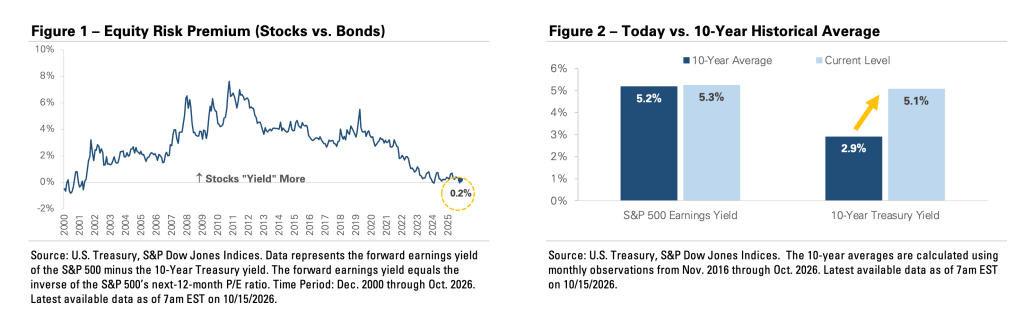
For most of the past two decades, investors seeking higher returns had to rely more heavily on stocks. After the 2008 financial crisis, the Federal Reserve kept interest rates extremely low to support the economy, which meant Treasury bonds offered relatively little income. While stocks carried more risk than bonds, they offered earnings growth, dividends, and higher potential returns. The low-interest-rate environment helped popularize the phrase “There Is No Alternative,” or TINA, because bonds weren’t competitive as a source of return. However, the trade-off has changed in recent years. The 10-year Treasury now yields nearly 5.1%, slightly below the S&P 500’s forward earnings yield of 5.3%. For the first time in more than twenty years, bonds offer a competitive alternative to stocks.
Figure 1 compares the 10-year Treasury yield with the S&P 500’s earnings yield. Because stocks don’t pay a fixed rate of interest like bonds, the earnings yield provides a way to compare stocks and bonds. The earnings yield shows how much profit S&P 500 companies are expected to generate relative to their market value. For example, a 5.3% earnings yield means S&P 500 companies are expected to generate about $5.30 of earnings for every $100 of market value. When the line in Figure 1 is above zero, the stock market’s earnings yield is higher than the 10-year Treasury yield. When it falls below zero, Treasury yields are higher than the earnings yield. For most of the period since the early 2000s, stocks held a sizable yield advantage. Today, the advantage is much smaller.
Figure 2 shows that the shift has come almost entirely from higher Treasury yields. The S&P 500’s current forward earnings yield of 5.3% is slightly higher than its 5.2% average over the past decade. In contrast, the 10-year Treasury now yields around 5.1%, about 2.2% above its 10-year average of 2.9%. Treasury yields started rising in 2022 as the Federal Reserve aggressively raised interest rates to bring inflation under control. More recently, Treasury yields have remained elevated as investors weigh persistent inflation, the possibility of additional Fed rate hikes, growing federal deficits, and heavy government borrowing.
The charts don’t necessarily signal that bonds will outperform stocks, and higher Treasury yields come with their own risks. Bond prices can fall when interest rates rise, and inflation can reduce the purchasing power of the income that bonds provide. Stocks also offer the potential for corporate earnings to grow over time, which is one of the main reasons investors own them for long-term growth. The broader takeaway is that investors have more choices today. For years, low bond yields pushed many investors to rely on stocks to generate higher returns. Today, higher starting bond yields offer a competitive source of return and give investors more flexibility to balance income, growth, and risk across their portfolios.
This material is for general information and educational purposes only. Information is based on data gathered from what we believe are reliable sources. It is not guaranteed as to accuracy, does not purport to be complete and is not intended to be used as a primary basis for investment decisions.
Find answers to your questions about Hightower Signature Wealth
Hightower Signature Wealth is a fiduciary wealth management practice that provides investment management, financial planning, estate strategies, insurance, and banking solutions. We work with families, business owners, professionals, women, and retirees across more than 40 offices nationwide. Our advisors take the time to understand your financial priorities, develop a plan around your goals, and adjust that plan as your life and circumstances evolve.
Hightower Signature Wealth provides a broad range of wealth management services designed to address different aspects of your financial life. Our capabilities include investment management, financial planning, retirement planning, estate strategies, insurance and risk management, banking solutions, and charitable giving strategies. By considering these areas together, our advisors can develop a coordinated approach based on your goals, priorities, financial circumstances, and plans for the future.
Hightower Signature Wealth advisors work with a broad range of clients, including women, families, business owners, professionals, retirees, and high-net-worth individuals navigating major life or financial transitions. Rather than applying a generic playbook, each advisor tailors the plan to a client’s specific goals and current stage of life – from early-career decisions to multigenerational wealth transfer.
Yes. Hightower Signature Wealth advisors serve as fiduciaries, which means they are committed to acting in their clients’ interests when providing investment advice. We offer fee-based advisory services, with fees depending on the services provided and the specifics of your relationship. Your advisor will discuss the applicable fee structure with you so you can understand how you are charged and what services are included.
Hightower Signature Wealth has more than 40 offices nationwide, allowing our advisors to serve individuals, families, and organizations across the country. Depending on your location and preferences, you may be able to work with an advisor locally or connect with a team in another market. Visit our Locations page to explore our office locations, learn more about the teams in each market, and find an office near you.
Getting started with Hightower Signature Wealth is simple. Complete our online contact form with some basic information about yourself and what you are looking for, and we’ll connect you with an advisor who can discuss your needs and financial priorities. That initial conversation is an opportunity to learn more about our approach, ask questions, and determine whether working with a Hightower Signature Wealth advisor may be a good fit.
Your first conversation is an opportunity for us to learn more about you, your financial circumstances, and what you hope to accomplish. An advisor may ask about your goals, current investments, family considerations, business interests, and other priorities that could influence your financial plan. You’ll also have an opportunity to ask questions, learn about our approach, and discuss what working together could look like.