The Challenge of Concentrated Wealth: Strategies for Managing Single-Stock Risk
For some ultra-high-net-worth individuals, their wealth has accumulated greatly from concentrated stock positions. A concentrated position is an investment portfolio where a significant portion of an individual’s wealth is held in a single stock or a small number of stocks. This is a reality for many business owners who hold a significant number of shares of their company’s stock, employees who receive employee compensation, or individuals who have received an inheritance or have a single successful investment in their portfolio.
Although a concentrated stock can bring significant wealth, it can also present the risk of losing wealth without the right strategies in place. Below, we detail the risks of concentrated positions and give guidance on the different strategies to use to help manage the team.
Why Concentration Can Undermine Long-Term Outcomes
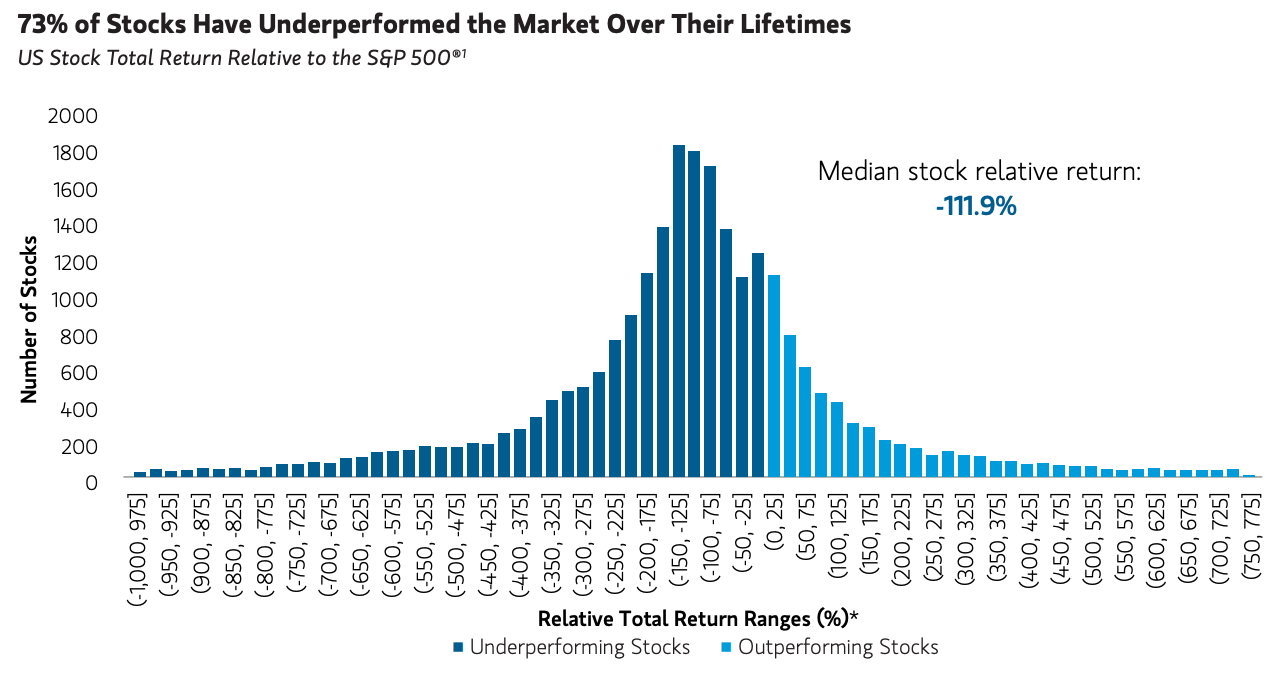
Past performance is no guarantee of future results.
Information is as of 12/31/24. *Bars represent 25% increments. Overflow returns at the top and bottom of the Relative Total Return Ranges (<-1,000% and >1,000%) have been removed. *Derived from a universe of 26,862 actively traded stocks listed on NYSE, NASDAQ, and NYSE American (formerly AMEX) since 12/31/1980; and based on relative total return versus the S&P 500° over the listed trading period of the stock through 12/31/24. Returns are calculated daily, starting on 1/3/1972. Sources: Ned Davis Research, Eaton Vance. 2All actively traded stocks listed on NYSE, NASDAQ and NYSE American (formerly AMEX) since 12/31/1980; 26,861 total stocks. Catastrophic loss is defined as a maximum price drawdown greater than 70%. Recovery is defined as recovery in price to high prior to maximum drawdown.
Sources: Ned Davis Research, Eaton Vance.
One of the most persistent myths in investing is that skillful stock selection consistently beats the market. In reality, most individual stocks underperform their benchmark indexes on a risk-adjusted basis over both short and long-time horizons. Even the stocks that do outperform tend to struggle to sustain their leadership, often lagging in subsequent periods.
When investors concentrate portfolios around these perceived winners, they frequently underestimate the risks involved, leading to higher volatility and the potential for meaningful drawdowns.
Concentrated stock positions are inherently risky because portfolio outcomes become tied to the fate of a single company. Historical data from the Russell 3000 Index dating back to 1980 shows that more than 40% of companies experienced a catastrophic stock price loss—typically defined as a 70% decline from peak levels that was never recovered—often resulting in a near-total loss of capital.1
For those with concentrated positions, this underscores the importance of managing exposure thoughtfully. While diversification remains a cornerstone of portfolio construction, practical considerations such as taxes, liquidity needs, and employer restrictions often require more deliberate approaches.
Strategies for Managing Concentrated Stock Risk
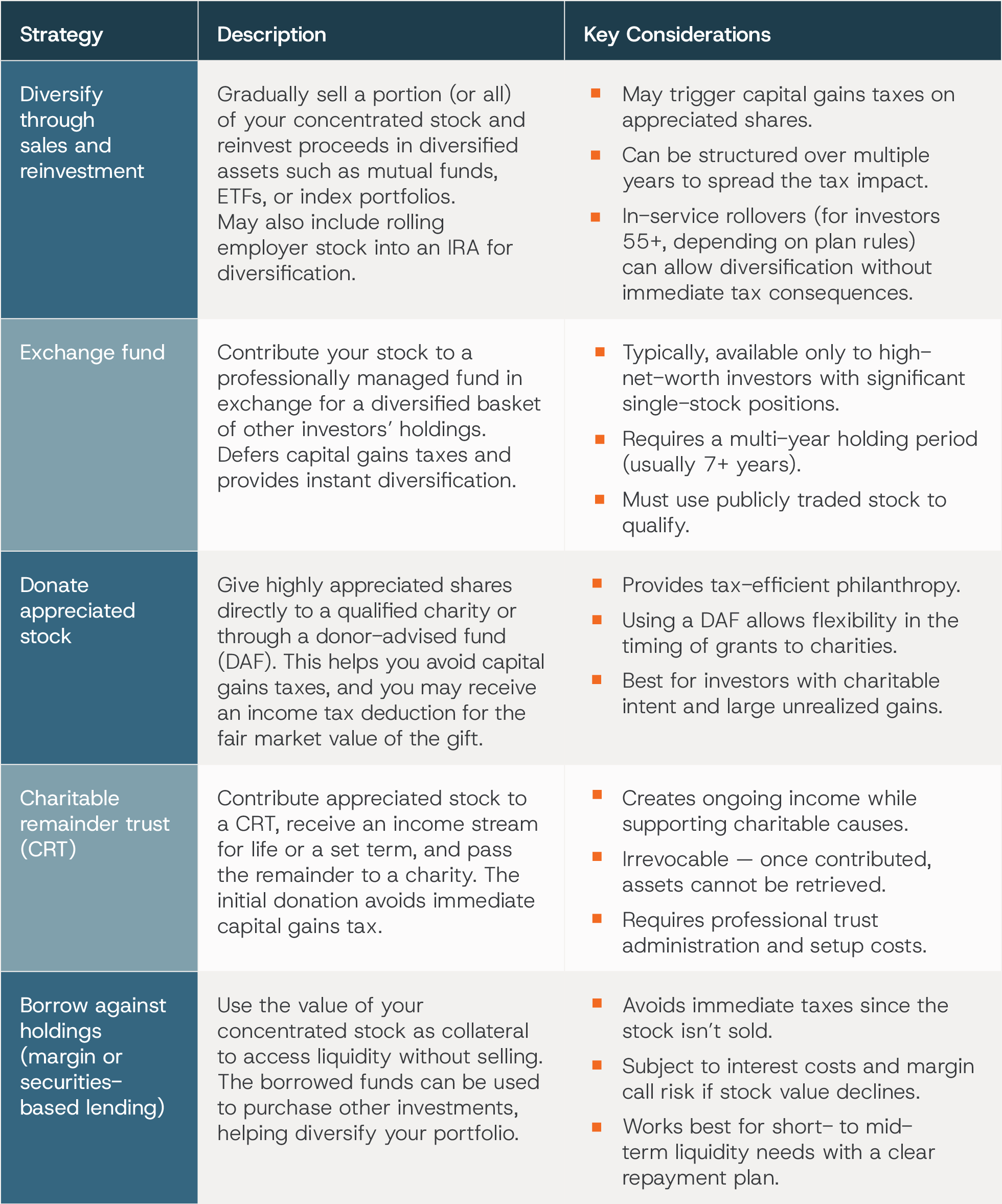
Once the risks of concentrated stock positions are understood, the next step is determining how to manage them in a thoughtful and practical way. For many investors, selling a large stock position outright may not be feasible due to tax considerations, timing concerns, or personal circumstances. The strategies below highlight different approaches investors can use to gradually reduce concentration risk while balancing diversification, taxes, and long-term financial goals.
Aligning Strategy with Your Financial Journey
While these strategies provide a strong foundation for understanding how to manage a concentrated stock position, the most appropriate approach ultimately depends on who holds the stock and where they are in their financial journey. An entrepreneur may remain concentrated to preserve control and long-term upside, a long-term investor may hold based on conviction and tax efficiency, an inheritor may prioritize diversification and simplicity, and a corporate executive or founder—particularly one preparing to leave a company—may choose to reduce exposure as influence over company decisions declines and personal financial goals evolve.
Because concentrated stock positions intersect with taxes, liquidity, career considerations, and personal objectives, there is no one-size-fits-all solution. This is why having a thoughtful conversation with a financial advisor is essential. Our advisors help evaluate these strategies within the context of your broader wealth, risk tolerance, and long-term objectives. Connect with us to discuss integrated approaches to managing concentration risk and enhancing after-tax outcomes.
[1] Turn concentrated stock risk into potential tax-savings reward. (n.d.). Retrieved January 4, 2026, from https://am.jpmorgan.com/us/en/asset-management/adv/investment-strategies/separately-managed-accounts/tax-managed-solutions/concentrated-stock-risk/
This material is for general information and educational purposes only. Information is based on data gathered from what we believe are reliable sources. It is not guaranteed as to accuracy, does not purport to be complete and is not intended to be used as a primary basis for investment decisions.
Find answers to your questions about Hightower Signature Wealth
Hightower Signature Wealth is a fiduciary wealth management practice that provides investment management, financial planning, estate strategies, insurance, and banking solutions. We work with families, business owners, professionals, women, and retirees across more than 40 offices nationwide. Our advisors take the time to understand your financial priorities, develop a plan around your goals, and adjust that plan as your life and circumstances evolve.
Hightower Signature Wealth provides a broad range of wealth management services designed to address different aspects of your financial life. Our capabilities include investment management, financial planning, retirement planning, estate strategies, insurance and risk management, banking solutions, and charitable giving strategies. By considering these areas together, our advisors can develop a coordinated approach based on your goals, priorities, financial circumstances, and plans for the future.
Hightower Signature Wealth advisors work with a broad range of clients, including women, families, business owners, professionals, retirees, and high-net-worth individuals navigating major life or financial transitions. Rather than applying a generic playbook, each advisor tailors the plan to a client’s specific goals and current stage of life – from early-career decisions to multigenerational wealth transfer.
Yes. Hightower Signature Wealth advisors serve as fiduciaries, which means they are committed to acting in their clients’ interests when providing investment advice. We offer fee-based advisory services, with fees depending on the services provided and the specifics of your relationship. Your advisor will discuss the applicable fee structure with you so you can understand how you are charged and what services are included.
Hightower Signature Wealth has more than 40 offices nationwide, allowing our advisors to serve individuals, families, and organizations across the country. Depending on your location and preferences, you may be able to work with an advisor locally or connect with a team in another market. Visit our Locations page to explore our office locations, learn more about the teams in each market, and find an office near you.
Getting started with Hightower Signature Wealth is simple. Complete our online contact form with some basic information about yourself and what you are looking for, and we’ll connect you with an advisor who can discuss your needs and financial priorities. That initial conversation is an opportunity to learn more about our approach, ask questions, and determine whether working with a Hightower Signature Wealth advisor may be a good fit.
Your first conversation is an opportunity for us to learn more about you, your financial circumstances, and what you hope to accomplish. An advisor may ask about your goals, current investments, family considerations, business interests, and other priorities that could influence your financial plan. You’ll also have an opportunity to ask questions, learn about our approach, and discuss what working together could look like.