Qualified Charitable Distributions: A Tax-Efficient Charitable Giving Strategy for Retirees
What Is a QCD?
If you have investments in tax-deferred retirement accounts, such as traditional IRAs and employer-sponsored retirement plans, you may be required to take annual required minimum distributions (RMDs) once you reach age 73. These withdrawals begin as a relatively small percentage of your retirement assets but increase over time, potentially creating a higher tax burden and even pushing you into a higher income tax bracket. In some cases, higher taxable income may also affect the taxation of Social Security benefits, Medicare premiums, and eligibility for certain tax deductions or credits.
For owners of eligible IRAs, Qualified Charitable Distributions (QCDs) may provide a tax-efficient way to satisfy some or all of those RMD obligations while supporting charitable causes that are meaningful to them. A QCD is a special provision in the tax code that allows eligible IRA owners to make tax-free gifts of up to $111,000 for tax year 2026 (indexed for inflation) directly to qualified charities.1
In addition to potentially reducing taxable income by up to $111,000, QCDs can help charitably inclined retirees incorporate philanthropy into their overall financial plan. Because QCDs are excluded from income rather than claimed as an itemized deduction, they may provide significant value for taxpayers who take the standard deduction.
What Are the Potential Benefits?
Qualified Charitable Distributions can provide several potential benefits beyond simply satisfying an RMD requirement. By reducing adjusted gross income (AGI), a QCD may help retirees manage the tax consequences of retirement distributions while simultaneously supporting charitable organizations.
Potential advantages may include satisfying all or a portion of an annual RMD obligation, excluding the distribution from taxable income, potentially reducing the taxation of Social Security benefits, helping avoid Medicare IRMAA thresholds, and providing tax benefits even for individuals who do not itemize deductions.
Examples
Scenario 1
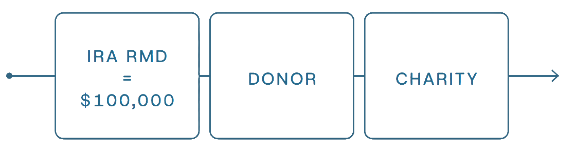
- The RMD is distributed to the IRA owner
- The owner writes a check to charity
- The entire distribution is added to the IRA owner’s gross income for that tax year and can be added to schedule A as an itemized deduction subject to a limitation of 60% of adjusted gross income (AGI)
- If the owner’s standard deduction — $32,200 in 2026 (married filing jointly), plus $1,650 for those over the age of 652 — is greater than the total of all itemized deductions, there is no tangible tax benefit for making the donation
- The IRA owner can still itemize other charitable donations on Schedule A if advantageous
- Certain other deductions may be limited / reduced due to the owner’s higher AGI
Scenario 2
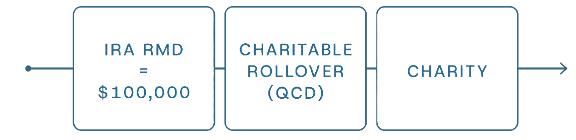
- The RMD is distributed directly from the owner’s IRA to the charity
- The owner’s RMD is satisfied, and the distribution is not included in the owner’s taxable income
- This particular donation is not itemized as a deduction on Schedule A (Form 1040 1040-SR) because it has already been excluded from taxation
- The donation may help reduce taxes on the owner’s Social Security income and prevent the loss or reduction of certain other deductions
- Other gifts to charity may still be itemized on Schedule A if advantageous
One-Time Additional $55,000 QCD Opportunity
Retirement account owners age 70½ or older may make a one-time $55,000 distribution directly from an IRA to a Charitable Gift Annuity (CGA), Charitable Remainder Unitrust (CRUT), or Charitable Remainder Annuity Trust (CRAT) and receive QCD treatment for tax purposes.3
This distribution may also count toward the owner’s required minimum distribution, if applicable.
Who Might Benefit from a QCD?
A Qualified Charitable Distribution may be worth considering for charitably inclined retirees, individuals with substantial IRA balances, retirees seeking tax-efficient charitable giving strategies, individuals affected by higher adjusted gross income due to RMDs, and families incorporating philanthropy into broader legacy planning goals.
Additional QCD Considerations
The distribution must be made directly from the retirement account to the qualified charity. QCDs cannot be directed to donor-advised funds or private foundations. Deductible IRA contributions made after age 70½ may reduce future QCD eligibility. QCDs cannot also be claimed as charitable deductions on Schedule A.
Integrating Charitable Giving Into Your Retirement Plan
Qualified Charitable Distributions can be an effective strategy for retirees who want to align their charitable intentions with broader retirement and tax-planning goals. At Hightower Signature Wealth, we help clients evaluate charitable giving opportunities as part of a comprehensive wealth management strategy that includes retirement income planning, estate planning, tax strategies, and legacy goals.
[1] Qualified Charitable Distributions from Individual Retirement Accounts (IRAs). (n.d.). Congress.gov | Library of Congress. Retrieved May 29, 2026, from https://www.congress.gov/crs-product/IF11377
[2] Taylor, K. R. (2026, February 21). The extra standard deduction for people age 65 and older: How much can you save? Kiplinger. https://www.kiplinger.com/taxes/extra-standard-deduction-age-65-and-older
[3] Adams, H. (2026, January 20). Reducing RMDs with QCDs. Schwab Brokerage. https://www.schwab.com/learn/story/reducing-rmds-with-qcds
This material is for general information and educational purposes only. Information is based on data gathered from what we believe are reliable sources. It is not guaranteed as to accuracy, does not purport to be complete and is not intended to be used as a primary basis for investment decisions.
Find answers to your questions about Hightower Signature Wealth
Hightower Signature Wealth is a fiduciary wealth management practice that provides investment management, financial planning, estate strategies, insurance, and banking solutions. We work with families, business owners, professionals, women, and retirees across more than 40 offices nationwide. Our advisors take the time to understand your financial priorities, develop a plan around your goals, and adjust that plan as your life and circumstances evolve.
Hightower Signature Wealth provides a broad range of wealth management services designed to address different aspects of your financial life. Our capabilities include investment management, financial planning, retirement planning, estate strategies, insurance and risk management, banking solutions, and charitable giving strategies. By considering these areas together, our advisors can develop a coordinated approach based on your goals, priorities, financial circumstances, and plans for the future.
Hightower Signature Wealth advisors work with a broad range of clients, including women, families, business owners, professionals, retirees, and high-net-worth individuals navigating major life or financial transitions. Rather than applying a generic playbook, each advisor tailors the plan to a client’s specific goals and current stage of life – from early-career decisions to multigenerational wealth transfer.
Yes. Hightower Signature Wealth advisors serve as fiduciaries, which means they are committed to acting in their clients’ interests when providing investment advice. We offer fee-based advisory services, with fees depending on the services provided and the specifics of your relationship. Your advisor will discuss the applicable fee structure with you so you can understand how you are charged and what services are included.
Hightower Signature Wealth has more than 40 offices nationwide, allowing our advisors to serve individuals, families, and organizations across the country. Depending on your location and preferences, you may be able to work with an advisor locally or connect with a team in another market. Visit our Locations page to explore our office locations, learn more about the teams in each market, and find an office near you.
Getting started with Hightower Signature Wealth is simple. Complete our online contact form with some basic information about yourself and what you are looking for, and we’ll connect you with an advisor who can discuss your needs and financial priorities. That initial conversation is an opportunity to learn more about our approach, ask questions, and determine whether working with a Hightower Signature Wealth advisor may be a good fit.
Your first conversation is an opportunity for us to learn more about you, your financial circumstances, and what you hope to accomplish. An advisor may ask about your goals, current investments, family considerations, business interests, and other priorities that could influence your financial plan. You’ll also have an opportunity to ask questions, learn about our approach, and discuss what working together could look like.