Market Note: Strong Growth, Healthy Consumers, and Banks on Deck
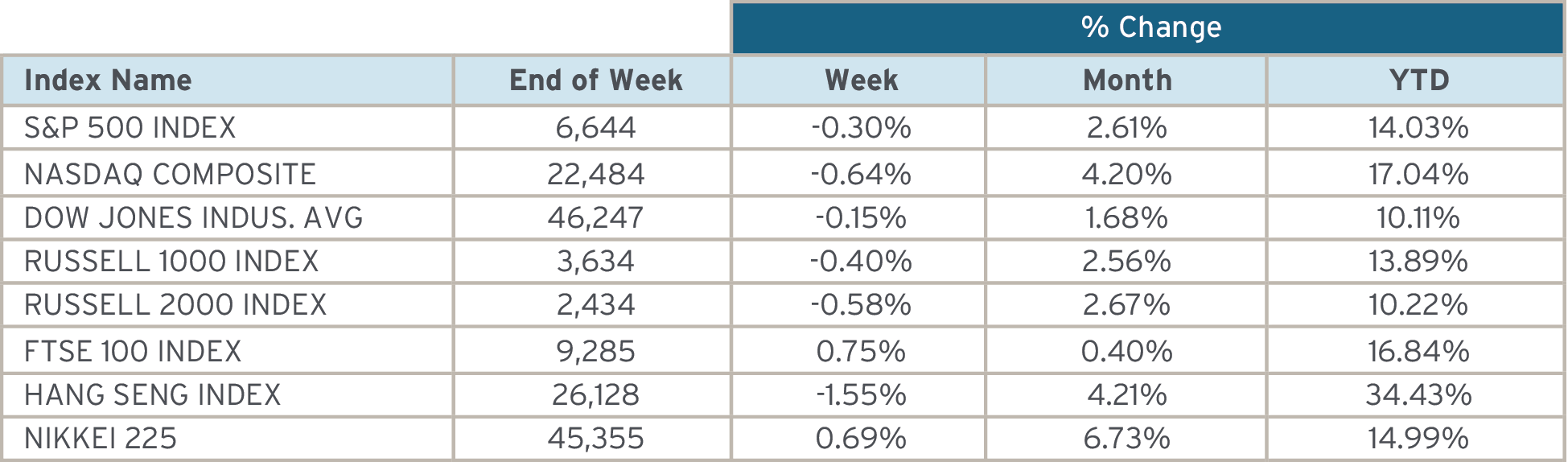
- Growth Momentum Building. The U.S. economy continues to show surprising strength. After putting up 3.8% GDP growth last quarter, tracking estimates for Q3 have already edged higher to 3.9%. What’s important here is the quality of this growth. Rather than being fueled by excess liquidity or unsustainable stimulus, the gains are being driven by broad demand across sectors. That kind of expansion translates into healthier earnings, with EPS set to rise double-digits this year. Revenues should grow mid-single-digits, and margin expansion is adding to the upside. In our view, this combination is one of the strongest signals for equity investors as it shows that companies are not only selling more but doing so more profitably.
- Consumers Driving the Engine. Last week’s data provided yet another reminder that the consumer remains the backbone of this expansion. Weekly claims came down, keeping the four-week moving average steady at 237K. This is well contained and shows that layoffs remain limited even as the labor market finds a new equilibrium. On top of that, personal spending rose 5.5% year-over-year, underscoring that households are still willing and able to open their wallets. Importantly, income growth is keeping pace, and wages are up 4.6% year-over-year[1], which not only supports spending but also helps offset inflationary pressures.
Durable goods orders accelerated, rising 5.4% year-over-year, with Boeing playing a standout role. Boeing’s resurgence supports both industrial demand and broader confidence in the aerospace cycle. Housing also showed striking resilience, with new home sales up 21% month-over-month and 15% year-over-year. What’s remarkable is that the economy is already growing around 3% without the full contribution of housing or autos. A recovery in either of these sectors would represent significant incremental upside, which keeps us bullish on their outlook.
- Banks Ready to Shine. We expect the next few weeks to be relatively quiet until October 14, when the third-quarter earnings season kicks off with financials. The setup for banks is strong. A steeper yield curve is supportive of higher net interest income and net interest margins, while capital markets activity remains robust, M&A volume has already reached $2.7 trillion year-to-date.[2] These dynamics should translate into strong earnings power across the sector.
The “Big Six” U.S. banks still have $192 billion of buybacks left on the table, which represents significant capital return potential. And importantly, we have yet to fully see the impact of deregulation, which could provide another boost to profitability and shareholder returns. For investors, banks offer not just cyclical upside but also structural tailwinds as the industry adapts to a stronger economy.
- Cash on the Sidelines, Credit Spreads Tight. Two additional dynamics should not be overlooked. First, there is roughly $7 trillion still sitting in money market funds.[3] Unlike last year, investors are no longer earning 5% on that cash, which makes equities relatively more attractive. Some of this liquidity is already moving into the market, creating a natural tailwind for stocks.
Second, credit spreads have tightened to levels not seen since 1998. This reflects confidence in corporate balance sheets and the overall economic outlook. Tight spreads signal that lenders see low default risk, which both supports financing activity and affirms the health of the credit markets. Together, these factors provide a stable foundation under equity valuations as we head into year-end.
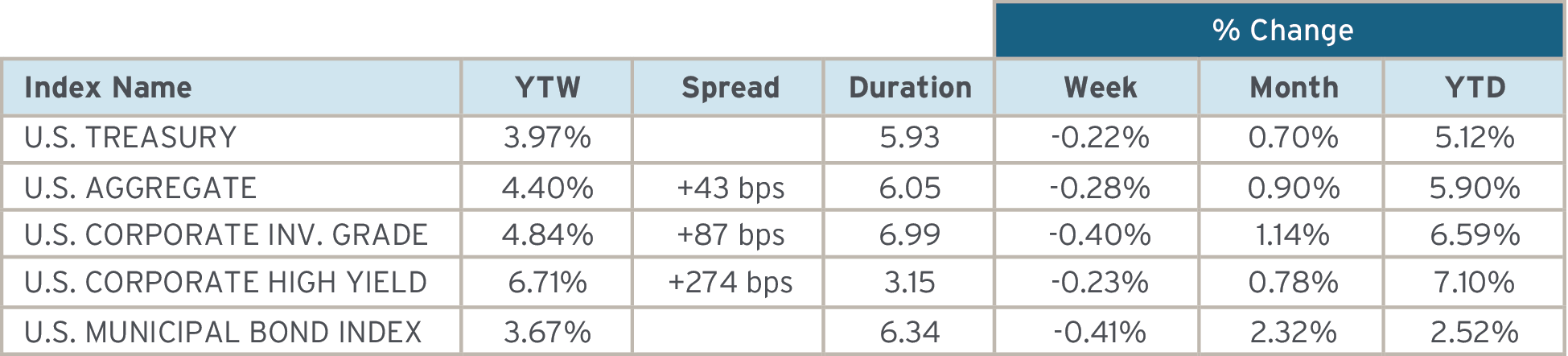
- Fixed Income. Last week, the U.S. Treasury yield curve experienced a modest bear flattening, driven by a PCE report that broadly met expectations, reinforcing the view that inflation remains sticky and tempering expectations for additional easing. By week’s end, the 2-year and 10-year yields rose by 2 & 6 basis points, respectively, while the 30-year yield remained unchanged.[4] Looking ahead, this week’s economic calendar includes ISM Manufacturing, JOLTS job openings, and September’s payrolls report; data that may help clarify if further rate cuts are required.
Investment-grade and high-yield spreads moved tighter last week. Investment-grade spreads tightened 1 basis point to +114, while high-yields also narrowed 1 basis point to +324. For the fourth consecutive week, U.S credit quality has improved as the main rating agencies issued 37 upgrades compared to 33 downgrades. The Technology sector led with the most upgrades, while the Consumer Discretionary sector had the most downgrades.
Tax-exempt yields sold off across the curve last week, given the confluence of elevated supply, thin reinvestment capital, and rising U.S. Treasury rates. By week’s end, the 2-, 5-, 10, and 30-year tax-exempt yields were higher by 23, 18, 7, and 5 basis points, respectively.
The Week Ahead.
Economics- Monday: Central Bank, Housing and Construction, Tuesday: Central Bank, Labor Market, Inflation, Wednesday: Industry Orders, Thursday: Payroll, Central Bank, Wages
Earnings –Monday: CCL, Tuesday: PAYX, LW, NKE, Wednesday: CAG
[1] Bureau of Labor Statistics, as of September 2025
[2] Bloomberg, as of September 2025
[3] FED, as of September 2025
[4] Bloomberg, as of September 2025
This material is for general information and educational purposes only. Information is based on data gathered from what we believe are reliable sources. It is not guaranteed as to accuracy, does not purport to be complete and is not intended to be used as a primary basis for investment decisions.
Find answers to your questions about Hightower Signature Wealth
Hightower Signature Wealth is a fiduciary wealth management practice that provides investment management, financial planning, estate strategies, insurance, and banking solutions. We work with families, business owners, professionals, women, and retirees across more than 40 offices nationwide. Our advisors take the time to understand your financial priorities, develop a plan around your goals, and adjust that plan as your life and circumstances evolve.
Hightower Signature Wealth provides a broad range of wealth management services designed to address different aspects of your financial life. Our capabilities include investment management, financial planning, retirement planning, estate strategies, insurance and risk management, banking solutions, and charitable giving strategies. By considering these areas together, our advisors can develop a coordinated approach based on your goals, priorities, financial circumstances, and plans for the future.
Hightower Signature Wealth advisors work with a broad range of clients, including women, families, business owners, professionals, retirees, and high-net-worth individuals navigating major life or financial transitions. Rather than applying a generic playbook, each advisor tailors the plan to a client’s specific goals and current stage of life – from early-career decisions to multigenerational wealth transfer.
Yes. Hightower Signature Wealth advisors serve as fiduciaries, which means they are committed to acting in their clients’ interests when providing investment advice. We offer fee-based advisory services, with fees depending on the services provided and the specifics of your relationship. Your advisor will discuss the applicable fee structure with you so you can understand how you are charged and what services are included.
Hightower Signature Wealth has more than 40 offices nationwide, allowing our advisors to serve individuals, families, and organizations across the country. Depending on your location and preferences, you may be able to work with an advisor locally or connect with a team in another market. Visit our Locations page to explore our office locations, learn more about the teams in each market, and find an office near you.
Getting started with Hightower Signature Wealth is simple. Complete our online contact form with some basic information about yourself and what you are looking for, and we’ll connect you with an advisor who can discuss your needs and financial priorities. That initial conversation is an opportunity to learn more about our approach, ask questions, and determine whether working with a Hightower Signature Wealth advisor may be a good fit.
Your first conversation is an opportunity for us to learn more about you, your financial circumstances, and what you hope to accomplish. An advisor may ask about your goals, current investments, family considerations, business interests, and other priorities that could influence your financial plan. You’ll also have an opportunity to ask questions, learn about our approach, and discuss what working together could look like.