Market Note / Special Edition: Quantum Computing Breakthrough
- Quantum Computing Making Headlines Quantum computing is back in the headlines this week, with IBM making news across financial markets. With investor attention on this fast-moving space, we’re dedicating this newsletter to explaining what quantum computing is, why it matters, and why IBM is leading the charge.

Photo of a Quantum Computer[1]
- Quantum Computing Explained Quantum computing represents an advancement beyond the most powerful supercomputers we have today. The difference lies in how these machines process information.
Traditional computers use binary code (1’s and 0’s) to process and calculate data. To solve a problem, computers calculate lines of binary code one by one. While each calculation may take a few milliseconds, for problems like sorting large databases, these individual calculations add up, resulting in long computation times.
Quantum computers, on the other hand, use qubits (quantum bits) instead of binary bits. A qubit is different as it can be both 1 and 0 at the same time. This allows quantum computers to perform hundreds of calculations simultaneously, performing the same calculation as normal computers in a fraction of the time.
The technology for quantum computing is not theoretical. Quantum processors have been in development for decades and currently exist with setups resembling golden chandeliers. For readers interested in diving deeper into this technology, IBM has an excellent article explaining quantum computing here.
- HSBC and IBM’s Breakthrough in Finance. On Thursday, the market saw a demonstration of quantum’s market impact with HSBC announcing a world-first deployment of quantum computing in financial markets. Using IBM’s most advanced Heron quantum processor, HSBC applied quantum processing to European bond trading data, producing a 34% improvement in predicting the price of a traded bond.
This marks the first time a bank has used real trades at scale to show quantum’s edge. By proving that quantum can enhance efficiency in bond trading and over-the-counter markets, HSBC’s project signals the start of a flurry of adoption across financial services. The market reaction was immediate: IBM shares surged 5% following the announcement, highlighting investor confidence in its leadership and the real-world potential of quantum computing.
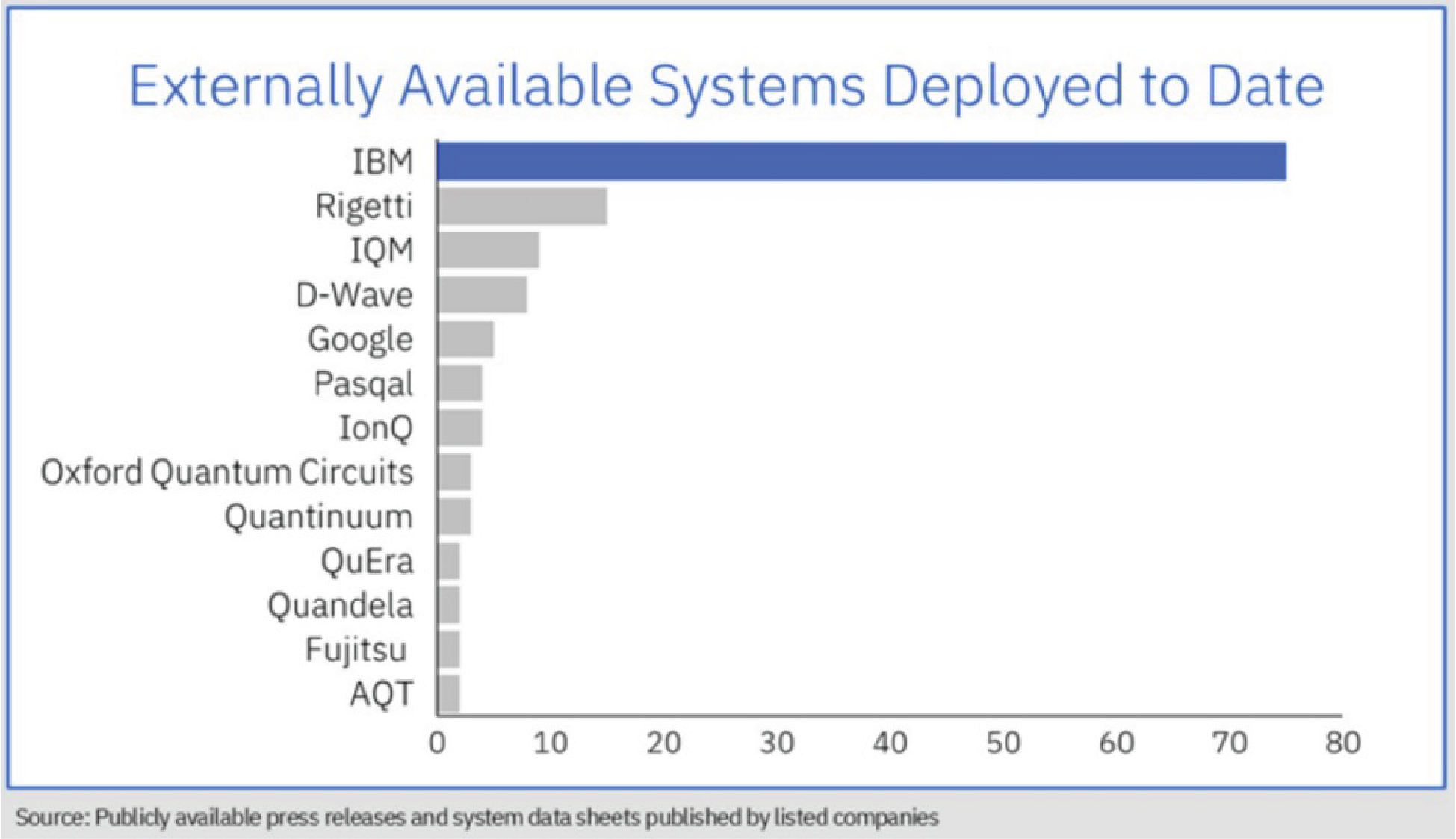
- IBM’s Quantum Leadership. At the center of quantum development is IBM, which has established itself as the industry leader. The company currently has 75 quantum computers in production, more than all competitors combined.
IBM’s strategy is crystal clear: build the dominant quantum platform. Through its Qiskit software, IBM is aiming to make Qiskit the predominant quantum software standard. Already deployed worldwide, Qiskit is being seeded in universities so that the next generation of engineers learns to code in Qiskit, a deliberate effort to lock in ecosystem leadership.
The firm’s long-term vision includes the IBM Quantum Data Center and IBM Quantum Client System, establishing an end-to-end stack where companies can build, run, and scale applications on IBM’s quantum backbone. In essence, IBM isn’t just building computers. It’s building the operating system and infrastructure for the quantum era.
Graph 1: IBM Quantum Computing Deployed Systems[2]
- Market Potential and Momentum IBM estimates the total addressable market for quantum computing to reach $1.3 trillion by 2036. The company already boasts hundreds of use cases across industries, from financial services (market simulations, fraud detection) to energy efficiency, utilities, solar, battery technology, healthcare, and drug discovery. IBM has already eclipsed $1 billion in bookings and signings since quantum commercialization began in 2017. While large-scale commercial use will take years to unfold, the trajectory is clear. Just as AI reshaped markets over the past decade, we expect quantum computing to do the same, being a strong theme of growth for the future.
[1] New York Times
[2] IBM, as of February 2025
This material is for general information and educational purposes only. Information is based on data gathered from what we believe are reliable sources. It is not guaranteed as to accuracy, does not purport to be complete and is not intended to be used as a primary basis for investment decisions.
Find answers to your questions about Hightower Signature Wealth
Hightower Signature Wealth is a fiduciary wealth management practice that provides investment management, financial planning, estate strategies, insurance, and banking solutions. We work with families, business owners, professionals, women, and retirees across more than 40 offices nationwide. Our advisors take the time to understand your financial priorities, develop a plan around your goals, and adjust that plan as your life and circumstances evolve.
Hightower Signature Wealth provides a broad range of wealth management services designed to address different aspects of your financial life. Our capabilities include investment management, financial planning, retirement planning, estate strategies, insurance and risk management, banking solutions, and charitable giving strategies. By considering these areas together, our advisors can develop a coordinated approach based on your goals, priorities, financial circumstances, and plans for the future.
Hightower Signature Wealth advisors work with a broad range of clients, including women, families, business owners, professionals, retirees, and high-net-worth individuals navigating major life or financial transitions. Rather than applying a generic playbook, each advisor tailors the plan to a client’s specific goals and current stage of life – from early-career decisions to multigenerational wealth transfer.
Yes. Hightower Signature Wealth advisors serve as fiduciaries, which means they are committed to acting in their clients’ interests when providing investment advice. We offer fee-based advisory services, with fees depending on the services provided and the specifics of your relationship. Your advisor will discuss the applicable fee structure with you so you can understand how you are charged and what services are included.
Hightower Signature Wealth has more than 40 offices nationwide, allowing our advisors to serve individuals, families, and organizations across the country. Depending on your location and preferences, you may be able to work with an advisor locally or connect with a team in another market. Visit our Locations page to explore our office locations, learn more about the teams in each market, and find an office near you.
Getting started with Hightower Signature Wealth is simple. Complete our online contact form with some basic information about yourself and what you are looking for, and we’ll connect you with an advisor who can discuss your needs and financial priorities. That initial conversation is an opportunity to learn more about our approach, ask questions, and determine whether working with a Hightower Signature Wealth advisor may be a good fit.
Your first conversation is an opportunity for us to learn more about you, your financial circumstances, and what you hope to accomplish. An advisor may ask about your goals, current investments, family considerations, business interests, and other priorities that could influence your financial plan. You’ll also have an opportunity to ask questions, learn about our approach, and discuss what working together could look like.