Market Note: Resilient Consumers, Market Highs, and Fed Anticipation
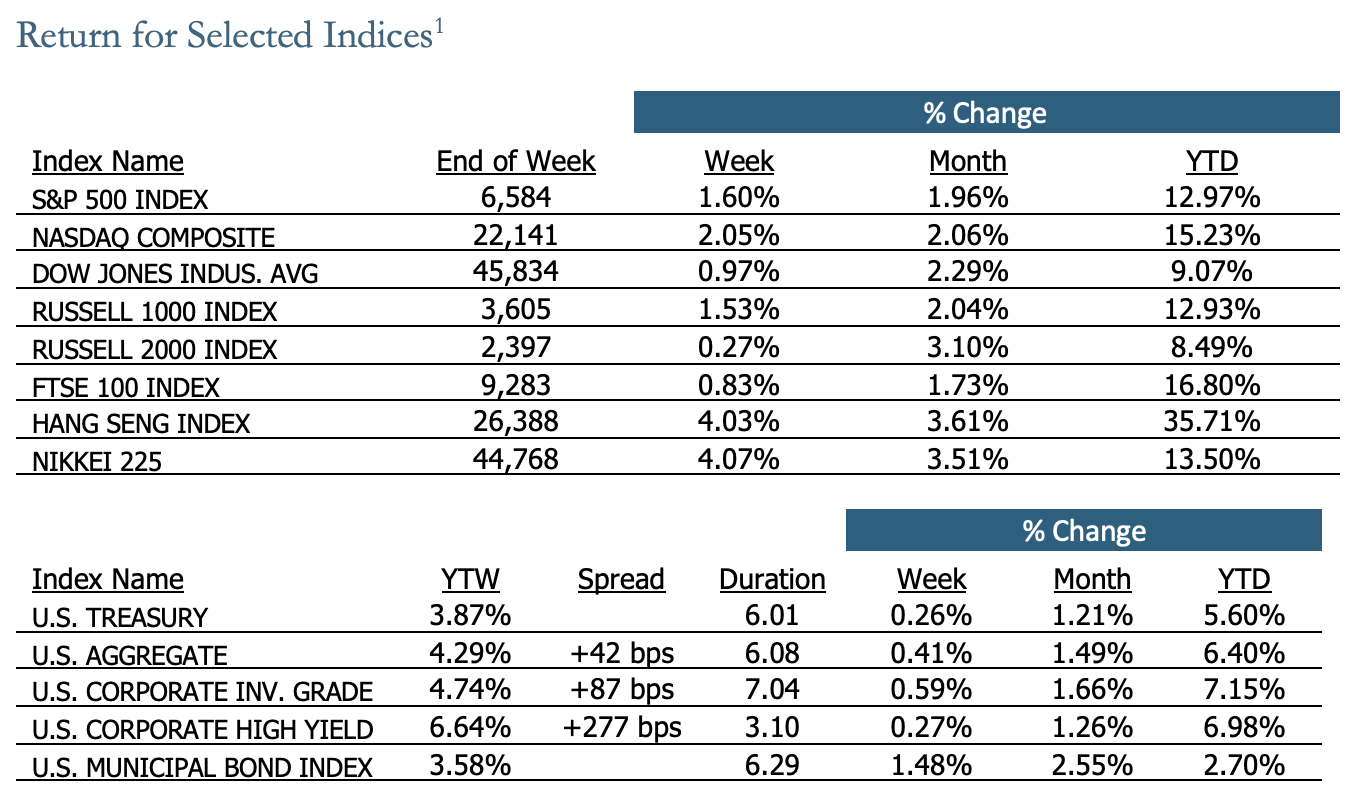
- Markets Continue to Reach Record Highs U.S. equity markets have continued their ascent, now up 33% from the lows in April. This powerful rally reflects the resilience of the U.S. economy, which has grown 2.5–3% despite tariffs, inflation volatility, and policy uncertainty. Corporate fundamentals remain robust, with companies investing in growth, repurchasing stock, and raising dividends, all reinforcing shareholder value. Confidence among management teams remains high, supported by an accommodative Federal Reserve. Markets are pricing in multiple rate cuts through the remainder of 2025, which historically creates a favorable environment for equities, housing, and credit-sensitive sectors.
- Consumer Resilience Drives Growth The strength of the U.S. consumer continues to underpin economic expansion. Credit card and auto lending growth remain robust, with Bank of America reporting card spending up roughly 4.5% year-over-year, accelerating from last year, and Wells Fargo noting continued strong consumer activity and declining delinquency rates. Restaurants, hotels, and airports are all experiencing high occupancy and activity levels, reflecting sustained services demand. Wage growth of around 5% supports ongoing consumption, even as the labor market slows modestly. Home prices, household balances, and wealth indicators remain healthy, and there is no evidence of meaningful weakness in consumer behavior.
Portfolio optimization across banks continues. Prime auto and mortgage exposures are being selectively dialed back, while specialty finance, corporate, and commercial lending remain growth areas. Truist anticipates low single-digit loan growth for 2025, with disciplined asset-liability management supporting net interest income increases of 2–3% for the year. Across the sector, credit quality is strong, with charge-offs trending low and consumer portfolios heavily weighted toward prime borrowers.
- Banks’ Earnings Strength and M&A Opportunities Bank executives highlighted continued strength in investment banking and trading. Fee income recovered in Q2 and is expected to grow in the second half of the year. Bank of America projects 10–15% growth in investment banking fees, while global markets have achieved 14 consecutive quarters of year-over-year revenue growth. M&A activity is accelerating, supported by a multi-year backlog of transactions and a recovering IPO market.
Morgan Stanley emphasized that IPOs since May and June have improved execution certainty, encouraging dealmaking across corporate and private equity clients. The sector’s efficiency gains, combined with operating leverage of 50–150 basis points and disciplined expense management, reinforce banks’ ability to capture both organic and strategic growth opportunities.
- Housing, Auto, and Fed Policy Tailwinds The Federal Reserve is widely expected to deliver its first 25-basis-point rate cut of the cycle next week, setting the stage for a multi-cut easing cycle through 2026. This pivot represents a significant shift from years of restrictive policy and opens the door for renewed momentum in rate-sensitive sectors like housing, autos, and consumer credit. While investors have grown accustomed to tight financial conditions, early Fed cuts in a period of economic strength historically extend market cycles, and the current backdrop points toward opportunity rather than contraction.
Housing stands out as a particularly powerful driver of cyclical renewal. Years of elevated rates have created a pause in housing turnover, with Home Depot noting that turnover is at a 40-year low, even as home prices continue to rise on constrained supply. Lowe’s provided additional context stating roughly 90% of its customers either own homes outright or carry mortgages under 4%, a dynamic that has delayed, rather than eliminated, home-related projects. With mortgage rates moving closer to 6% or lower, a surge in demand could be unlocked, setting the stage for a broad-based housing recovery. Both Lowe’s and Home Depot are actively positioning to capture this demand when it materializes.
The auto sector is also poised for revival as financing conditions ease. Promotional financing offers are starting to return, and manufacturers are regaining pricing power amid improving supply chain dynamics. The Fed’s shift will amplify these dynamics, with lower rates expected to fuel auto and housing demand, expand lending opportunities, and strengthen overall credit performance, which remains strong according to conference commentary from all major banks. These developments collectively illustrate the cyclical opportunity embedded in today’s market. After years of suppressed activity, even modest interest rate relief could unleash a wave of housing turnover, construction demand, and auto purchases.
- Global Recovery and Consumer Insights Global growth is providing additional tailwinds for consumer-facing companies. Asian economies, particularly Japan and China, are showing renewed momentum. Estee Lauder highlighted that Tom Ford was a key driver of share gains in the region, with trends stabilizing and consumer sentiment improving. Other consumer companies like Nike, Starbucks, and Las Vegas Sands all report improving conditions in China, signaling a return to growth. Elsewhere in Asia, Japan remains strong while other countries show moderation.
- Fixed Income The U.S. Treasury curve flattened last week as short-term yields rose while longer maturities rallied. The 2-year yield increased by 5 basis points, whereas the 10- & 30-year yields declined by 1 and 8 basis points, respectively. This week’s economic and policy calendar is dense, offering several key data releases that could shape expectations for the remainder of the year. Economic data releases include Retail Sales on Tuesday, housing starts and permits on Wednesday, and Initial Jobless claims on Thursday. Looking at policy, on Wednesday we get September’s FOMC rate decision, in which market participants fully expect a 25-basis-point cut.
Credit markets posted constructive total return gains on the back of lower rates in the belly and long end of the curve. Investment-grade spreads tightened 3 basis points to +118, while high-yield spreads narrowed 7 basis points to + 335. Concurrently, U.S. credit quality improved as the main rating agencies issued 33 upgrades and 24 downgrades. The Consumer Discretionary sector led with the most upgrades, while the Industrial sector had the most downgrades.
Tax-exempt yields rallied across the curve last week, finishing lower by 8-22 basis points, respectively. This week’s tax-exempt issuance is expected to dip relative to recent Fed weeks with just $4.4 billion in expected issuance. This would represent just half of the average tax-exempt issuance relative to the past five Fed-weeks.
The Week Ahead
Economics- Tuesday: Retail Sales, Capacity, Industrial Production, Housing Market, Export/Import Prices, Wednesday: FOMC, Housing Construction, Thursday: Initial Claims, Friday: Central Bank,
Earnings –Wednesday: GIS, Thursday: DRI, FDS, FDX, Friday: LEN,
This material is for general information and educational purposes only. Information is based on data gathered from what we believe are reliable sources. It is not guaranteed as to accuracy, does not purport to be complete and is not intended to be used as a primary basis for investment decisions.
Find answers to your questions about Hightower Signature Wealth
Hightower Signature Wealth is a fiduciary wealth management practice that provides investment management, financial planning, estate strategies, insurance, and banking solutions. We work with families, business owners, professionals, women, and retirees across more than 40 offices nationwide. Our advisors take the time to understand your financial priorities, develop a plan around your goals, and adjust that plan as your life and circumstances evolve.
Hightower Signature Wealth provides a broad range of wealth management services designed to address different aspects of your financial life. Our capabilities include investment management, financial planning, retirement planning, estate strategies, insurance and risk management, banking solutions, and charitable giving strategies. By considering these areas together, our advisors can develop a coordinated approach based on your goals, priorities, financial circumstances, and plans for the future.
Hightower Signature Wealth advisors work with a broad range of clients, including women, families, business owners, professionals, retirees, and high-net-worth individuals navigating major life or financial transitions. Rather than applying a generic playbook, each advisor tailors the plan to a client’s specific goals and current stage of life – from early-career decisions to multigenerational wealth transfer.
Yes. Hightower Signature Wealth advisors serve as fiduciaries, which means they are committed to acting in their clients’ interests when providing investment advice. We offer fee-based advisory services, with fees depending on the services provided and the specifics of your relationship. Your advisor will discuss the applicable fee structure with you so you can understand how you are charged and what services are included.
Hightower Signature Wealth has more than 40 offices nationwide, allowing our advisors to serve individuals, families, and organizations across the country. Depending on your location and preferences, you may be able to work with an advisor locally or connect with a team in another market. Visit our Locations page to explore our office locations, learn more about the teams in each market, and find an office near you.
Getting started with Hightower Signature Wealth is simple. Complete our online contact form with some basic information about yourself and what you are looking for, and we’ll connect you with an advisor who can discuss your needs and financial priorities. That initial conversation is an opportunity to learn more about our approach, ask questions, and determine whether working with a Hightower Signature Wealth advisor may be a good fit.
Your first conversation is an opportunity for us to learn more about you, your financial circumstances, and what you hope to accomplish. An advisor may ask about your goals, current investments, family considerations, business interests, and other priorities that could influence your financial plan. You’ll also have an opportunity to ask questions, learn about our approach, and discuss what working together could look like.