Aligning Your Estate Plan with Your Legacy Goals
Imagine an estate plan as the blueprint for your legacy. Without careful alignment, even the most well-intentioned plans can fall short of truly representing your wishes. We believe that your estate plan should be a direct reflection of your life’s work and your deepest convictions, designed to secure your family’s future, support causes you cherish, and honor the legacy you’ve built.
Oftentimes, estate planning is viewed merely as a technical process of distributing assets. While crucial, it’s so much more. It’s about empowering you to dictate your terms, ensuring your values are upheld, and your loved ones are protected according to your vision. It’s the strategic framework that transforms your wishes into reality, providing clarity and assurance for you and those who matter most.
Your life’s journey is unique, filled with experiences, values, and aspirations that define who you are. As you build your life, you’re not just accumulating assets; you’re cultivating a personal legacy – the lasting impact you wish to leave on your loved ones and the world. But how do you ensure that this legacy, carefully crafted over years, continues to thrive and reflect your deepest desires long after you’re gone? The answer lies in thoughtful estate planning.
Planning Checklist
- REVIEW YOUR EXISTING PLAN: When was the last time you looked at your overall plan? Life is constantly evolving, and significant events such as marriage, divorce, birth, relocation, or major financial change can render parts of your plan outdated or misaligned with your current goals. Have there been any life events that require some updates? If so, take the time to work with your advisory team to review your plan holistically and make appropriate changes.
Ask yourself:
- Do I understand how my estate plan will work?
- How old is my estate plan? Have I outgrown it?Do I have a digital estate plan?Are the right people in charge?
- If I have a trust, is it funded?
- REVIEW YOUR HOLDINGS: Work with your advisor to truly understand your net worth, take the time to inventory your assets, and get valuations on items of significant value. Understanding the value and cost basis of your assets will position you to take advantage of strategic gifting opportunities.
- REVIEW YOUR DESIGNATED ASSETS: All designated assets, such as IRAs and life insurance policies, will pass based on the designations you have on file. These assets do not pass via your will or revocable trust unless you have designated your trust as the beneficiary. It’s essential to review these designations so they align with your overall estate plan. Discuss the pros and cons of your current plan with your advisory team and make necessary changes.
Foundational Planning Considerations
- LAST WILL AND TESTAMENT: A legal document that outlines your intentions for the distribution of your assets following your death. Additionally, a Will plays a critical role in naming guardians for minor children, if applicable, helping ensure their care and upbringing are managed to your wishes. Without a Will, your estate will be distributed according to state law (intestate succession), which may not align with your intentions. This can potentially lead to disputes among heirs or leave important decisions – such as guardianship of your children – in the hands of the court.
- REVOCABLE TRUST: A legal entity — often referred to as a “Living Trust” — that holds your assets during your lifetime. As the grantor, you typically serve as the initial trustee and retain full control over the trust’s assets. The term “revocable” indicates you can modify or dissolve the trust at any time while you are alive and competent. Upon your death, a successor trustee manages and distributes the assets held within the trust according to your instructions, bypassing the often lengthy and public probate process. A revocable trust offers privacy, removes probate-related delays and expenses, and provides a mechanism for continuous asset management in the event of incapacity. It also offers flexibility, allowing your estate plan to evolve with changing life circumstances.
- DURABLE POWER OF ATTORNEY (DPOA): A legal document that grants a designated agent (your “attorney-in-fact”) the authority to make financial and legal decisions on your behalf. “Durable” means the power remains effective even if you become incapacitated and unable to make decisions for yourself. This document covers a wide range of financial matters, including paying bills, managing investments, handling real estate transactions, and filing taxes.
- MEDICAL POWER OF ATTORNEY (MPOA): Also known as a Healthcare Power of Attorney, it is a legal document that designates a trusted individual (your “agent” or “healthcare proxy”) to make healthcare decisions for you if you become unable to do so yourself. This includes decisions about medical treatments, surgeries, medications, and other healthcare interventions. Establishing a Medical Power of Attorney helps ensure that the trusted individual is empowered to act in accordance with your preferences during critical health events, reducing the risk of delays in care, avoiding potential conflicts amongst family members, and eliminating court involvement.
- HIPAA AUTHORIZATION FORM: A document that grants specific individuals, typically family members or trusted advisors, permission to access your Protected Health Information (PHI). Without this authorization, healthcare providers are legally prohibited from disclosing your medical records or discussing your condition with anyone. This restriction applies even to immediate family members, due to federal privacy regulations under the Health Insurance Portability and Accountability Act (HIPAA).
- BENEFICIARY DESIGNATIONS: Critical instructions associated with financial accounts and policies – life insurance policies, retirement accounts (e.g., 401(k)s, IRAs), and annuities – that specify who will receive the assets directly upon your death. They hold considerable legal authority, often overriding provisions in a Will or Trust, and facilitate the direct transfer of assets to named beneficiaries, bypassing the probate process. It is crucial to review and update beneficiary designations regularly, particularly following life events such as marriage, divorce, or birth of a child. Doing so helps ensure asset distribution aligns with the intended estate plan.
Advanced Estate Planning Considerations
- LIFETIME GIFTING: Gifting during your lifetime is a powerful estate planning strategy that not only reduces the size of your taxable estate but also removes future appreciation of the gifted asset. Gifts may take various forms, including outright gifting, funding trusts, or funding education accounts. The nature of the gift can significantly have a long-term impact. In addition to cash or marketable securities, individuals may choose to gift interest in privately held businesses or family limited partnerships, taking advantage of discounts or anticipated appreciation. The annual exclusion is the amount you may give per individual over the course of the year that does not take away from your lifetime exemption. For 2026, an individual can give $19,000, and this doubles for a married couple, allowing them to give $38,000.
- IRREVOCABLE LIFE INSURANCE TRUST (ILIT): This strategy allows the trust to serve as both the owner and beneficiary of a life insurance policy. This strategy allows the death benefit to pass outside of the insured’s taxable estate. Upon the insured’s death, the insurance payout is paid into the trust and distributed as directed by the trust agreement, providing control over how and when beneficiaries access the funds.

- SPOUSAL LIFETIME ACCESS TRUST (SLAT): Irrevocable trust strategy which allows one spouse (the donor spouse) to make a gift of property for the benefit of the other spouse and other beneficiaries such as children. The trust is intentionally designed so that the gift does not qualify for the unlimited marital deduction. This approach allows the donor spouse to use their lifetime estate tax exemption, which removes the future growth on those assets from their taxable estate. SLATs are often used to reduce estate taxes while still giving the couple indirect access to the assets, since the beneficiary spouse can receive distributions from the trust if needed.

- INTENTIONALLY DEFECTIVE GRANTOR TRUSTS (IDGT): An Intentionally Defective Grantor Trust is an irrevocable trust used to freeze assets for estate tax purposes but not income tax purposes. The income tax liability generated in the trust is passed down to the grantor. This type of trust can help minimize estate and gift tax liability. While the trust is irrevocable, its grantor trust status provides more flexibility, such as the ability to substitute assets.
- CHARITABLE GIFTING: Take the time to review how you are fulfilling your philanthropic goals and consider a different avenue of philanthropy. Consider how you can make a larger impact in the way you give.
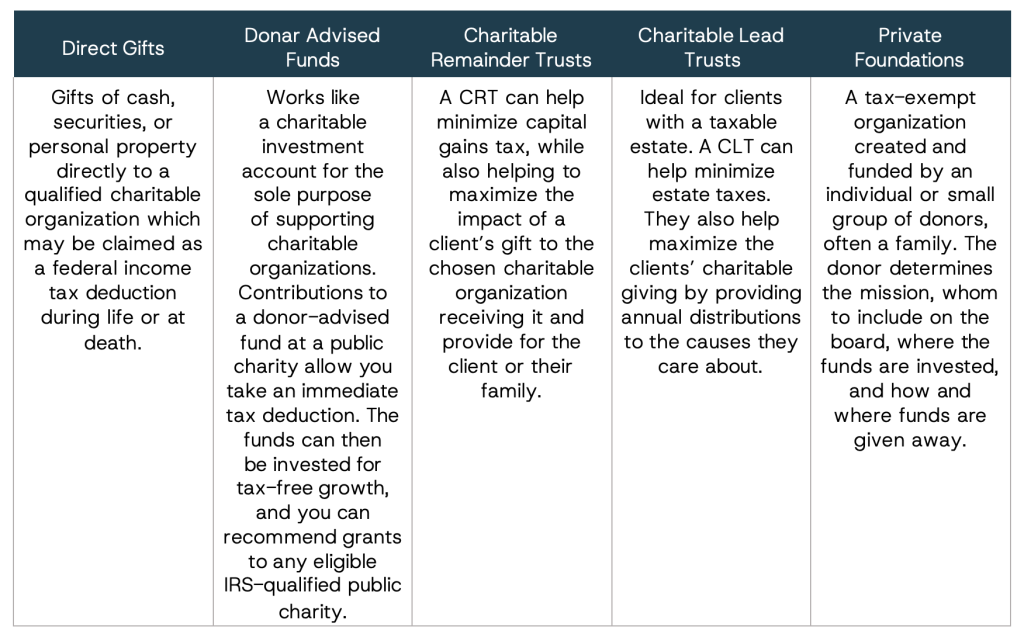
While procrastination may tempt you to postpone estate planning, delays often come at a cost. Proactive planning allows you to stay ahead of evolving laws, life changes, and opportunities to better protect your legacy. Engage with your advisory team and take meaningful steps toward building a comprehensive estate plan that truly reflects your long-term goals.
This material is for general information and educational purposes only. Information is based on data gathered from what we believe are reliable sources. It is not guaranteed as to accuracy, does not purport to be complete and is not intended to be used as a primary basis for investment decisions.
Find answers to your questions about Hightower Signature Wealth
Hightower Signature Wealth is a fiduciary wealth management practice that provides investment management, financial planning, estate strategies, insurance, and banking solutions. We work with families, business owners, professionals, women, and retirees across more than 40 offices nationwide. Our advisors take the time to understand your financial priorities, develop a plan around your goals, and adjust that plan as your life and circumstances evolve.
Hightower Signature Wealth provides a broad range of wealth management services designed to address different aspects of your financial life. Our capabilities include investment management, financial planning, retirement planning, estate strategies, insurance and risk management, banking solutions, and charitable giving strategies. By considering these areas together, our advisors can develop a coordinated approach based on your goals, priorities, financial circumstances, and plans for the future.
Hightower Signature Wealth advisors work with a broad range of clients, including women, families, business owners, professionals, retirees, and high-net-worth individuals navigating major life or financial transitions. Rather than applying a generic playbook, each advisor tailors the plan to a client’s specific goals and current stage of life – from early-career decisions to multigenerational wealth transfer.
Yes. Hightower Signature Wealth advisors serve as fiduciaries, which means they are committed to acting in their clients’ interests when providing investment advice. We offer fee-based advisory services, with fees depending on the services provided and the specifics of your relationship. Your advisor will discuss the applicable fee structure with you so you can understand how you are charged and what services are included.
Hightower Signature Wealth has more than 40 offices nationwide, allowing our advisors to serve individuals, families, and organizations across the country. Depending on your location and preferences, you may be able to work with an advisor locally or connect with a team in another market. Visit our Locations page to explore our office locations, learn more about the teams in each market, and find an office near you.
Getting started with Hightower Signature Wealth is simple. Complete our online contact form with some basic information about yourself and what you are looking for, and we’ll connect you with an advisor who can discuss your needs and financial priorities. That initial conversation is an opportunity to learn more about our approach, ask questions, and determine whether working with a Hightower Signature Wealth advisor may be a good fit.
Your first conversation is an opportunity for us to learn more about you, your financial circumstances, and what you hope to accomplish. An advisor may ask about your goals, current investments, family considerations, business interests, and other priorities that could influence your financial plan. You’ll also have an opportunity to ask questions, learn about our approach, and discuss what working together could look like.