Weekly Wisdom: Leveraging Deregulation for Long Term Appreciation
Public Banks Strength Against Private Credit Headlines
The narrative surrounding stress in private credit has created a “guilt by association” drag on the financials sector, yet the data tells a story of immense public bank strength. Isolated issues at firms like Tricolor, First Brands Group, and 777 Partners along with overexposure in volatile sectors like software highlight underwriting failures in niche areas, but they do not signal a systemic crisis. For those interested, we provided a technical breakdown and commentary of these current developments in our Private Credit Update. In contrast, the U.S. Big Six banks are currently operating from a position of power with stronger underwriting standards and improved risk controls compared to prior cycles. These institutions hold approximately $170 billion in excess capital, a surplus expected to approach $200 billion in the near term.1 While private market vehicles grapple with transparency and liquidity concerns, major public banks are benefiting from diversified revenue streams and disciplined processes.
Unleashing Bank Capital Through Deregulation
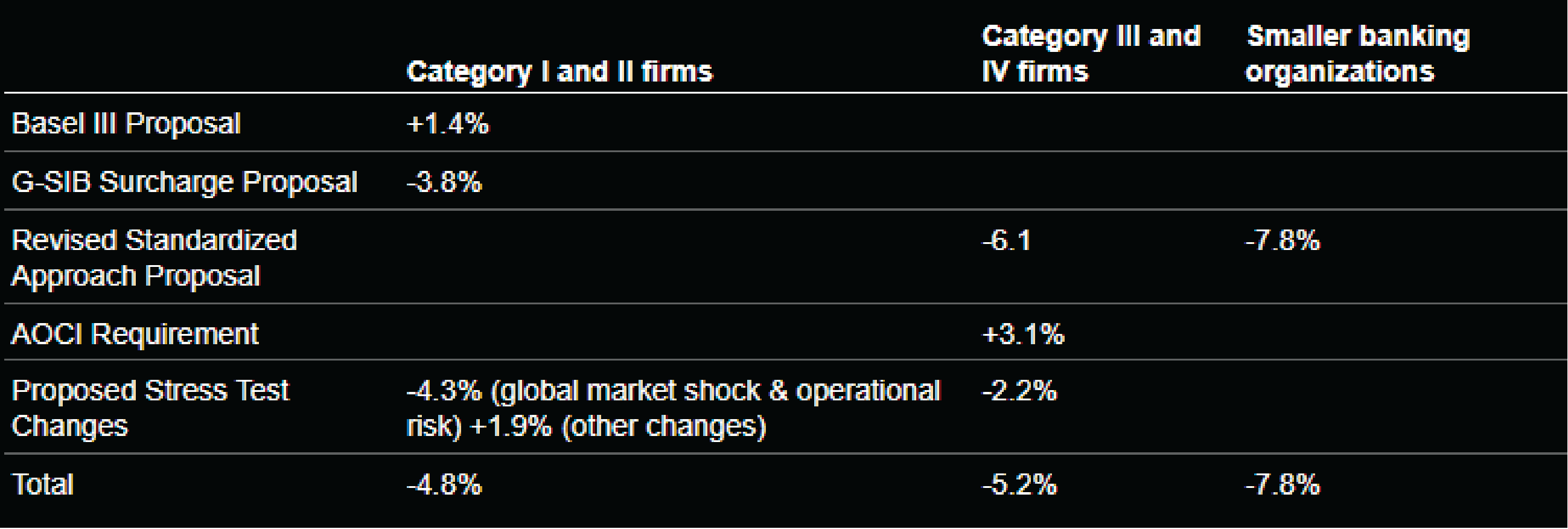
A transformative shift in the regulatory landscape has emerged as U.S. regulators unveiled plans to significantly ease capital requirements for the nation’s largest lending giants. This strategic pivot is expected to result in a 4.8% aggregate decrease in common equity tier 1 capital for big banks, with some smaller institutions seeing cuts as high as 7.8%.2 By streamlining the supplementary leverage ratio and reducing capital constraints, this deregulation is designed to unleash billions of dollars for new lending, share buybacks, and increased dividends. Furthermore, this move is pressuring European regulators to loosen their own frameworks, which requires banks to maintain 8% capital, to preserve global competitiveness.3 For investors, this represents a significant removal of growth barriers, allowing traditional lenders to compete more effectively with non-bank entities and private credit.
Proposed Capital Requirements Impacts Chart4
Fed Stability and Confidence Amid Transitory Shocks
The Federal Reserve maintained the federal funds rate at 3.5%–3.75% during its March meeting, a decision that reflects a balanced approach to current global uncertainties.5 While the conflict in the Middle East and the resulting energy shock have pushed 2026 PCE expectations up to 2.7%, the Fed has signaled that these pressures are largely transitory and expected to come back down next year. The Fed continues to project a rate cut this year, and a growing appetite for easing is evidenced by Stephen Miran’s dissent in favor of an immediate 25-basis-point cut (projecting 100 bps of easing this year).6 We believe the Fed’s outlook suggests a near-term inflation shock rather than a long-term trend, which eventually supports more stimulative rates and provides a powerful tailwind for bank valuations.
While recent employment figures have shown signs of cooling, the broader economic foundation remains remarkably firm. Federal Reserve officials additionally noted that the unemployment rate has remained minimally impacted by the conflict in Iran, with projections suggesting it will settle between 4.2% and 4.4% by the end of 2026.7 Despite a slight uptick in caution, policymakers actually upgraded their 2026 GDP growth outlook to 2.4%. For the financial sector, this environment is ideal: growth is steady enough to support loan demand and healthy credit quality, yet the labor market is not overheating in a way that would force aggressive, restrictive policy. We view the current stabilization as a positive scenario that supports a long-term expansionary cycle for financial institutions.
Positioned for Strength
The convergence of regulatory relief and macroeconomic resilience creates a favorable backdrop for the financial sector. Between the substantial capital tailwinds provided by the Basel III recalibration and a Federal Reserve that views current geopolitical inflationary pressures as transitory, the path forward for traditional lenders is increasingly clear. Ultimately, as short-term uncertainties regarding the Middle East transition into known quantities and the focus shifts back to pro-growth deregulation and rate normalization, we believe the financial sector is exceptionally well-positioned to drive the next leg of market appreciation.
Stephanie Link’s TV Schedule

[1] UBS Analyst Note: as of March 23, 2026
[2] Bloomberg News: as of March 19, 2026
[3] Politico, as of March 23, 2026
[4] Bloomberg News: as of March 19, 2026
[5] Bloomberg, as of March 18, 2026
[6] Associated Press, as of March 19, 2026
[7] Associated Press, as of March 19, 2026
This material is for general information and educational purposes only. Information is based on data gathered from what we believe are reliable sources. It is not guaranteed as to accuracy, does not purport to be complete and is not intended to be used as a primary basis for investment decisions.
Find answers to your questions about Hightower Signature Wealth
Hightower Signature Wealth is a fiduciary wealth management practice that provides investment management, financial planning, estate strategies, insurance, and banking solutions. We work with families, business owners, professionals, women, and retirees across more than 40 offices nationwide. Our advisors take the time to understand your financial priorities, develop a plan around your goals, and adjust that plan as your life and circumstances evolve.
Hightower Signature Wealth provides a broad range of wealth management services designed to address different aspects of your financial life. Our capabilities include investment management, financial planning, retirement planning, estate strategies, insurance and risk management, banking solutions, and charitable giving strategies. By considering these areas together, our advisors can develop a coordinated approach based on your goals, priorities, financial circumstances, and plans for the future.
Hightower Signature Wealth advisors work with a broad range of clients, including women, families, business owners, professionals, retirees, and high-net-worth individuals navigating major life or financial transitions. Rather than applying a generic playbook, each advisor tailors the plan to a client’s specific goals and current stage of life – from early-career decisions to multigenerational wealth transfer.
Yes. Hightower Signature Wealth advisors serve as fiduciaries, which means they are committed to acting in their clients’ interests when providing investment advice. We offer fee-based advisory services, with fees depending on the services provided and the specifics of your relationship. Your advisor will discuss the applicable fee structure with you so you can understand how you are charged and what services are included.
Hightower Signature Wealth has more than 40 offices nationwide, allowing our advisors to serve individuals, families, and organizations across the country. Depending on your location and preferences, you may be able to work with an advisor locally or connect with a team in another market. Visit our Locations page to explore our office locations, learn more about the teams in each market, and find an office near you.
Getting started with Hightower Signature Wealth is simple. Complete our online contact form with some basic information about yourself and what you are looking for, and we’ll connect you with an advisor who can discuss your needs and financial priorities. That initial conversation is an opportunity to learn more about our approach, ask questions, and determine whether working with a Hightower Signature Wealth advisor may be a good fit.
Your first conversation is an opportunity for us to learn more about you, your financial circumstances, and what you hope to accomplish. An advisor may ask about your goals, current investments, family considerations, business interests, and other priorities that could influence your financial plan. You’ll also have an opportunity to ask questions, learn about our approach, and discuss what working together could look like.