Frequently Asked Questions (FAQ) – November 2026
Dennis Stearns, CFP®, ChFC, MS
Wealth Advisor, Managing Director
Q: It seems that many companies on the front lines of Artificial Intelligence are up big and then down big, often in days. Do normal valuation measures still apply in this age of disruption?
A: Yes, they still apply, but AI is a massive trend and the magnification of ups and downs magnifies the normal valuation analysis. There is a reason why we call this AI boom a “rational bubble.” When there is huge demand and lofty expectations, stocks surge ahead and then fall back (sometimes a lot) when expectations adjust down, even a little bit. The trend can still be up and the stocks behind the trend can be down, at least temporarily.
The Nasdaq (home to many of the AI front line stocks) exchange just experienced another 10% correction. That’s the third 10% correction in 2026 alone and yet the index of growth stocks is still (as of press time) positive year to date.
Google’s recent drop of 11% in one week was a result of the not surprising news that when people Google some topic today, they focus on the AI explanation first and don’t click into as many of the sponsored ads, which is where Google makes a lot of its profit. This trend was well predicted, so why the “surprise” when it happens?
The answer is in Warren Buffet’s famous quote that the stock market (and individual stocks) are a voting machine short term and a weighing machine longer term. Short term, emotions get overly hot, either fear or greed. Longer term, the weight of actual results drives a stock more than emotions.
AI being one of the biggest trends in a generation (maybe ever – time will tell) makes the heat, or greed, hotter and the cold (fear) colder.
Google surged ahead earlier this year as Apple chose them to be their AI developer, and AI frenzy went into high gear. Several years ago, Google was the victim of too negative short-term emotions as it appeared the introduction of ChatGPT might torpedo Google’s own AI model and business plan.
Strip away every model, every variant, every complex spreadsheet of investing metrics, and the value of any company rests on 3 things.
1. The cash flows from revenues it already has. What does the existing business generate in free cash flow. As more of the big frontline AI companies borrow money to invest in AI, and free cash flow drops, the risk baked into #3 below increases.
2. The expected growth in those cash flows. How much more will it generate in the future, and for how long. If any of the existing cash flows look like they will grow less fast, the risk baked into #3 below increases.
3. The discount rate that reflects the risk in those cash flows. This is the key to recent volatility in the AI stocks. How confident are you that any of these variables trend positive? If you go from “very confident” to “sort of confident”, the future is discounted more creating downward moves in a stock. Discount rates can be affected by interest rates (negative lately), geopolitical issues (negative lately) and a variety of other economic issues (mostly positive, but some negative like the housing market and inflation).
Then layer on top other fears like whether the Blue Wave mid-term election results will slow down data center building, create more regulation for AI and slow down future profits. Perception is more risk and a higher discount rate is warranted even if a company is producing good revenue growth and profits. The sum of the fears creates a 10% plus correction. Additional reinforcement in #1 and #2 and less fear in #3 then creates the next wave up.
Our Team’s Take: The AI positive productivity trend is still intact, although it faces more headwinds that could slow it down. Anton Levy (Airbnb and Uber early investor – “it’s a 100-foot wave”) is still bullish on the future productive trends around AI. Every person in the middle of this wave tells us that demand for computing power is outstripping supply by a wide margin.
In response to growing local and political backlash to data centers, OpenAI has introduced a policy framework aimed at state, local, and federal officials:
- Grid Protection & Power Costs: Pledging that utility providers should require large-load customers (like AI facilities) to cover the full cost of the energy and infrastructure they add, while protecting regular residential customers.
- Power Throttling: Agreeing to allow power providers to throttle or scale back energy usage during peak-demand periods to prevent strain on local grids (such as a 1,000 MW flexible demand agreement with Georgia Power).
- Public Reporting & Transparency: Committing to public reporting on water usage, energy consumption, noise levels, and expected local jobs.
- Restricting NDAs: Narrowing the use of nondisclosure agreements (NDAs) that have historically kept local communities in the dark about developments.
- Local Investment & Cooling: Pledging to use closed-loop cooling systems to conserve water, partner with local unions, and fund community improvement projects chosen directly by local residents.
For those with 10+ years to retirement, or who have other sources of income later on, it’s okay to ride the waves of “explore” assets, including the companies (public or private) on the front lines of AI.
Diversification remains key in a “core” portfolio. Keep the garden well pruned and don’t overweight frontline AI stocks. Even non-AI stocks have been swept into some of the recent corrections.
Q: What are some books I could read that would explain the opportunities for companies in my portfolio in AI?
A: A new book that helps us understand the opportunity to improve company productivity (which will be positive for earnings in stocks you own) is No One Works Here, written by MIT’s Paul Cheek. I was in a briefing with Cheek recently – he doesn’t just teach this stuff, he is a consultant on dozens of companies building the future of 1 human + 1 set of good AI skills = the productivity of 3 humans.
Cheek highlights the opportunities and challenges is what he calls a “split-screen reality.” On one side are the “AI-abled elite”, newer companies who can move quickly, free from the administrative burdens of legacy organizations.
On the other side, old-school companies are still operating under the burden of a 20th century decision-making hierarchy and trying to use AI tools for spot projects instead of building new workflows.
Cheek discusses creating systems where the human does what they do best, and the AI does what it does best – marry the two together for the best result. One of his examples “A modern motor vehicle equipped with an intelligent emergency braking system reacts before a human driver even perceives a hazard or has the time to react. By the time the human brain processes the visual cue of a car stopping two vehicles ahead, a car often obscured from the driver’s line of sight, the AI has already calculated the physics of the impending collision and initiated a stop. In this moment, the human’s biological latency is a liability; the machine’s autonomous agency is the lifesaver.”
Gino Wickman and Tyler Smith wrote a book coming out soon that is more for entrepreneurs than public companies called The Future Is Human. It is about AI and human energy: AI can carry more of the load, but only people bring the vision, judgment and trust that make a team work.
This chart highlights the positive productivity that public companies, and many private ones, can create. Note that previous productivity waves went way up and then came way down. Levy’s “100 foot wave” suggests that the coming productivity spike could remain high for a prolonged period of time.
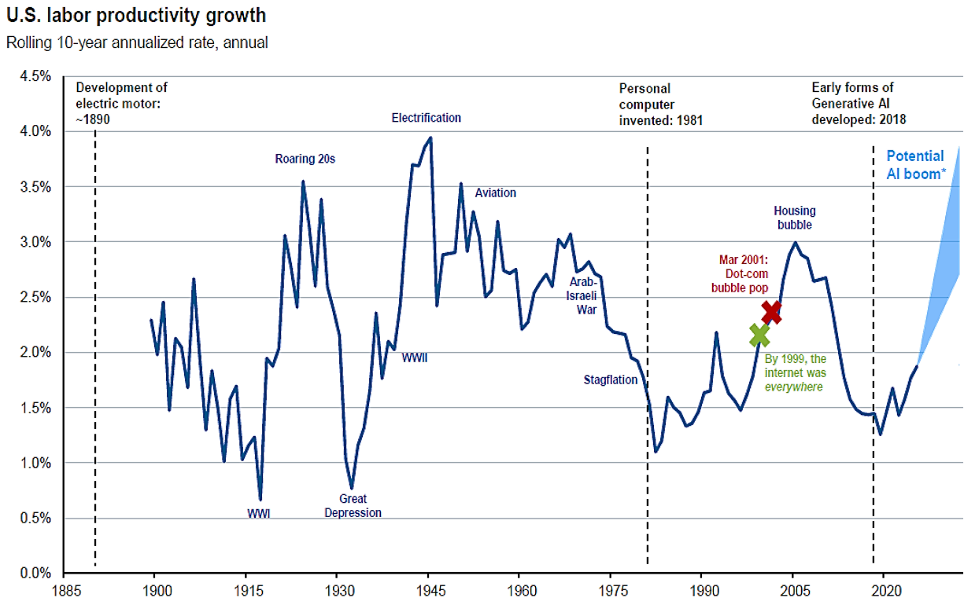
*J.P. Morgan Asset Management estimates plausible productivity gains of 1.4-2.7% from generative AI and other AI technologies over the next few years, in addition to the expected 1.5% annual productivity growth projected by the Congressional Budget Office. Source: BLS, NBER, J.P. Morgan Asset Management The AI Revolution: Where We Are, What’s Next, April 17, 2026. Data from 1888 to 1957 reflect productivity data for the total private economy from John Kendrick, “Productivity Trends in the United States,” NBER. Data from 1958 to 2023 reflect non-farm productivity data from the BLS. Forecasts, projections and other forward-looking statements are based upon current beliefs and expectations. They are for illustrative purposes only and serve as an indication of what may occur. Given the inherent uncertainties and risks associated with forecasts, projections or other forward-looking statements, actual events, results or performance may differ materially from those reflected or contemplated. Data are as of March 6, 2026
Investing involves risk, including the possible loss of principal, and no investment process or strategy is guaranteed to be profitable. Past performance does not guarantee future results, and any investments mentioned may not be suitable for all investors. Hypothetical examples are for illustrative purposes only, do not represent actual results, and actual results and individual experiences may differ.
This material is for general informational and educational purposes only. It is not individualized investment, tax, legal or insurance advice, or a recommendation to buy or sell any security or insurance product. Consult qualified professionals regarding your individual circumstances. Views expressed are solely those of the [author(s) and do not necessarily reflect the views of Hightower Advisors, LLC or any of its affiliates.
All information referenced is current as of the publication date and may change without notice. Although obtained from sources believed to be reliable, Hightower Advisors, LLC, and their respective affiliates do not guarantee its accuracy or completeness. References or links to third-party content do not constitute an endorsement of any third party or its products, services, or views. Click here for definitions of and disclosures specific to commonly used terms.
Hightower Signature Wealth is a group comprised of investment professionals associated, and/or registered, with Hightower Advisors, LLC, an SEC registered investment advisor. Some investment professionals may also be registered with Hightower Securities, LLC, member FINRA and SIPC.
Find answers to your questions about Hightower Signature Wealth
Hightower Signature Wealth is a fiduciary wealth management practice that provides investment management, financial planning, estate strategies, insurance, and banking solutions. We work with families, business owners, professionals, women, and retirees across more than 40 offices nationwide. Our advisors take the time to understand your financial priorities, develop a plan around your goals, and adjust that plan as your life and circumstances evolve.
Hightower Signature Wealth provides a broad range of wealth management services designed to address different aspects of your financial life. Our capabilities include investment management, financial planning, retirement planning, estate strategies, insurance and risk management, banking solutions, and charitable giving strategies. By considering these areas together, our advisors can develop a coordinated approach based on your goals, priorities, financial circumstances, and plans for the future.
Hightower Signature Wealth advisors work with a broad range of clients, including women, families, business owners, professionals, retirees, and high-net-worth individuals navigating major life or financial transitions. Rather than applying a generic playbook, each advisor tailors the plan to a client’s specific goals and current stage of life – from early-career decisions to multigenerational wealth transfer.
Yes. Hightower Signature Wealth advisors serve as fiduciaries, which means they are committed to acting in their clients’ interests when providing investment advice. We offer fee-based advisory services, with fees depending on the services provided and the specifics of your relationship. Your advisor will discuss the applicable fee structure with you so you can understand how you are charged and what services are included.
Hightower Signature Wealth has more than 40 offices nationwide, allowing our advisors to serve individuals, families, and organizations across the country. Depending on your location and preferences, you may be able to work with an advisor locally or connect with a team in another market. Visit our Locations page to explore our office locations, learn more about the teams in each market, and find an office near you.
Getting started with Hightower Signature Wealth is simple. Complete our online contact form with some basic information about yourself and what you are looking for, and we’ll connect you with an advisor who can discuss your needs and financial priorities. That initial conversation is an opportunity to learn more about our approach, ask questions, and determine whether working with a Hightower Signature Wealth advisor may be a good fit.
Your first conversation is an opportunity for us to learn more about you, your financial circumstances, and what you hope to accomplish. An advisor may ask about your goals, current investments, family considerations, business interests, and other priorities that could influence your financial plan. You’ll also have an opportunity to ask questions, learn about our approach, and discuss what working together could look like.