Update on the Economy and Markets – November 2026
By PJ Williams, CFA
Director, Investments
Overview
With the midterms in the rearview mirror, investors will now turn their attention to what the outcome means for their portfolios. The blue wave that prediction markets had priced in prior to election night became a reality as Democrats took control of both the House and Senate. This means that the U.S. will have a divided government for the next two years.
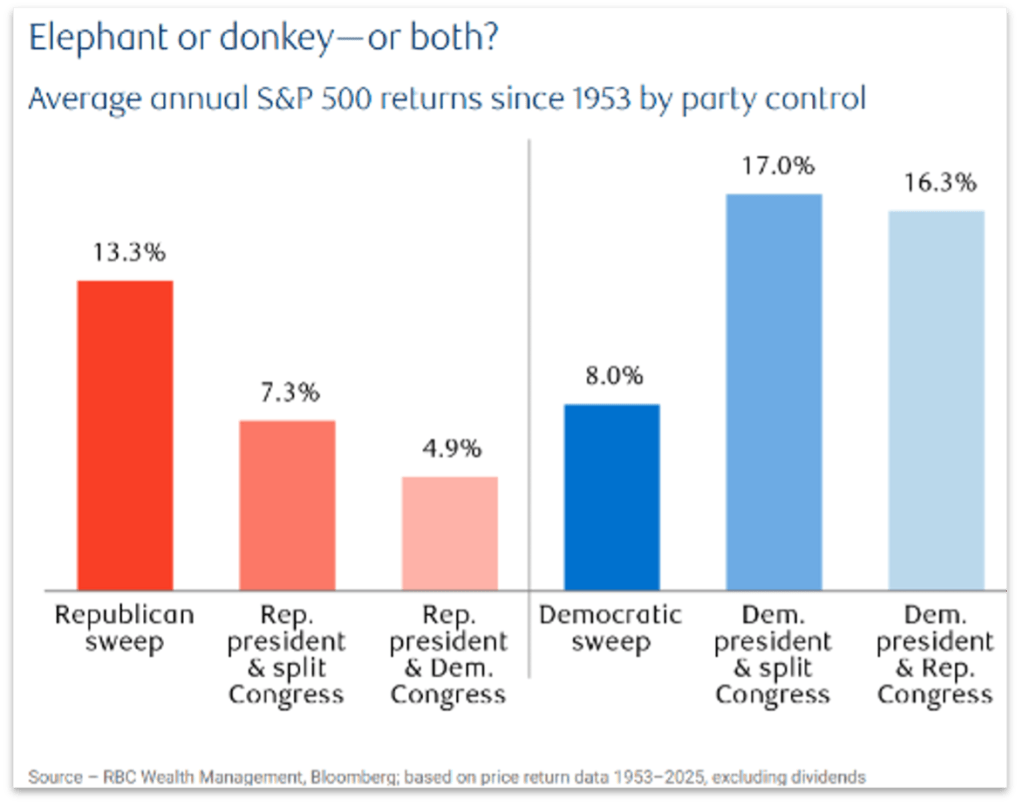
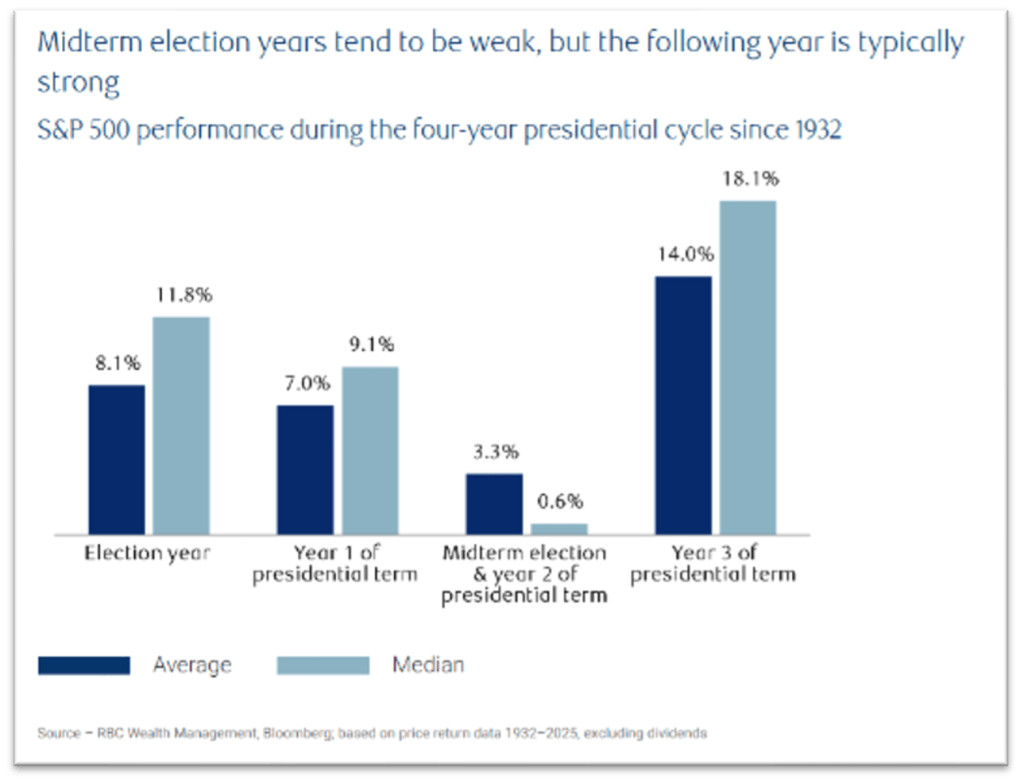
The charts below were part of last month’s commentary as well. They show that the third year of a President’s term has been the best for equities; however, a divided government with a Republican President and Democrat controlled Congress has delivered the weakest results of the possible combinations. How year three of Trump’s term goes will be driven by corporate earnings, U.S. fiscal policy, AI regulation, and wars in Iran and Ukraine. U.S. equities began the divided government phase of Trump’s second presidency with a strong rise as the S&P 500 surged over 1.5% on the Wednesday after the elections. However, this rally was short lived as the S&P 500 fell more than 4% the following day while the Nasdaq fell over 5% as concerns over the AI capital expenditures and returns on these investments reentered the narrative.
AI investment by hyperscalers and others has driven earnings growth and markets over the past few years (Note: hysperscalers are companies that provide massive cloud computing, storage and networking infrastructure… examples of hyperscalers include Microsoft, Alphabet, Amazon and Oracle). There have been increasing concerns about the ultimate return-on-investment (ROI) for the massive capital expenditures that companies have committed to alongside a growing pushback across many communities regarding the use of land for new data centers.
AI oversight and regulation is expected to be a main focus of Congress over the next two years. While Congress may seek to implement more oversight of AI, President Trump still has veto power. With state elections at the governor and legislature levels favoring Democrats on election night, data centers are also likely to be in the spotlight of debates and policy. Volatility in some of these names is likely to increase as Democrats set agenda items that could create headwinds to revenue and profitability for these companies, but it is unlikely in the near term that there are any changes of magnitude that alter the long-term path for AI, especially given the competition and lack of guardrails from China and others.
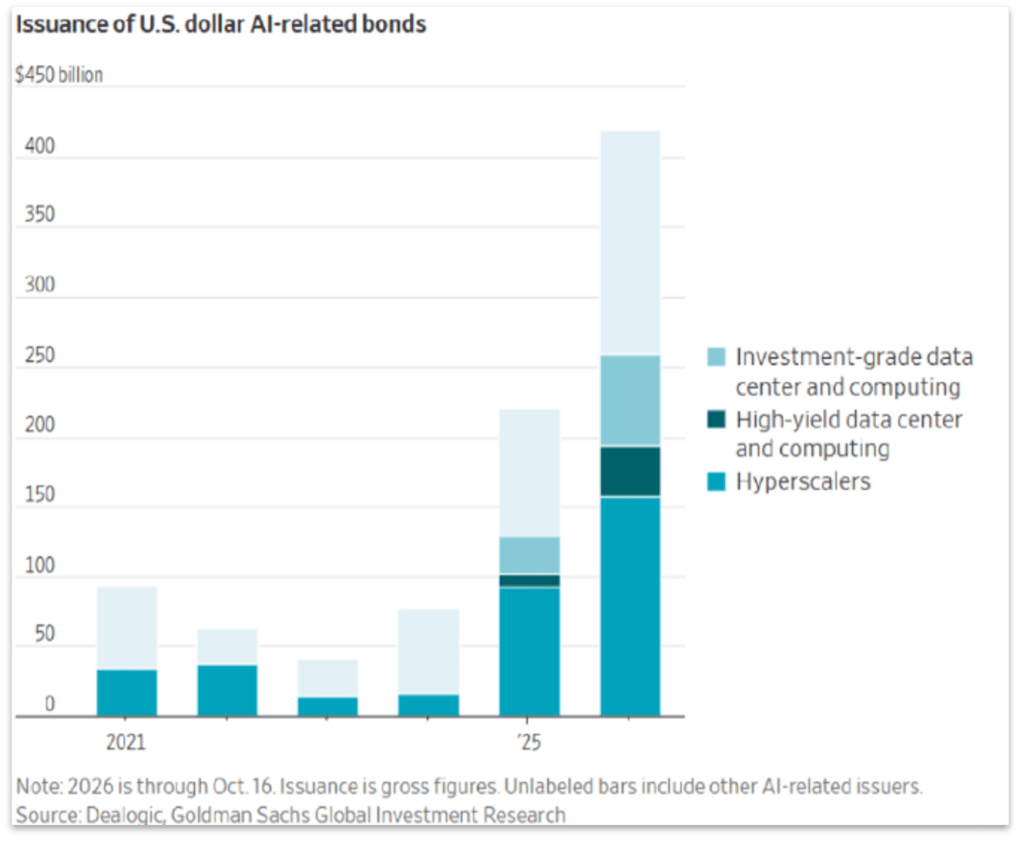
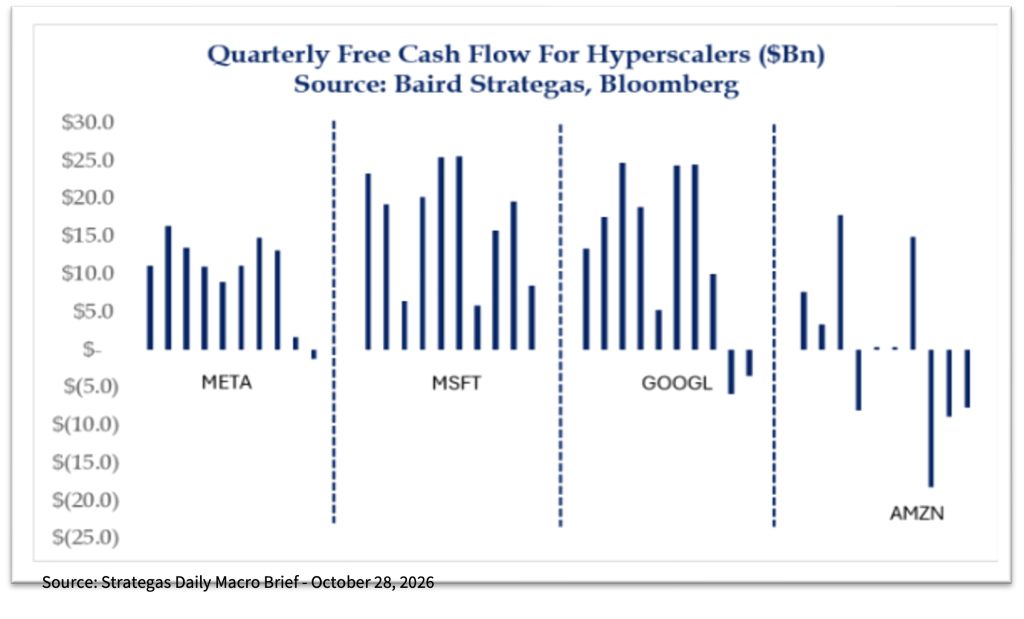
Alongside the concern of increased AI regulation being a governor on growth is the increased scrutiny on AI-related borrowing. The issuance of AI-related bonds has more than doubled already in 2026 from the previous year. At the same time, the hyperscalers, which represent some of the largest companies in the world, are seeing their free cash flow decline. This is leading some of these companies to look to the debt markets for additional financing. Earnings calls will be a focal point for investors during the coming quarters as these companies provide updates as to whether this exorbitant amount of funding into CAPEX is driving revenue growth. If investors are not satisfied with what they hear, some of the largest companies could experience significant drops in their stock prices which would weigh on the U.S. equity markets given the proportional size of these companies to the overall market.
Fed Pauses Rate Hikes
The Fed hit pause on additional rate hikes during their October meeting, but there were two dissenters who voted for a rate hike. However, markets expect another 0.25% hike at the December meeting (there is no meeting in November). During his comments, Chairman Warsh announced that in 2027 the Fed will keep its schedule of eight meetings, but one of these meetings will be a discussion of broad monetary policy strategy with no vote on rates. The following year in 2028 he has stated that two meetings will be for strategy with no rate votes leaving only six rate decision votes that year. His rational for this change: “Getting policy right involves assessing near-term developments at timely, regular, and information-rich intervals. But it’s equally important we reserve time and space, as an intellectually diverse group, for strategic deliberations—for thinking anew about big questions, looking out over longer time horizons, focusing, as I say, on the left side of the decimal point.” 1
During the Q&A portion of his press conference, Warsh was asked about whether the AI boom is as sensitive to interest rates in the same way as other sectors such as housing. In his response, he stated: “So, there was a narrative for quite a while, maybe even in this room over the course of the last several press conferences, well, they’re going to raise rates, they’re talking about raising rates, but it’s not going to have any effect on AI, because the returns that investors are expecting are so different. I was skeptical of that view. Interest rates get in the cracks, interest rates affect directly or indirectly, almost everything. And what have we seen? Since early September what we’ve seen inside of the technology complex, outside of the technology complex, whether you pronounce it AI or SI, Claire, is up to you, what have you seen? Interest rates have had an effect. You’ve seen market participants that are discriminating between the kinds of investments they want to make. You’ve seen credit spreads for certain assets widen out, gap out. For others you’ve seen some tightening in financial conditions, but not significantly. So on the thrust of your question of — with respect to the new technology and this investment surge, do interest rates matter? I believe they do. And I don’t believe that they’re somehow divorced from the rest of the economy. Secondly, I’ll just say this, it is convenient to say that the strength of the economy is all about this new technology wave. In fact, if we look at the data, really including data from the last meeting until this, the CapEx story is not just robust, not just strong, but it is broadening. And so if you wanted to tell the story somehow that this is strength we’re seeing only in narrow pockets, that’s a much harder story to tell now than it would have been several quarters ago.”1
Higher rates will be a headwind to technology stocks, so the question will be whether earnings growth and investor sentiment will continue to outweigh this concern
Bond Market
Treasury yields have eased in recent weeks as oil prices have fallen during a calm in the war with Iran. The yield on the 10-year treasury has pulled back from a multi-decade high above 5.3% to 4.9% the day after the midterms as there was some hope that government spending may be reined in. While it is likely that the Democrats change the composition of some federal spending, it is unlikely that they fundamentally change the long-term trajectory of the deficit and debt levels over the next two years.
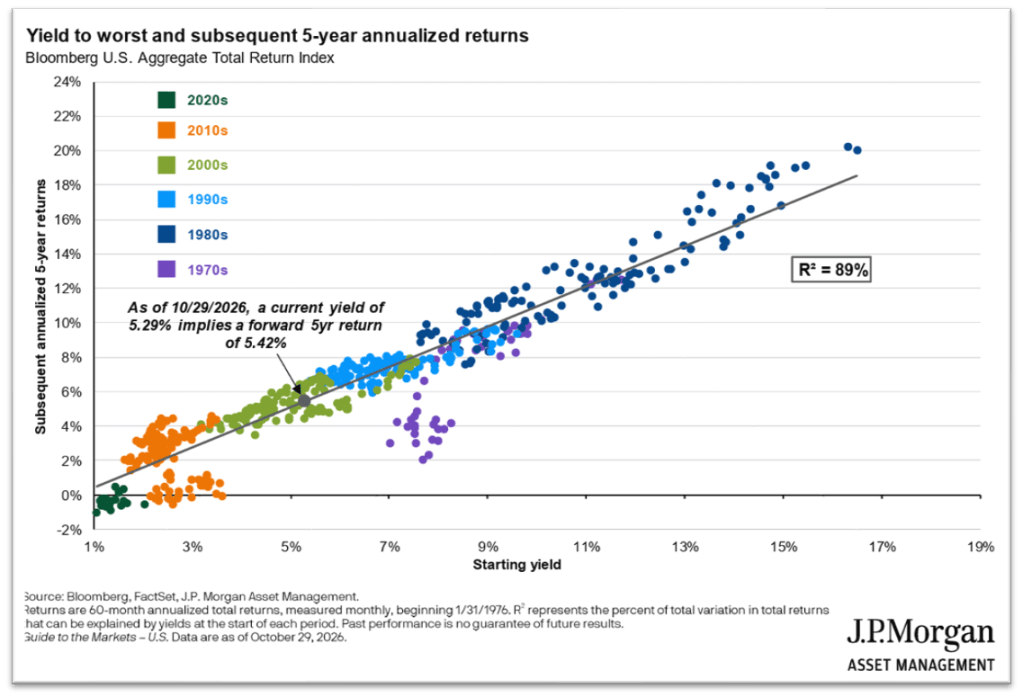
The short-term outlook for yields will be driven by inflation and fiscal policy decisions or lack thereof. With a higher starting yield, an increase in yields from this point will not be as painful for bondholders as 2022. The starting yield for a bond investment matters as evidenced by the chart below.
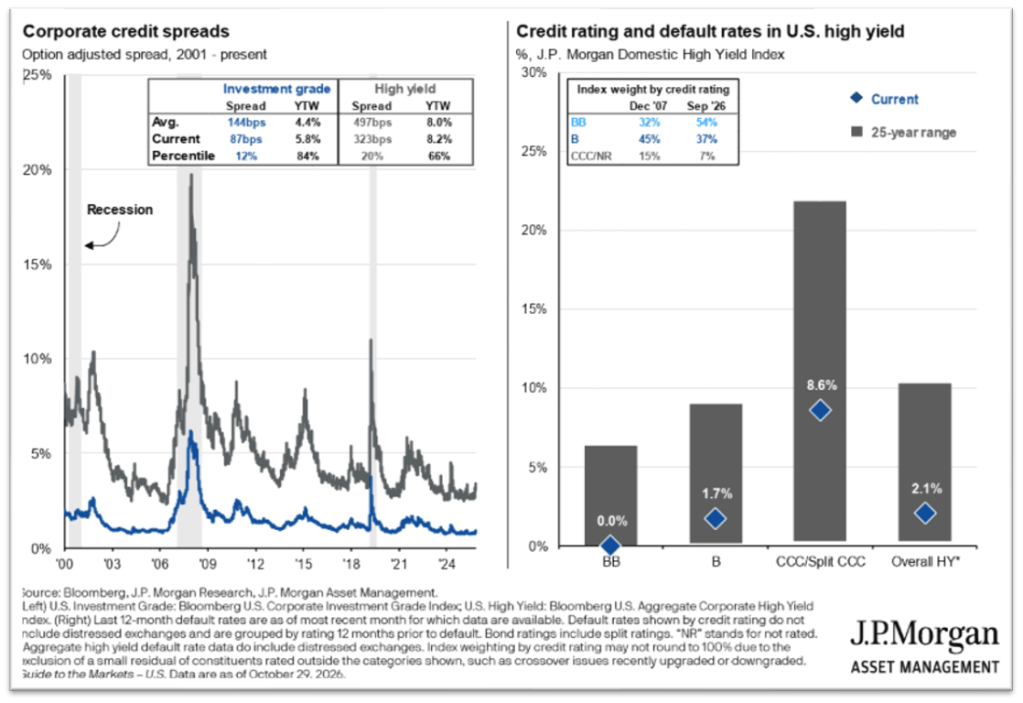
Fixed income investing has become more attractive this year, but spreads remain tight for corporate bonds while defaults remain below historical averages. Widening credit spreads have historically been an early warning sign of a weakening economy, so this will be closely monitored by investors, especially as corporations refinance over the coming years at higher rates.
U.S. Corporate Earnings
According to FactSet, as of October 30th, “For Q3 2026, the estimated (year-over-year) earnings growth rate for the S&P 500 is 30.2%. If 30.2% is the actual growth rate for the quarter, it will mark the third-straight quarter of earnings growth above 25% for the index… With Alphabet, Amazon.com, and Microsoft reporting actual results for Q3 2026 during the past week, 5 of the 7 companies in the “Magnificent 7” have now reported earnings for the third quarter. How have earnings reported by the “Magnificent 7” companies to date performed relative to analyst expectations and year-ago results?
On September 30, the estimated earnings growth rate for the “Magnificent 7” companies for Q3 2026 was 33.6%… Earnings reported by the “Magnificent 7” companies have fallen short of estimates by 14.7% in aggregate, while earnings reported by all S&P 500 companies have exceeded estimates by 1.9% in aggregate. As a result of this subpar performance relative to expectations to date, the blended (combines actual results for companies that have reported and estimates for companies yet to report) earnings growth rate for the “Magnificent 7” companies has declined to 22.6% today from 33.6% on September 30.
On the other hand, the blended earnings growth rate for the other 493 S&P 500 companies has increased to 32.6% today from 27.8% on September 30. Thus, the blended earnings growth rate for the “Magnificent 7” companies for Q3 2026 (22.6%) is now lower than the blended earnings growth rate for the other 493 S&P 500 companies for Q3 2026 (32.6%). If these results hold until the end of the earnings season, this will mark the first time the “Magnificent 7” companies have reported lower earnings growth than the other 493 S&P 500 companies since Q4 2022 (-30.6% vs. 1.6%).”2
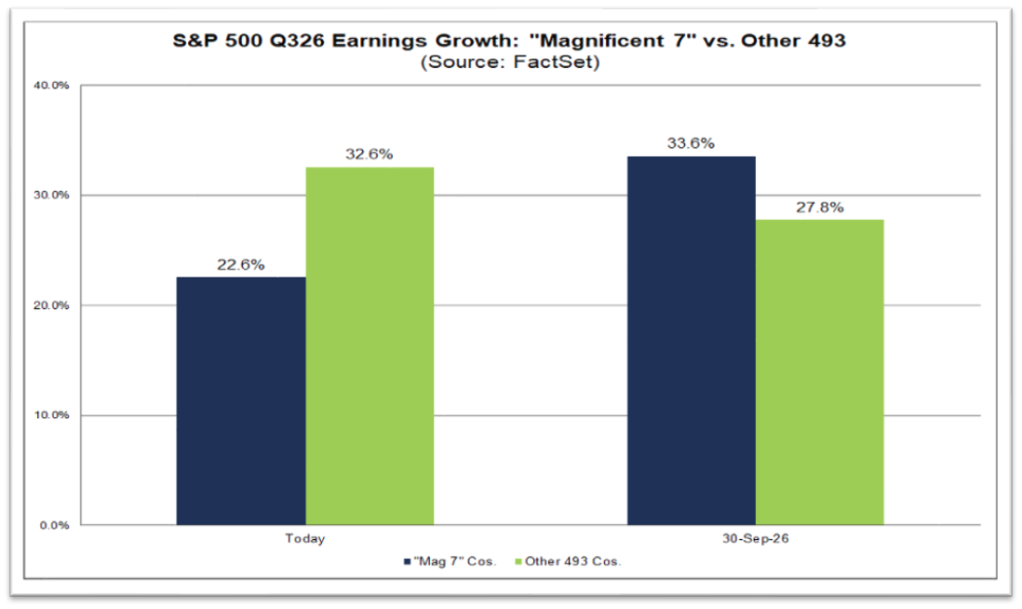
Source: FactSet Earnings Insight – October 30, 2026.
If this trend continues, it could be a positive for the health of the overall market with broader breadth of strong earnings growth. However, the weightings of the largest names put them in a position to have a material effect on the market performance if they underperform expectations. As discussed above, the AI story and success or lack thereof of the largest companies to produce an attractive ROI on their investments is going to be a major theme for equity markets during the rest of the decade and beyond.
Geopolitics
With neither war showing any signs of ending, Trump must decide the path forward for the U.S.’ engagement in the war with Iran and its role as a negotiator of peace between Ukraine and Russia. In the days leading up to and after the midterms, Trump appeared to cool on intensifying strikes in the Middle East. This combined with the Democrats control of Congress pushed oil prices back below $100. This price action supports the belief that the war with Iran is the main driver of higher oil prices. Trump is now seeking diplomatic solutions to both wars. The issues, though, remain the same. Can Trump and Iran both find offramps that allow them to position the end of the war as a victory for their respective countries and can Trump broker a peace deal that would receive buy-in from both Ukraine and Russia? Neither negotiation is straightforward, and there still appears to be wide chasms between the players.
Russia has increased its strikes on Ukraine over the past month as Ukraine struggled with air defense without sufficient Starlink access and patriot missiles. While Starlink has been restored, Ukraine is still struggling to procure patriot missiles from allies. The U.S. did approve a shipment of new patriot missiles last week with first deliveries during 2030 which does not help the current situation.
Investors will be monitoring U.S. military action against Iran in the coming weeks before the new Congress is sworn in during January. If there is a thawing in the conflict that allows more tankers through the Strait of Hormuz, it could push oil prices down further easing pressure on inflation.
Markets
U.S. equities were down slightly during October as investors prepared for midterms. The S&P 500 pulled back 1% during the month, bringing its year-to-date (YTD) return to 11.8%. International stocks were down during the month as well but remain up 11% YTD through October.
Yields on the 10-year treasury fell during the month. The 10-year yield closed October at just under 5% after starting the month at 5.3%.
Economic Trends
In the initial reading of Q3 U.S. GDP growth, real GDP grew at 3.4%. This represented the fastest growth in a year. It was above the 2.2% rise during Q2 and above expectations of 3.2%. Growth was driven by strong consumer spending, AI-driven investment and government spending.
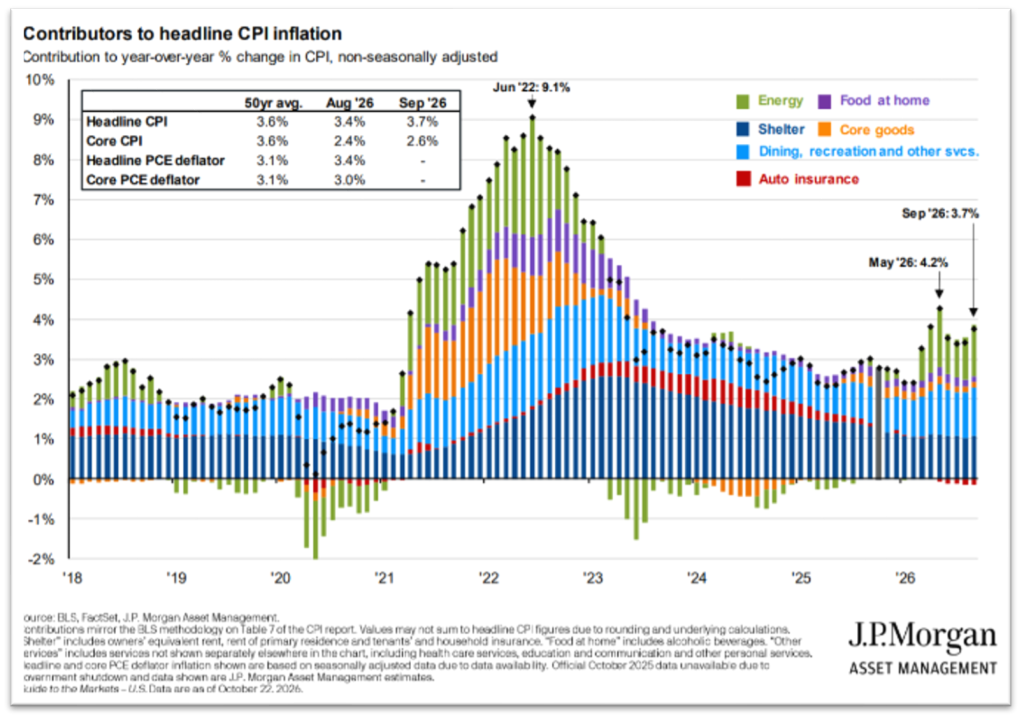
Headline inflation increased to 3.7% in September as core inflation increased to 3.6%. As in previous months, energy prices were again a main driver of inflation.
U.S. hiring picked up during October. The US economy added 165K jobs in October, well above market forecasts of 65K. Also, the unemployment rate fell back to 4.1%.
Our Team’s Take:
With the midterms in the rearview mirror, investors will turn their attention to what the next two years hold for markets and the economy. As discussed in this commentary, AI regulation, the war in Iran and corporate earnings will be in the spotlight.
We continue to focus on diversification across asset classes, including private alternatives such as infrastructure, real estate, private equity, and private credit. Public stock valuations are elevated relative to history, but strong earnings growth and a decent economy continue to provide support for stock markets. Eventually, AI productivity growth should help maintain strong profit margins; however, markets continue to punish stocks that fall short of lofty expectations. We therefore believe continued turbulence is likely.
As we continue to reiterate, it is imperative for clients to be invested in the correct risk-tolerance for their own personal situations. If you have concerns, please do not hesitate to reach out to your wealth advisor.
Sources:
1 https://www.federalreserve.gov/mediacenter/files/FOMCpresconf20261028.pdf, October 28, 2026.
2https://advantage.factset.com/hubfs/Website/Resources%20Section/Research%20Desk/Earnings%20Insight/EarningsInsight_103026.pdf, October 30, 2026.
Investing involves risk, including the possible loss of principal, and no investment process or strategy is guaranteed to be profitable. Past performance does not guarantee future results, and any investments mentioned may not be suitable for all investors. Hypothetical examples are for illustrative purposes only, do not represent actual results, and actual results and individual experiences may differ.
This material is for general informational and educational purposes only. It is not individualized investment, tax, legal or insurance advice, or a recommendation to buy or sell any security or insurance product. Consult qualified professionals regarding your individual circumstances. Views expressed are solely those of the [author(s) and do not necessarily reflect the views of Hightower Advisors, LLC or any of its affiliates.
All information referenced is current as of the publication date and may change without notice. Although obtained from sources believed to be reliable, Hightower Advisors, LLC, and their respective affiliates do not guarantee its accuracy or completeness. References or links to third-party content do not constitute an endorsement of any third party or its products, services, or views. Click here for definitions of and disclosures specific to commonly used terms.
Hightower Signature Wealth is a group comprised of investment professionals associated, and/or registered, with Hightower Advisors, LLC, an SEC registered investment advisor. Some investment professionals may also be registered with Hightower Securities, LLC, member FINRA and SIPC.
Find answers to your questions about Hightower Signature Wealth
Hightower Signature Wealth is a fiduciary wealth management practice that provides investment management, financial planning, estate strategies, insurance, and banking solutions. We work with families, business owners, professionals, women, and retirees across more than 40 offices nationwide. Our advisors take the time to understand your financial priorities, develop a plan around your goals, and adjust that plan as your life and circumstances evolve.
Hightower Signature Wealth provides a broad range of wealth management services designed to address different aspects of your financial life. Our capabilities include investment management, financial planning, retirement planning, estate strategies, insurance and risk management, banking solutions, and charitable giving strategies. By considering these areas together, our advisors can develop a coordinated approach based on your goals, priorities, financial circumstances, and plans for the future.
Hightower Signature Wealth advisors work with a broad range of clients, including women, families, business owners, professionals, retirees, and high-net-worth individuals navigating major life or financial transitions. Rather than applying a generic playbook, each advisor tailors the plan to a client’s specific goals and current stage of life – from early-career decisions to multigenerational wealth transfer.
Yes. Hightower Signature Wealth advisors serve as fiduciaries, which means they are committed to acting in their clients’ interests when providing investment advice. We offer fee-based advisory services, with fees depending on the services provided and the specifics of your relationship. Your advisor will discuss the applicable fee structure with you so you can understand how you are charged and what services are included.
Hightower Signature Wealth has more than 40 offices nationwide, allowing our advisors to serve individuals, families, and organizations across the country. Depending on your location and preferences, you may be able to work with an advisor locally or connect with a team in another market. Visit our Locations page to explore our office locations, learn more about the teams in each market, and find an office near you.
Getting started with Hightower Signature Wealth is simple. Complete our online contact form with some basic information about yourself and what you are looking for, and we’ll connect you with an advisor who can discuss your needs and financial priorities. That initial conversation is an opportunity to learn more about our approach, ask questions, and determine whether working with a Hightower Signature Wealth advisor may be a good fit.
Your first conversation is an opportunity for us to learn more about you, your financial circumstances, and what you hope to accomplish. An advisor may ask about your goals, current investments, family considerations, business interests, and other priorities that could influence your financial plan. You’ll also have an opportunity to ask questions, learn about our approach, and discuss what working together could look like.