2026 Year-End Tax Planning Opportunities
The 2026 tax year marks the first full year under many provisions of the One Big Beautiful Bill Act (OBBBA), creating new considerations and opportunities for taxpayers as they approach year-end. Changes to retirement contributions, charitable giving and itemized deductions, business tax provisions, and estate and gifting strategies may affect the decisions you make before December 31.
With these new rules now in effect, year-end is a great opportunity to revisit your tax strategy and determine which provisions may apply to your financial situation.
Below are several planning opportunities to discuss with your financial and tax advisors before the year comes to a close.
Retirement Tax Planning
With many nongovernmental employers having until December 31 of this year to adopt discretionary plan amendments related to the SECURE and SECURE 2.0 Acts, year-end can be an opportunity to review which provisions are available through your workplace retirement plan. Consider how changes affecting Roth contributions, catch-up contributions, and other plan features may factor into your retirement and tax-planning strategy.
Make the most of your retirement plan contributions: Confirm that you have contributed the maximum amounts allowed under current tax law — and feasible given your financial situation — to your retirement accounts. This may also include:
- You and/or your working spouse maximizing contributions to employer-sponsored retirement plans, with the intention of taking advantage of any available employer-matching contributions.
- You and/or your non-working spouse contributing to a traditional or Roth IRA, subject to applicable eligibility and income limitations. For 2026, the IRA contribution limit is $7,500, or $8,600 for individuals age 50 or older.
- For 2026, you can contribute up to $24,500 to a 401(k), 403(b) or most 457(b) plans. If you are age 50 or older, you may generally contribute an additional $8,000 in catch-up contributions, for a total of $32,500. For individuals who turn ages 60 through 63 during 2026, the higher catch-up contribution limit is $11,250, bringing the total potential contribution to $35,750.1
- If self-employed, consider whether you can defer a portion of your earnings through a simplified employee pension (SEP) IRA or SIMPLE IRA, or, in some cases, establish a defined benefit or cash balance plan. For 2026, SEP contributions are generally limited to the lesser of 25% of compensation or $72,000. Contribution and benefit limits for defined benefit and cash balance plans are calculated differently and may allow for significantly higher amounts depending on your circumstances.
- The SECURE 2.0 Act also allows employers maintaining SEP plans to offer participants the option of having contributions made to a Roth SEP IRA. If available, consider whether Roth treatment may fit into your broader retirement and tax-planning strategy.
Understand the new Roth catch-up contribution requirements: If you earned more than $150,000 in wages in 2025 from the employer sponsoring your retirement plan, any catch-up contributions you make in 2026 generally must be made on a Roth basis. Unlike traditional pre-tax catch-up contributions, Roth contributions do not provide an upfront income tax deduction, but qualified withdrawals in retirement are tax-free. Consider how this change may affect your year-end contributions and broader retirement and tax-planning strategy. The new Roth requirement does not apply to SEPs or SIMPLE IRAs.
Consider a Roth conversion: A Roth conversion generally involves moving pre-tax retirement assets from a traditional IRA or eligible employer-sponsored retirement account into a Roth IRA. The amount converted is generally included in your taxable income for the year of the conversion, while qualified withdrawals from the Roth IRA can be tax-free in retirement.
A conversion may be worth considering during a year when your income or tax rate is lower than you expect it to be in the future. The years between retirement and the start of required minimum distributions (RMDs), for example, may provide an opportunity to convert some retirement assets while managing the resulting tax liability. A Roth conversion may also be considered as part of an estate-planning strategy, since Roth IRA owners are not subject to lifetime RMDs.
Many taxpayers find their income exceeds the threshold to contribute directly to a Roth IRA. In such cases, it may be advisable to consider making a “backdoor” Roth contribution whereby an after-tax IRA contribution is converted to a Roth IRA. Note that the presence of pre-tax IRA balances hampers the ability to make such a contribution tax-free.
Strategically take required minimum distributions (including QCDs): If you are age 73 or older and subject to RMDs, make sure you satisfy your distribution requirement before year-end. Consider how the timing and use of your RMD may fit into your broader income and tax-planning strategy, including whether you anticipate major expenses or charitable giving. Other considerations include:
- The SECURE 2.0 Act raised the RMD age to 73 beginning in 2023 and will increase it to age 75 for individuals born in 1960 or later.
- If you turned 73 in 2026 and are taking your first RMD, you generally have until April 1, 2027, to take it. However, your 2027 RMD would still need to be taken by December 31, 2027. Consider the potential tax implications of delaying your first RMD, as doing so could result in two taxable RMDs in 2027.
- If you inherited an IRA, review whether you are required to take an annual distribution. Certain beneficiaries subject to the 10-year rule may also be required to take annual RMDs during that period, depending on when the original account owner died and other circumstances. One strategy may be to take roughly equal annual distributions to help manage taxable income and reduce the likelihood of moving into a higher tax bracket, assuming other sources of income and deductions remain relatively consistent throughout the distribution period.
- If you have charitable intentions and are age 70½ or older, consider whether a qualified charitable distribution (QCD) fits into your giving and tax strategy. In 2026, you can generally transfer up to $111,000 directly from an IRA to eligible charities, and a QCD can count toward satisfying your RMD for the year.2
Business Tax Planning
Section 179 expensing and bonus depreciation: If your business is planning to purchase equipment or other qualifying property, consider whether completing those purchases and placing the property in service before year-end could provide a tax benefit.
For 2026, businesses may be able to immediately expense up to $2.56 million of qualifying property under Section 179, with the deduction beginning to phase out when qualifying property placed in service during the year exceeds $4.09 million. The OBBBA also made 100% bonus depreciation permanent for qualifying property acquired after January 19, 2025, allowing businesses to deduct the full cost of eligible new or certain used property in the year it is placed in service rather than depreciating the cost over several years.3
Review deductions for research and experimental (R&E) expenses: The OBBBA restored the ability for businesses to immediately deduct qualifying domestic R&E expenses, rather than requiring those costs to be amortized over five years. If your business conducts research or develops products, technology or software, review your 2026 R&E expenditures and consider how the ability to immediately deduct these costs may affect your taxable income for the year.
Eligible small businesses may also have an opportunity to apply the new rules retroactively to certain domestic R&E expenses incurred in tax years beginning after December 31, 2021, and before January 1, 2025.
Consider accelerating business equipment purchases: If your business is planning to purchase equipment or other qualifying property, consider whether completing those purchases before year-end could provide a tax benefit. For 2026, Section 179 allows businesses to immediately expense up to $2.56 million of qualifying property, with the deduction beginning to phase out once qualifying purchases exceed $4.09 million. Certain limitations apply based on the type of property and the business’s taxable income.
Review the timing of business income and expenses: For business owners, the timing of income and deductible expenses can affect taxable income from one year to the next. Depending on your business’s accounting method and circumstances, consider working with your tax advisor to determine whether there are opportunities to defer income into 2027 or accelerate eligible deductions into 2026.
For example, a business may consider whether certain planned expenses, such as insurance premiums, professional fees or other eligible business costs, can be paid before year-end. Business owners may also want to review the timing of bonuses, capital expenditures and other significant expenses. Because the rules governing when income must be recognized and when expenses can be deducted vary, weigh any potential tax benefit against your business’s cash flow, liquidity needs and other financial obligations.
The 199A deduction (20% qualified business income (QBI) deduction) for sole proprietorships, certain rentals, and passthrough businesses may reduce a business’ tax bill if applicable. This allows a deduction of up to 20% of QBI from pass-through or rental income.4
In the simplest of examples, an individual with $100,000 of QBI may be able to receive a $20,000 tax deduction, which at the top 37% tax bracket saves $7,400 in federal taxes. However, the calculation of the actual deduction is much more complex, as several factors may limit it. At the entity level, compensation structure should be reviewed prior to year-end. For a sole proprietorship, it may be advisable to consider making an S election. If you are considering restructuring or an S election, it is important to also take reasonable compensation for the owner into account, as well as the impact of payroll taxes, state taxes, administrative costs, and the fact that S corporation wages reduce QBI.
Income Tax Planning
Understand the SALT deduction limitation: OBBBA temporarily increased the federal deduction available for state and local taxes (SALT), while phasing out the higher deduction for taxpayers above certain income levels. For 2026, the SALT deduction is generally capped at $40,400 ($20,200 for married individuals filing separately), with the higher limit phasing down by 30% of modified adjusted gross income above $505,000 and cannot fall below $10,000. For high-income earners, consider how the phaseout may affect the amount of state and local taxes you can deduct. The increased SALT deduction is temporary and is scheduled to revert to a $10,000 cap ($5,000 for married individuals filing separately) beginning in 2030.5
Consider the new limitation on itemized deductions for high-income earners: Beginning in 2026, taxpayers in the 37% federal income tax bracket are subject to a new limitation on the tax benefit of itemized deductions. For 2026, the limitation applies when taxable income exceeds $640,600 for single filers or $768,700 for married couples filing jointly. If your income is near or above these thresholds, consider how the new limitation may affect the value and timing of deductible expenses, including charitable contributions.
Revisit charitable giving strategies under the new deduction rules: Beginning in 2026, taxpayers who itemize can generally deduct charitable contributions only to the extent their contributions exceed 0.5% of adjusted gross income (AGI). High-income taxpayers in the 37% tax bracket may also see the tax benefit of their itemized deductions reduced under the new limitation on itemized deductions. Consider whether these changes affect the timing or structure of your charitable giving.
For taxpayers who do not itemize, a new deduction allows up to $1,000 in qualifying cash contributions ($2,000 for married couples filing jointly) beginning in 2026.
Consider donating appreciated securities: Donating appreciated securities directly to charity may allow you to receive a deduction based on fair market value, subject to applicable AGI limitations, while avoiding capital gains tax on the appreciation. The example below shows how this can compare with selling the stock and donating the cash proceeds.
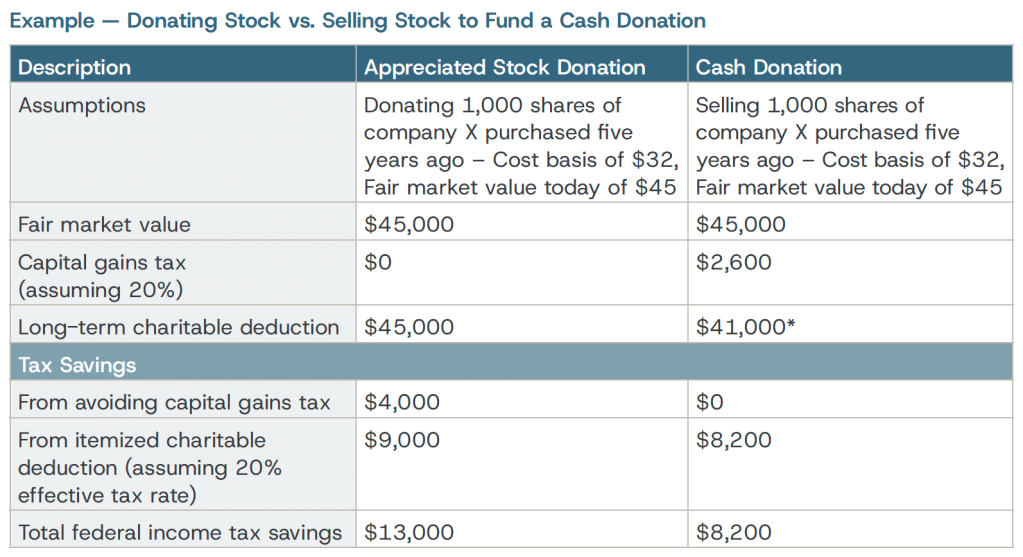
*Assumes donor’s AGI exceeds $150,000 and therefore that the charitable deduction for the donation does not exceed 30% of the donor’s AGI. For Illustrative Purposes Only. Investor should not expect the same outcome and should consult with a tax advisor
Consider bunching charitable contributions: Combining multiple years of charitable contributions into a single year, potentially through a donor-advised fund, may help increase your itemized deductions above the standard deduction. The example below illustrates the potential impact over a two-year period.
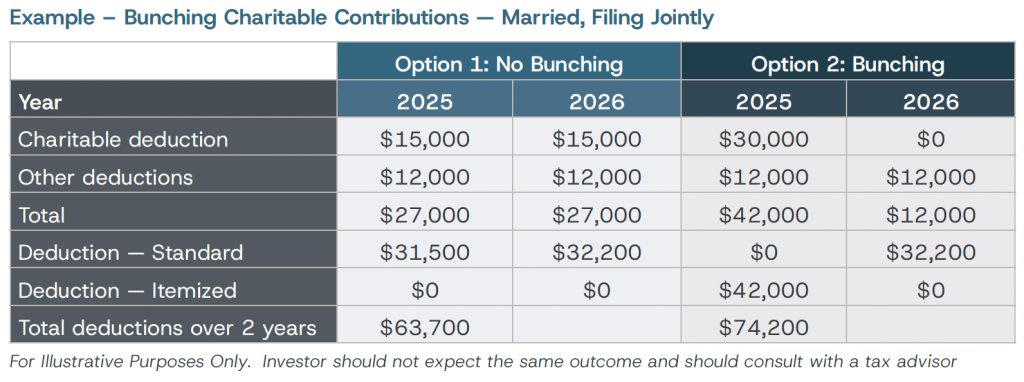
Additional deduction amount: $10,500
Estimated tax savings: $2,100
Additional deduction amount assumes a 20% effective tax rate.
Harvest tax losses: Consider whether tax-loss harvesting may help offset capital gains in your taxable investment accounts. This strategy generally involves selling investments that have declined in value and using those losses to offset realized capital gains, while remaining mindful of the wash-sale rule when reinvesting.
If your capital losses exceed your capital gains for the year, you may generally use up to $3,000 of remaining losses ($1,500 if married filing separately) to offset other income. Additional unused capital losses can generally be carried forward to future tax years until exhausted.
Consider realizing capital gains at a 0% rate: Depending on your taxable income, you may be able to take advantage of a 0% long-term capital gains tax rate. For 2026, the 0% rate applies to taxable income up to $98,900 for married couples filing jointly and $49,450 for single filers.6 Consider whether realizing gains while you fall within this range could make sense before year-end.
Consider gifting appreciated stock: If you are subject to a higher capital gains tax rate, gifting appreciated stock to an adult child or other family member in a lower tax bracket may allow the investment to be sold at a lower capital gains rate. Kiddie tax rules and potential state taxes should be considered before using this strategy.
Review tax-loss harvesting opportunities: Selling investments at a loss may allow you to offset realized capital gains and potentially reduce your tax liability. Be mindful of wash-sale rules and state-specific treatment of unused capital losses. In some situations, realizing gains may also be worth considering when you have losses available to offset them.
Evaluate Qualified Opportunity Zone investments: Investing eligible capital gains in a Qualified Opportunity Fund (QOF) may provide tax benefits. Beginning in 2027, new rules will provide a 10% basis step-up for qualifying investments held at least five years, with additional benefits available for certain rural investments.
Review Qualified Small Business Stock (QSBS): If you own qualifying small business stock, Section 1202 may allow some or all of the gain from a sale to be excluded from federal income tax. Recent changes expanded eligibility and introduced a tiered exclusion for certain shares held for less than five years. Consider reviewing your holdings before a potential sale to determine whether they qualify.
Monitor AMT and Tax exposure: High-income taxpayers should consider whether year-end financial decisions could increase their exposure to the Alternative Minimum Tax (AMT) or the 3.8% Net Investment Income Tax (NIIT).
Common factors that can increase AMT exposure include exercising incentive stock options and holding the shares beyond the end of the calendar year, as well as certain deductions and higher levels of income. If you exercised incentive stock options or experienced a significant change in income this year, consider reviewing your potential AMT liability before year-end.
You may also be subject to the 3.8% NIIT if you have investment income and your modified adjusted gross income exceeds $200,000 for single filers or $250,000 for married couples filing jointly.7 Investment income can include capital gains, interest, dividends, rental income and other sources. If you expect significant investment income or are considering realizing a large capital gain, review the potential NIIT implications as part of your year-end planning.
Maximize HSA contributions and use remaining FSA funds: Employees can contribute to their Health Savings Account (HSA) pre-tax through payroll deductions or make lump-sum direct contributions up until the federal tax deadline. For 2026, the maximum contribution an individual can make is $4,400 and $8,750 for families.8
FSAs can be used to pay for qualified medical, dental, vision, and dependent care using pre-tax dollars. FSA funds operate on a use-it-or-lose-it model. If you do not spend the funds by the end of the year, the unused amounts are generally forfeited unless the employer’s plan permits a grace period or a limited carryover. To understand your employer’s rules, refer to your enrollment documentation.
Review tax withholding and estimated payments: Life changes such as marriage, the birth of a child, employment changes or a home purchase may affect your tax situation. Review your 2026 tax withholding and estimated payments to determine whether adjustments are needed before year-end. This is particularly important if you received additional income from investments, bonuses or self-employment that may not have been fully covered by withholding. If you make estimated tax payments, keep in mind that the final payment for the 2026 tax year is generally due January 15, 2027. Individual estimated-tax penalties generally can be avoided by paying 90% of current-year tax or 100% of prior-year tax, increased to 110% of prior-year tax if prior-year AGI exceeded $150,000, or $75,000 for married filing separately.
Gift and Estate Tax Planning
Review your estate plan under the current federal estate and gift tax exemption: The OBBBA increased the federal estate and gift tax exemption to $15 million per individual for 2026, or a combined $30 million for married couples, subject to applicable requirements. The legislation also eliminated the previously scheduled reduction in the exemption and provides for inflation adjustments in future years.
Even with the higher exemption, individuals and families should consider how future asset appreciation, existing trusts and potential state estate taxes may affect their long-term wealth transfer plans. Review your estate plan with your financial advisor and estate-planning attorney to determine whether lifetime gifting or other wealth transfer strategies may align with your goals.
Make annual exclusion gifts before year-end: Annual gifting can help reduce your taxable estate by allowing you to transfer money or assets to family members or other individuals without using your lifetime gift and estate tax exemption. For 2026, you can generally gift up to $19,000 per recipient ($38,000 for married couples using both spouses’ exclusions) without incurring gift tax or needing to file a gift tax return, although certain exceptions apply. Consider discussing with your financial advisor whether annual gifting fits into your broader wealth transfer strategy.
Consider other wealth-transfer opportunities, including direct tuition and medical payments and 529 contributions: Beyond annual exclusion gifts, you may be able to pay qualifying tuition directly to an educational institution or medical expenses directly to a healthcare provider on behalf of another person. These payments generally do not count against your annual gift tax exclusion or lifetime gift and estate tax exemption.
Another strategy is front-loading a 529 education savings plan. In 2026, an individual can contribute up to $95,000 per beneficiary ($190,000 for married couples using both spouses’ annual exclusions) and elect to treat the contribution as being made over five years for gift tax purposes, subject to applicable requirements.9
529 plans also offer flexibility in how the funds can ultimately be used. Beginning in 2026, up to $20,000 per beneficiary, per year can be used for qualifying K–12 education expenses.10 Certain states may also provide tax benefits for 529 contributions.
If funds remain unused, eligible beneficiaries may roll over up to $35,000 from a 529 plan to their Roth IRA over their lifetime, subject to annual Roth IRA contribution limits and other requirements. Among other rules, the 529 account generally must have been open for at least 15 years and amounts attributable to contributions made within the previous five years are not eligible for rollover.
New for 2026: Trump Accounts: Families have another option to consider when setting aside assets for younger generations. Trump Accounts are tax-deferred investment accounts for eligible beneficiaries under age 18. Under a pilot program, qualifying children born from 2025 through 2028 may receive a one-time $1,000 federal government contribution.11
Additional contributions can be made on behalf of the beneficiary, subject to annual limits. Withdrawals are generally restricted until age 18, at which point the account is generally treated under applicable IRA rules.
[1] 2026 catch-up contribution limits: What to know for Gen X | TIAA. (n.d.). Retrieved September 29, 2026, from https://www.tiaa.org/public/invest/services/wealth-management/perspectives/catch-up-contributions-2026
[2] Adams, H. (2026, May 12). 2026 RMD Reference Guide. Schwab Brokerage. https://www.schwab.com/learn/story/rmd-reference-guide
[3] Maximizing your deductions: Section 179 and Bonus Depreciation. (2026, July 22). https://www.usbank.com/corporate-and-commercial-banking/insights/credit-finance/equipment/maximize-deductions-section-179.html
[4] Qualified business income deduction | Internal Revenue Service. (n.d.). Retrieved October 22, 2026, from https://www.irs.gov/newsroom/qualified-business-income-deduction
[5] Thomson Reuters. (2025, August 21). How the “One Big Beautiful Bill” reshapes SALT planning. Tax & Accounting Blog Posts by Thomson Reuters. https://tax.thomsonreuters.com/blog/how-the-one-big-beautiful-bill-reshapes-salt-planning/
[6] 2026 capital gains tax rates. (2026, October 1). https://www.fidelity.com/learning-center/smart-money/capital-gains-tax-rates
[7] Net Investment Income Tax | Internal Revenue Service. (n.d.). Retrieved October 7, 2026, from https://www.irs.gov/individuals/net-investment-income-tax
[8] HSA contribution limits and eligibility rules for 2025 and 2026. (2025, August 26). https://www.fidelity.com/learning-center/smart-money/hsa-contribution-limits
[9] The Vanguard Group. (2026, June 5). Superfunding a 529 plan: How it could benefit your estate. https://investor.vanguard.com/investor-resources-education/article/superfunding-a-529-plan
[10] Chase, J. M. (2026, January 21). New 529 Plan Rules for 2026: Key changes under the One Big Beautiful Bill Act | CHASE. https://www.chase.com/personal/investments/learning-and-insights/article/new-529-plan-rules-2026
[11] Trump Accounts: What you need to know | State Street. (2025, December). State Street. https://www.statestreet.com/us/en/insights/trump-accounts
This material is for general information and educational purposes only. Information is based on data gathered from what we believe are reliable sources. It is not guaranteed as to accuracy, does not purport to be complete and is not intended to be used as a primary basis for investment decisions.
Find answers to your questions about Hightower Signature Wealth
Hightower Signature Wealth is a fiduciary wealth management practice that provides investment management, financial planning, estate strategies, insurance, and banking solutions. We work with families, business owners, professionals, women, and retirees across more than 40 offices nationwide. Our advisors take the time to understand your financial priorities, develop a plan around your goals, and adjust that plan as your life and circumstances evolve.
Hightower Signature Wealth provides a broad range of wealth management services designed to address different aspects of your financial life. Our capabilities include investment management, financial planning, retirement planning, estate strategies, insurance and risk management, banking solutions, and charitable giving strategies. By considering these areas together, our advisors can develop a coordinated approach based on your goals, priorities, financial circumstances, and plans for the future.
Hightower Signature Wealth advisors work with a broad range of clients, including women, families, business owners, professionals, retirees, and high-net-worth individuals navigating major life or financial transitions. Rather than applying a generic playbook, each advisor tailors the plan to a client’s specific goals and current stage of life – from early-career decisions to multigenerational wealth transfer.
Yes. Hightower Signature Wealth advisors serve as fiduciaries, which means they are committed to acting in their clients’ interests when providing investment advice. We offer fee-based advisory services, with fees depending on the services provided and the specifics of your relationship. Your advisor will discuss the applicable fee structure with you so you can understand how you are charged and what services are included.
Hightower Signature Wealth has more than 40 offices nationwide, allowing our advisors to serve individuals, families, and organizations across the country. Depending on your location and preferences, you may be able to work with an advisor locally or connect with a team in another market. Visit our Locations page to explore our office locations, learn more about the teams in each market, and find an office near you.
Getting started with Hightower Signature Wealth is simple. Complete our online contact form with some basic information about yourself and what you are looking for, and we’ll connect you with an advisor who can discuss your needs and financial priorities. That initial conversation is an opportunity to learn more about our approach, ask questions, and determine whether working with a Hightower Signature Wealth advisor may be a good fit.
Your first conversation is an opportunity for us to learn more about you, your financial circumstances, and what you hope to accomplish. An advisor may ask about your goals, current investments, family considerations, business interests, and other priorities that could influence your financial plan. You’ll also have an opportunity to ask questions, learn about our approach, and discuss what working together could look like.