2026 Year-End Charitable Giving
The start of One Big Beautiful Bill (OBBBA) federal tax provisions in 2026 brought several significant changes to charitable contributions. Many high-income earners are now faced with new limitations on the federal income tax benefits often associated with charitable contributions.
Nevertheless, charitable giving remains an important component of wealth planning. However, now that these tax provisions are in place, donors may need to reconsider how much, when, and what they contribute.
As the year begins to wrap up, now is a great time to make charitable contributions before the December 31st deadline to qualify for tax deductions for the 2026 calendar year.
What’s Changed for Charitable Giving in 2026?
Non-itemizers have a new charitable deduction: Individuals who don’t itemize their taxes have a new opportunity to deduct taxes this year. Non-itemizers can deduct up to $1,000 of cash donations (including checks, credit or debit cards, online payments, and gift cards) to charitable, religious, educational, scientific, literary, and certain other eligible organizations (up to $2,000 on joint returns).1
A new floor applies to charitable deductions for itemizers: Those who itemize are now subject to a 0.5% adjusted gross income (AGI) floor on charitable contributions, meaning only the portion of their annual giving that exceeds 0.5% of their AGI is tax-deductible. For example, an individual with $1 million in AGI would need to give more than $5,000 before any portion of their charitable contributions would be deductible. For high-income earners, this may make the amount and timing of charitable gifts increasingly important, particularly when considering whether to consolidate multiple years of planned giving into a single year.
The value of itemized deductions is limited for taxpayers in the highest tax bracket: Taxpayers in the top 37% federal income tax bracket are now subject to a 2/37 limitation on certain itemized deductions, effectively limiting their federal income tax benefit to 35%. For example, a $50,000 deduction that would otherwise reduce federal income taxes by $18,500 at a 37% rate would instead provide a maximum benefit of $17,500.
What Hasn’t Changed
- Cash contributions remain deductible: Individuals who itemize can generally deduct qualifying cash contributions to public charities up to 60% of AGI, subject to applicable rules.
- Appreciated assets can still offer additional tax advantages: Donating long-term appreciated assets, such as publicly traded securities held for more than one year, directly to a qualified charity may allow you to avoid recognizing capital gains on the appreciation while potentially receiving a charitable deduction based on the asset’s fair market value. The new 0.5% AGI floor and limitation on itemized deductions should still be considered when evaluating the potential tax benefit.
- Consider appreciated assets alongside your estate and wealth-transfer plans: If you have both charitable and legacy goals, which assets you give to charity and which you transfer to your heirs can have different tax implications. Appreciated assets gifted to family during your lifetime generally carry over your cost basis, while appreciated assets inherited at death generally receive a basis adjustment to fair market value. Reviewing these assets together can help determine which holdings may be better suited for charitable giving and which may be appropriate to preserve for your heirs.
- Use IRA QCDs if you’re 70 1/2 or older to reduce taxable income: Qualified Charitable Distributions (QCDs) allow individuals age 70½ or older to transfer funds directly from an eligible IRA to a qualified charity. These distributions are excluded from taxable income and, once you are subject to required minimum distributions (RMDs), can count toward satisfying all or part of your annual RMD. In 2026, eligible individuals can make QCDs of up to $111,000.2
- Use a donor-advised fund to plan your charitable giving: A donor-advised fund (DAF) allows you to contribute cash, securities, and certain other assets while potentially receiving a charitable deduction in the year the contribution is made. You can then recommend grants to qualified charities over time. This can make DAFs particularly useful for bunching several years of planned charitable contributions into one year to help more of your giving exceed the new 0.5% AGI deduction floor.
Important DAF considerations:
- Contributions are irrevocable: Once assets are contributed to a DAF, they are owned by the sponsoring charitable organization and must ultimately be used for charitable purposes.
- The deduction generally occurs when you contribute to the DAF: You don’t receive another charitable deduction when grants are later distributed from the DAF to charities.
- Appreciated assets can be contributed: Depending on the sponsoring organization, DAFs may accept publicly traded securities, privately held business interests and other noncash assets in addition to cash.
- QCDs cannot be contributed to a DAF: Qualified Charitable Distributions from an IRA must go directly to an eligible charity and cannot be directed to a donor-advised fund.
- Plan ahead for year-end contributions: To be eligible for a potential 2026 charitable deduction, the contribution must be completed by December 31. Processing times vary depending on the type of asset and sponsoring organization, so securities and other noncash contributions may need to be initiated well in advance.
Putting the New Rules into Action Before Year-End
With the new charitable deduction floor now in effect, year-end planning is an opportunity to look at your giving differently. Rather than simply considering how much you plan to contribute before December 31, review your expected income, the amount you have already given, the assets available to fund future gifts and your charitable intentions for the years ahead. Your financial and tax advisors can help you determine whether changes to the timing, amount or type of your contributions may make sense.
- Start With Your 0.5% AGI Floor
Before making additional year-end contributions, estimate your 2026 AGI and determine your charitable deduction floor. Comparing that amount with what you’ve already contributed and what you still intend to give can help you understand how much of your charitable giving may be deductible this year. - Decide Whether to Give Annually or Bunch Your Contributions
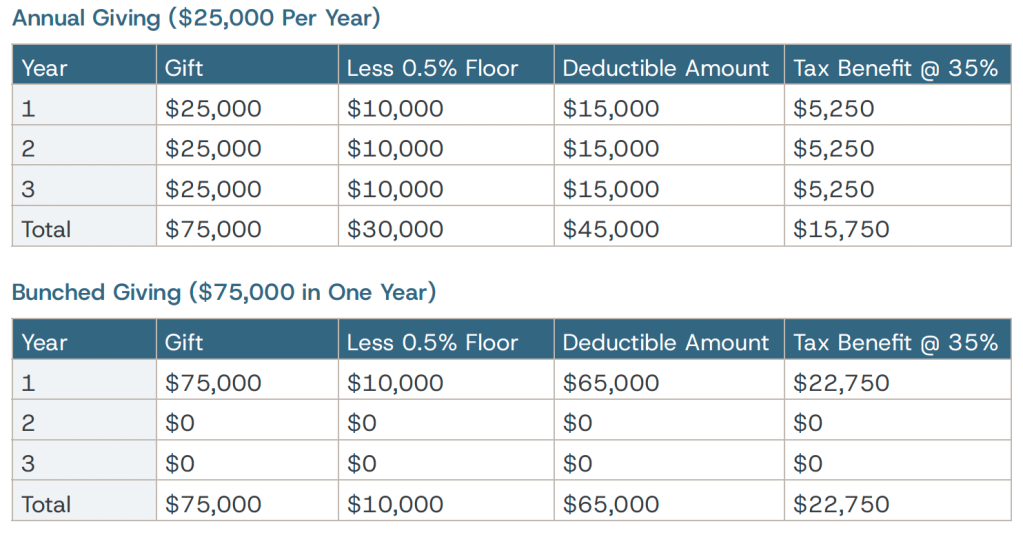
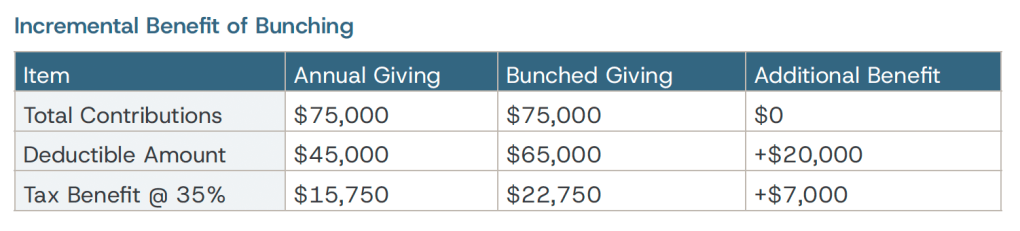
Once you know your charitable deduction floor, consider the timing of the contributions you already intend to make. Rather than giving similar amounts every year, some individuals may benefit from consolidating multiple years of planned contributions into a single year.
Scenario: Assume a married couple has $2 million in AGI each year and typically gives $25,000 annually. What would the deductible charitable contribution look like over three years if they give $25,000 annually versus contributing $75,000 in one year?
- Review What You’re Giving — Not Just How Much
Once you’ve determined how much you intend to give, consider which assets you use to fund those contributions. Cash may be straightforward, but individuals with highly appreciated investments may want to evaluate whether donating an asset directly could make sense. That approach could potentially enable you to avoid recognizing the embedded capital gain while potentially receiving a charitable deduction, subject to applicable limitations.
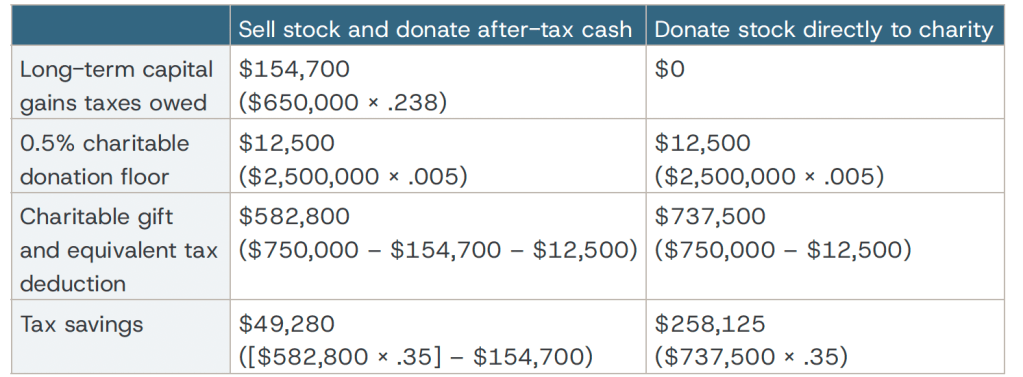
Disclaimer: This hypothetical example is for illustrative purposes only. The example assumes an original cost basis for the stock of $100,000, federal long-term capital gains tax rate of 20%, net investment income tax of 3.8%, and an adjusted gross income of $2.5 million. This example does not take into account any state or local taxes. Source: https://www.schwab.com/learn/story/tax-smart-ways-to-gift-highly-appreciated-assets
- Bring It All Together with Your Advisor
Charitable giving decisions don’t happen in isolation. Your income, investment portfolio, retirement distributions, estate plan, and other year-end tax considerations can all influence how you approach your charitable goals. Before making significant year-end contributions, consider reviewing the full picture with your financial advisor and tax professional.
In addition to traditional cash and asset gifts, you may want to consider more advanced charitable planning strategies. These could include Charitable remainder trusts (CRTs), donating life insurance policies or annuities that have outlived their original purpose, or utilizing lending and leverage strategies to fund charitable contributions. Depending on your circumstances, these approaches may provide additional deduction opportunities, enhance tax efficiency, increase your charitable impact, and support broader wealth-transfer and estate-planning goals.
[1] Attorney, R. M. (2026, July 26). One big beautiful bill: Charitable deduction changes for 2026. TurboTax Tax Tips & Videos. https://turbotax.intuit.com/tax-tips/tax-deductions-and-credits/one-big-beautiful-bill-charitable-deduction-changes-for-2026/c10OQHJpK
[2] What is a qualified charitable distribution? (n.d.). Fidelity Charitable. Retrieved October 15, 2026, from https://www.fidelitycharitable.org/guidance/philanthropy/qualified-charitable-distribution.html
This material is for general information and educational purposes only. Information is based on data gathered from what we believe are reliable sources. It is not guaranteed as to accuracy, does not purport to be complete and is not intended to be used as a primary basis for investment decisions.
Find answers to your questions about Hightower Signature Wealth
Hightower Signature Wealth is a fiduciary wealth management practice that provides investment management, financial planning, estate strategies, insurance, and banking solutions. We work with families, business owners, professionals, women, and retirees across more than 40 offices nationwide. Our advisors take the time to understand your financial priorities, develop a plan around your goals, and adjust that plan as your life and circumstances evolve.
Hightower Signature Wealth provides a broad range of wealth management services designed to address different aspects of your financial life. Our capabilities include investment management, financial planning, retirement planning, estate strategies, insurance and risk management, banking solutions, and charitable giving strategies. By considering these areas together, our advisors can develop a coordinated approach based on your goals, priorities, financial circumstances, and plans for the future.
Hightower Signature Wealth advisors work with a broad range of clients, including women, families, business owners, professionals, retirees, and high-net-worth individuals navigating major life or financial transitions. Rather than applying a generic playbook, each advisor tailors the plan to a client’s specific goals and current stage of life – from early-career decisions to multigenerational wealth transfer.
Yes. Hightower Signature Wealth advisors serve as fiduciaries, which means they are committed to acting in their clients’ interests when providing investment advice. We offer fee-based advisory services, with fees depending on the services provided and the specifics of your relationship. Your advisor will discuss the applicable fee structure with you so you can understand how you are charged and what services are included.
Hightower Signature Wealth has more than 40 offices nationwide, allowing our advisors to serve individuals, families, and organizations across the country. Depending on your location and preferences, you may be able to work with an advisor locally or connect with a team in another market. Visit our Locations page to explore our office locations, learn more about the teams in each market, and find an office near you.
Getting started with Hightower Signature Wealth is simple. Complete our online contact form with some basic information about yourself and what you are looking for, and we’ll connect you with an advisor who can discuss your needs and financial priorities. That initial conversation is an opportunity to learn more about our approach, ask questions, and determine whether working with a Hightower Signature Wealth advisor may be a good fit.
Your first conversation is an opportunity for us to learn more about you, your financial circumstances, and what you hope to accomplish. An advisor may ask about your goals, current investments, family considerations, business interests, and other priorities that could influence your financial plan. You’ll also have an opportunity to ask questions, learn about our approach, and discuss what working together could look like.