Trust vs. Will: Key Differences, Costs, and When You May Need Each
A will and a revocable living trust can both help carry out your wishes, but they work in different ways. A will generally directs how probate assets are distributed after your death. A revocable living trust can manage assets during your lifetime and transfer assets held in the trust without probate. Many estate plans include both.
Estate planning is not only about who receives your property. It can also address who will manage your financial affairs if you become incapacitated, who may care for minor children, and how and when beneficiaries receive an inheritance. Understanding the roles of a will and a trust can help you prepare for a more productive conversation with your estate planning attorney and financial advisor.
How Wills and Trusts Differ
A last will and testament is a legal document that states how you want probate assets distributed after your death. It can also name an executor or personal representative and nominate guardians for minor children. A will generally takes effect only after death and is administered through probate.
A revocable living trust is a legal arrangement you create during your lifetime. You transfer assets to the trust and name a trustee to manage them for the benefit of designated beneficiaries. You may serve as the initial trustee and retain control while you are able. A successor trustee can step in if you become incapacitated or after your death, subject to the trust’s terms.
The table below summarizes common differences. State law and the terms of your documents can affect how each feature applies.
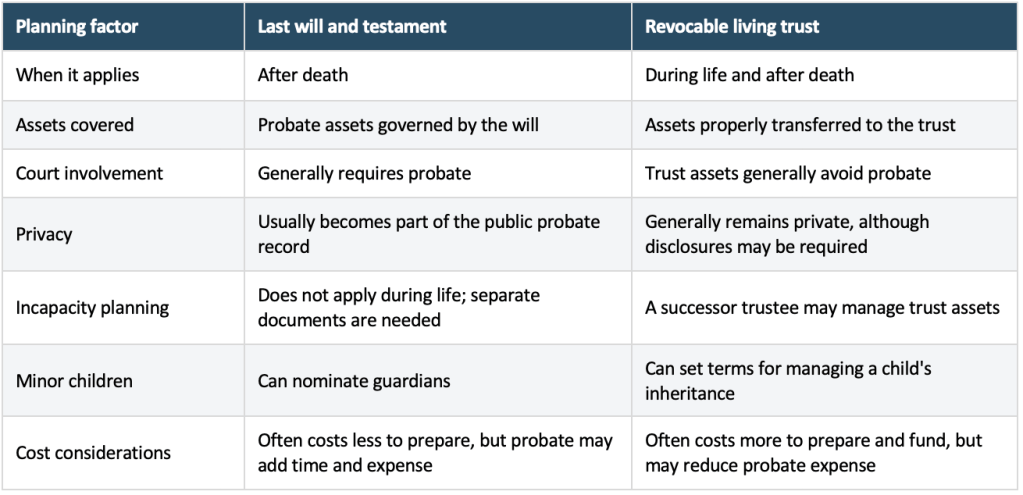
How Costs Compare
A will often has a lower upfront drafting cost because it does not require assets to be retitled during your lifetime. After death, however, probate may involve court costs, legal fees, executor or personal representative fees, appraisal expenses, and additional administrative work.
A revocable living trust generally costs more to establish because the document must be drafted and assets must be transferred to it. The trust also requires ongoing attention as you acquire, sell, or retitle property. If it is properly funded and maintained, it may reduce the time and expense associated with probate. Actual costs vary widely based on state law, estate complexity, the assets involved, and the professionals you engage.
When a Will May Be Enough
A will may serve as the primary estate planning document when your assets and wishes are relatively straightforward. Common examples include the following.
- Your estate may qualify for a simplified or small-estate procedure under state law.
- You want to nominate guardians for minor children.
- Most of your assets have valid beneficiary, transfer-on-death, or payable-on-death designations and would pass outside probate.
- You own property in one state and do not need detailed controls over the timing or conditions of an inheritance.
Even in a straightforward plan, beneficiary designations and account titles should be coordinated with the will. A will governs only assets that become part of the probate estate.
When a Revocable Living Trust May Be Useful
A trust may be appropriate when you want additional control, continuity, or privacy. It may be worth considering in the following situations.
- You own real estate in more than one state. A properly funded trust may help avoid separate probate proceedings for those properties.
- You have a blended family or want to balance support for a surviving spouse with an inheritance for children from a prior relationship.
- You want to manage distributions for young beneficiaries or release funds over time rather than as a lump sum.
- You want a successor trustee to manage trust assets if you become incapacitated.
- You value keeping the administration of trust assets outside the routine public probate process.
A trust provides these benefits only for assets that are properly transferred to it. Assets left outside the trust may still require probate or pass according to a beneficiary designation or other transfer arrangement.
Why Many Estate Plans Include Both
A revocable living trust usually does not eliminate the need for a will. Estate planning attorneys often pair a trust with a pour-over will. If an asset was not transferred to the trust during your lifetime and does not pass another way, the pour-over will directs that asset to the trust after death. The asset may still have to go through probate before it reaches the trust.
A will can also nominate guardians for minor children, which a trust cannot do. Used together, the documents can address different parts of the same plan.
Could You Need Neither
Some assets can pass without a will or trust through beneficiary designations, joint ownership, transfer-on-death registrations, or payable-on-death instructions. A person with limited assets may also qualify for a simplified estate procedure. Even so, dying without a valid will means state intestacy law determines who receives probate assets, and the court may decide who administers the estate. A basic will and incapacity documents may therefore provide useful direction even when a trust is unnecessary.
How Probate Fits into the Decision
Probate is the court-supervised process used to administer a deceased person’s probate estate. When there is a valid will, the court generally confirms the document and authorizes the executor or personal representative to collect assets, pay valid debts and expenses, and distribute the remaining property. If there is no valid will, the court appoints a personal representative and state intestacy law determines who inherits probate assets.
Assets held in a properly funded trust generally pass under the trust’s terms without probate. That can offer greater privacy and continuity, but it does not necessarily remove every court, tax, creditor, or reporting requirement.
Choosing the Right Tools for Your Family
The right approach depends on your family, assets, goals, state law, and tolerance for ongoing administration. An estate planning attorney can prepare the legal documents and explain how local law applies. Your financial advisor can help identify accounts and property that should be coordinated with the plan and can work with your attorney and tax professional as your circumstances change.
Frequently Asked Questions
Do a will and a trust serve the same purpose?
They overlap, but they are not interchangeable. A will directs the administration of probate assets after death and can nominate guardians for minor children. A revocable living trust can manage assets during life and distribute trust assets after death, generally outside probate.
Does a last will and testament avoid probate?
Generally, no. A will provides instructions for probate, but it does not avoid the process. Assets that pass through beneficiary designations, joint ownership, a trust, or another nonprobate arrangement may transfer outside the will.
Are trust documents and asset values public after death?
A revocable living trust is generally not filed as part of a routine public probate proceeding. However, disclosure may be required in certain legal, tax, creditor, or beneficiary matters, depending on state law and the circumstances.
What is a pour over will?
A pour-over will directs probate assets that were not transferred to a living trust during your lifetime into the trust after death. It serves as a backup, but those assets may still pass through probate first.
Does a trust replace a power of attorney?
Not necessarily. A successor trustee generally has authority over trust assets. A durable power of attorney may still be needed for financial matters involving property outside the trust, and separate health care documents are typically used for medical decisions.
This material is for general information and educational purposes only. Information is based on data gathered from what we believe are reliable sources. It is not guaranteed as to accuracy, does not purport to be complete and is not intended to be used as a primary basis for investment decisions.
Find answers to your questions about Hightower Signature Wealth
Hightower Signature Wealth is a fiduciary wealth management practice that provides investment management, financial planning, estate strategies, insurance, and banking solutions. We work with families, business owners, professionals, women, and retirees across more than 40 offices nationwide. Our advisors take the time to understand your financial priorities, develop a plan around your goals, and adjust that plan as your life and circumstances evolve.
Hightower Signature Wealth provides a broad range of wealth management services designed to address different aspects of your financial life. Our capabilities include investment management, financial planning, retirement planning, estate strategies, insurance and risk management, banking solutions, and charitable giving strategies. By considering these areas together, our advisors can develop a coordinated approach based on your goals, priorities, financial circumstances, and plans for the future.
Hightower Signature Wealth advisors work with a broad range of clients, including women, families, business owners, professionals, retirees, and high-net-worth individuals navigating major life or financial transitions. Rather than applying a generic playbook, each advisor tailors the plan to a client’s specific goals and current stage of life – from early-career decisions to multigenerational wealth transfer.
Yes. Hightower Signature Wealth advisors serve as fiduciaries, which means they are committed to acting in their clients’ interests when providing investment advice. We offer fee-based advisory services, with fees depending on the services provided and the specifics of your relationship. Your advisor will discuss the applicable fee structure with you so you can understand how you are charged and what services are included.
Hightower Signature Wealth has more than 40 offices nationwide, allowing our advisors to serve individuals, families, and organizations across the country. Depending on your location and preferences, you may be able to work with an advisor locally or connect with a team in another market. Visit our Locations page to explore our office locations, learn more about the teams in each market, and find an office near you.
Getting started with Hightower Signature Wealth is simple. Complete our online contact form with some basic information about yourself and what you are looking for, and we’ll connect you with an advisor who can discuss your needs and financial priorities. That initial conversation is an opportunity to learn more about our approach, ask questions, and determine whether working with a Hightower Signature Wealth advisor may be a good fit.
Your first conversation is an opportunity for us to learn more about you, your financial circumstances, and what you hope to accomplish. An advisor may ask about your goals, current investments, family considerations, business interests, and other priorities that could influence your financial plan. You’ll also have an opportunity to ask questions, learn about our approach, and discuss what working together could look like.