How a Pour-Over Will Works With a Living Trust
A pour-over will can serve as a backup for assets that were not transferred to your living trust during your lifetime. It does not, however, eliminate probate.
A revocable living trust requires ongoing attention. As you open accounts, acquire real estate, or make new investments, some assets may remain in your individual name rather than being transferred to the trust.
A pour-over will is designed to address those assets after your death. It directs them to your trust so they can be distributed under the trust’s terms. Because the will generally operates through probate, it is best viewed as a backup rather than a substitute for properly funding the trust. The following sections explain how a pour-over will works with a living trust, what it can and cannot accomplish, and which common mistakes to avoid.
What Is a Pour-Over Will
A pour-over will is a type of will designed to work with a living trust. It directs assets still held in your individual name at death to the trust. Those assets can then be managed and distributed according to the trust’s instructions, rather than passing under state intestacy laws when no valid will governs them. A pour-over will can also nominate an executor to administer your probate estate and, if you have minor children, nominate a guardian. State law and the court ultimately determine who may serve, so these provisions should be prepared with an estate-planning attorney.
How a Pour-Over Will and Living Trust Work Together
The documents have distinct, complementary roles. The table below summarizes how they differ.
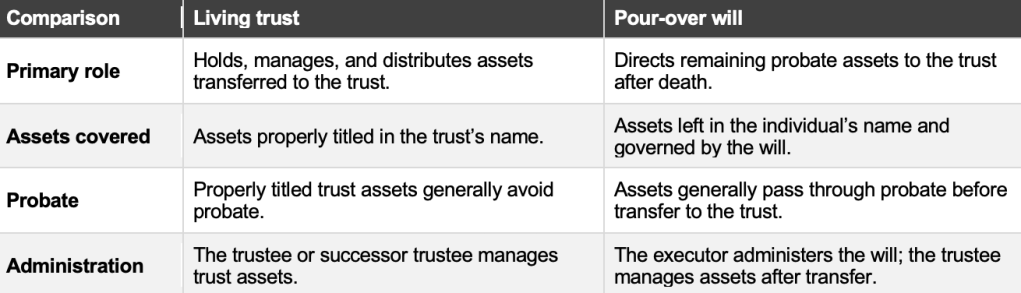
Some families name the same person as executor and successor trustee to simplify coordination. These are separate roles with different responsibilities, however, and the best choice depends on the individuals involved and the terms of the estate plan.
What a Pour-Over Will Can and Cannot Do
A pour-over will can help coordinate your estate plan by bringing assets under the same trust terms as property already held in the trust. This may be especially useful when the trust includes provisions for staggered distributions or education expenses. After probate, the trustee can manage the transferred assets alongside other trust property. Trust administration is generally private, although the will and information filed during probate may become part of the public record.
A pour-over will does not avoid probate for assets left in your individual name. Timing, costs, and simplified procedures for smaller estates vary by state. A pour-over will and a revocable living trust also do not, by themselves, exclude assets from your estate for estate-tax purposes or prevent creditors from submitting claims against the probate estate. The will and certain information about probate assets may become public records.
Common Pour-Over Will Mistakes
A pour-over will works best as part of a coordinated estate plan. One common mistake is creating a trust without fully funding it. If real estate, financial accounts, and other assets remain in your individual name, more property may need to pass through probate. Review how each asset is titled and follow your attorney’s instructions for transferring appropriate assets to the trust. Beneficiary designations also require careful coordination because retirement accounts, life insurance policies, and similar assets generally pass according to those forms, not under the will. Naming a trust as beneficiary can have significant tax and legal consequences, so discuss these decisions with your estate-planning attorney, tax professional, and financial advisor.
Your documents should also remain aligned over time. If you amend, revoke, or replace a trust, confirm that the pour-over will still refers to the correct trust and remains effective under applicable state law. If you have minor children, remember that a trust does not nominate a guardian. Discuss the appropriate will provisions with an estate-planning attorney.
Next Steps
Begin by reviewing how your assets are titled, confirming your beneficiary designations, and identifying any property that has not been transferred to your trust. Revisit the plan after a major life event, a significant change in assets, or an update to the trust. Your Hightower Signature Wealth advisor can help you consider how your estate plan fits within your broader financial plan and coordinate with your estate-planning attorney and tax professional. Your attorney can advise you on the documents and requirements that apply in your state.
Frequently Asked Questions
If I already have a living trust, do I still need a pour-over will? A pour-over will is commonly used as a backup to a living trust because assets may be unintentionally left outside the trust. Whether you need one depends on your circumstances and state law. An estate-planning attorney can help you determine the appropriate documents for your plan.
Do assets transferred through a pour-over will require probate? Generally, yes. Assets governed by a pour-over will typically pass through probate before they can be transferred to the trust. Some states offer simplified procedures for smaller estates, but eligibility and thresholds vary.
How is a pour-over will different from an ordinary will? A conventional will generally directs probate assets to named beneficiaries. A pour-over will directs those assets to a trust, which then governs their management and distribution.
How often should I review my living trust and pour-over will? Review your estate plan periodically and after major events, such as marriage, divorce, the birth or adoption of a child, a significant change in assets, or a move to another state. Your attorney and financial advisor can help you determine whether updates are appropriate.
Sources
- https://www.investopedia.com/terms/p/pour-overwill.asp
- https://sanderslawyers.com/blog/understanding-pour-over-wills-in-estate-planning/
- https://www.ubt.com/learning-center/blogs/pairing-living-trust-pour-over-will-can-help-cover-all-your-assets
Investing involves risk, including the possible loss of principal, and no investment process or strategy is guaranteed to be profitable. Past performance does not guarantee future results, and any investments mentioned may not be suitable for all investors. Hypothetical examples are for illustrative purposes only, do not represent actual results, and actual results and individual experiences may differ.
This material is for general informational and educational purposes only. It is not individualized investment, tax, legal or insurance advice, or a recommendation to buy or sell any security or insurance product. Consult qualified professionals regarding your individual circumstances. Views expressed are solely those of the [author(s) and do not necessarily reflect the views of Hightower Advisors, LLC or any of its affiliates.
All information referenced is current as of the publication date and may change without notice. Although obtained from sources believed to be reliable, Hightower Advisors, LLC, and their respective affiliates do not guarantee its accuracy or completeness. References or links to third-party content do not constitute an endorsement of any third party or its products, services, or views. Click here for definitions of and disclosures specific to commonly used terms.
Hightower Signature Wealth is a group comprised of investment professionals associated, and/or registered, with Hightower Advisors, LLC, an SEC registered investment advisor. Some investment professionals may also be registered with Hightower Securities, LLC, member FINRA and SIPC.
Find answers to your questions about Hightower Signature Wealth
Hightower Signature Wealth is a fiduciary wealth management practice that provides investment management, financial planning, estate strategies, insurance, and banking solutions. We work with families, business owners, professionals, women, and retirees across more than 40 offices nationwide. Our advisors take the time to understand your financial priorities, develop a plan around your goals, and adjust that plan as your life and circumstances evolve.
Hightower Signature Wealth provides a broad range of wealth management services designed to address different aspects of your financial life. Our capabilities include investment management, financial planning, retirement planning, estate strategies, insurance and risk management, banking solutions, and charitable giving strategies. By considering these areas together, our advisors can develop a coordinated approach based on your goals, priorities, financial circumstances, and plans for the future.
Hightower Signature Wealth advisors work with a broad range of clients, including women, families, business owners, professionals, retirees, and high-net-worth individuals navigating major life or financial transitions. Rather than applying a generic playbook, each advisor tailors the plan to a client’s specific goals and current stage of life – from early-career decisions to multigenerational wealth transfer.
Yes. Hightower Signature Wealth advisors serve as fiduciaries, which means they are committed to acting in their clients’ interests when providing investment advice. We offer fee-based advisory services, with fees depending on the services provided and the specifics of your relationship. Your advisor will discuss the applicable fee structure with you so you can understand how you are charged and what services are included.
Hightower Signature Wealth has more than 40 offices nationwide, allowing our advisors to serve individuals, families, and organizations across the country. Depending on your location and preferences, you may be able to work with an advisor locally or connect with a team in another market. Visit our Locations page to explore our office locations, learn more about the teams in each market, and find an office near you.
Getting started with Hightower Signature Wealth is simple. Complete our online contact form with some basic information about yourself and what you are looking for, and we’ll connect you with an advisor who can discuss your needs and financial priorities. That initial conversation is an opportunity to learn more about our approach, ask questions, and determine whether working with a Hightower Signature Wealth advisor may be a good fit.
Your first conversation is an opportunity for us to learn more about you, your financial circumstances, and what you hope to accomplish. An advisor may ask about your goals, current investments, family considerations, business interests, and other priorities that could influence your financial plan. You’ll also have an opportunity to ask questions, learn about our approach, and discuss what working together could look like.