What Is a Roth IRA, and Is It Right for Me?
In recent years, such headlines about Roth IRAs have become commonplace, stemming from the prospect of increasing tax rates and the passage of the Setting Every Community Up for Retirement Enhancement Act of 2019 (SECURE Act) and the subsequent SECURE 2.0 Act passed in 2022.
But what exactly is a Roth IRA? Who should have one? And is it worth taking the time to find out — especially if you already have retirement accounts?
In short, the answer is yes. While Roth IRAs aren’t for everyone — nor is everyone eligible to contribute to one — the potential tax savings associated with them, and other key benefits, can make a meaningful difference in one of the most important financial journeys one can take: preparing for retirement.
Here is some baseline information about Roth IRAs to help you begin considering whether one might be right for you.
What does “Roth” stand for?
Roth IRAs are named after former Delaware Senator William V. Roth, Jr., who was instrumental in legislation passed into law in 1997 that established the account type — allowing individuals to invest after-tax income into IRAs that can be withdrawn tax-free in retirement. Senator Roth served 34 years in Congress, during which he chaired the Senate Finance Committee, the Governmental Affairs Committee and the Permanent Subcommittee on Investigations.1
What is a Roth IRA?
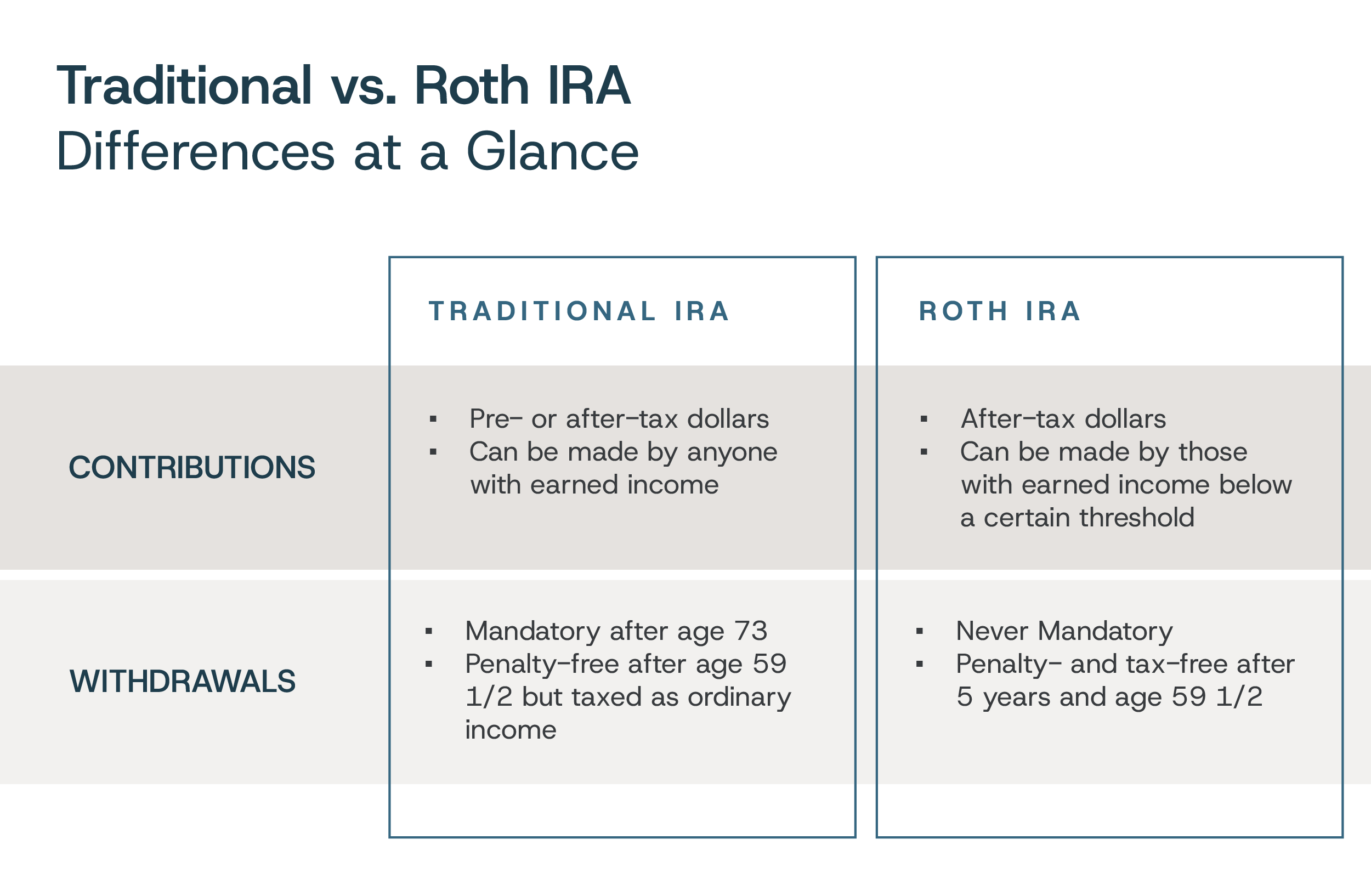
A Roth IRA is a retirement savings vehicle that differs from most retirement savings accounts in that contributions are made with after-tax dollars, and withdrawals are tax exempt, assuming certain requirements are met. The inverse is generally true for traditional IRAs: qualified contributions are tax deductible, but withdrawals count towards taxable income.
How else do Roth IRAs differ from traditional IRAs?
Other main differences include the following:
- Withdrawals after the age of 72 are not mandatory
- Penalty-free withdrawals can be made under a wider set of circumstances, including if they:
- Come from contributions you have made rather than earnings on your contributions
- Were made because you are disabled
- Were made to a beneficiary or to your estate after your death
- Were made to buy or rebuild a first home, subject to various Internal Revenue Service (IRS) requirements
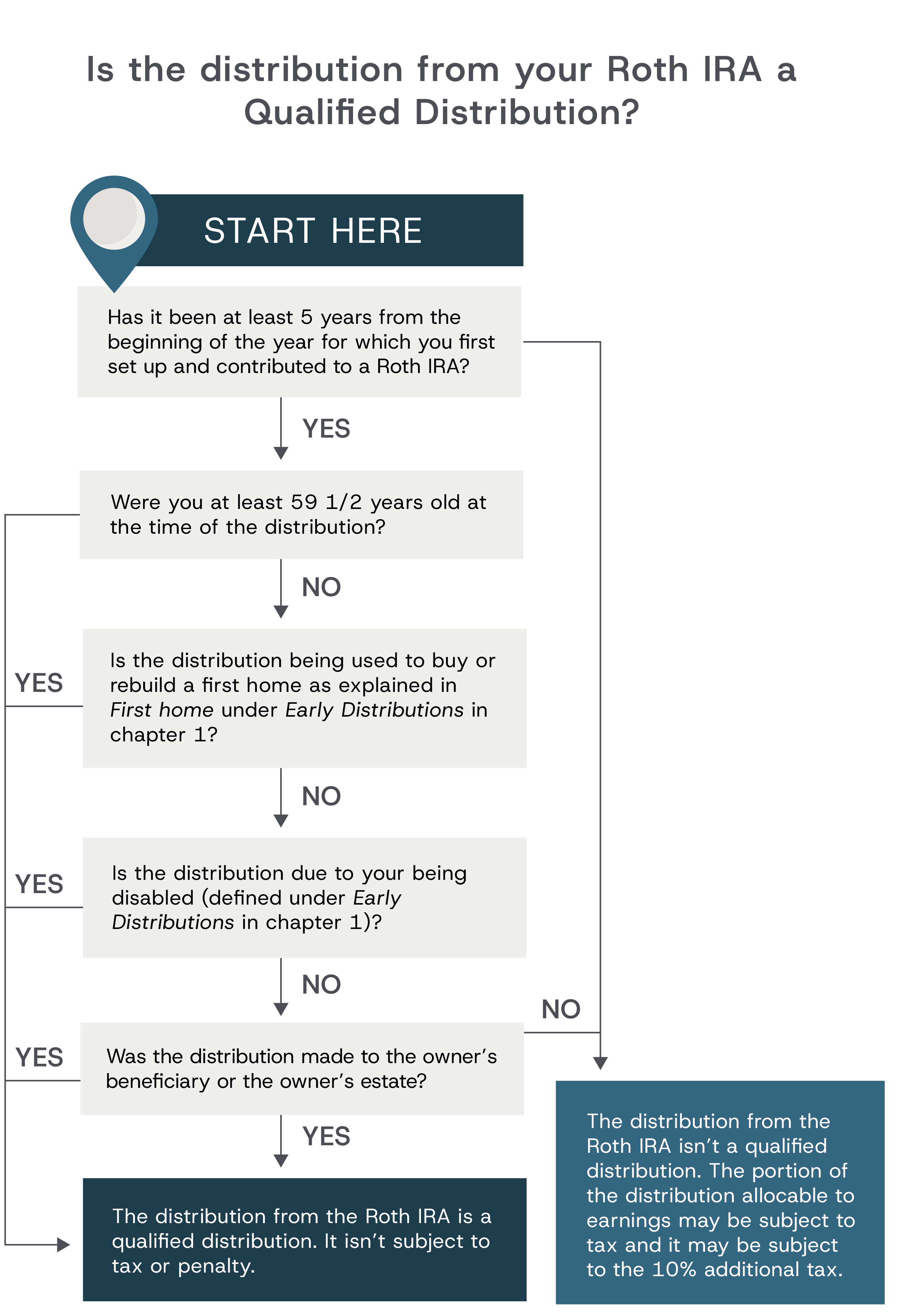
The below flowchart from the IRS provides a useful guide for determining if a distribution from a Roth IRA would be tax and penalty free.2
Can anyone own a Roth IRA?
Anyone can own a Roth IRA, but only taxpayers below certain income thresholds can contribute to one. In 2026, the threshold for single taxpayers is $153,000 with a contribution phase-out beginning at $168,000, and the threshold for joint filers is $242,000 with a contribution phase-out beginning at $252,000.
The following chart from the IRS summarizes this eligibility criteria3:
| Filing Status | MAGI | Contribution Limit |
| Single individuals | <$153,000 | Under age 50: $7,500 50 and older: $8,600 |
| ≥$153,000 but <$168,000 | Partial contribution | |
| ≥$168,000 | Not eligible | |
| Married (filing joint returns) | <$242,000 | Under age 50: $7,500 50 and older: $8,600 |
| ≥$242,000 but <$252,000 | Partial contribution | |
| ≥$252,000 | Not eligible | |
| Married (filing separately) | <$10,000 | Partial contribution |
| ≥$10,000 | Not eligible |
How much can you contribute to a Roth IRA?
For 2026, the total contributions you make to all of your traditional Roth IRAs can’t be more than:
- $7,500 ($8,600 if you’re age 50 or older)4, or
- If less, your taxable compensation for the year
You can contribute to a Roth IRA, if you otherwise are eligible, even if you participate in another retirement plan through your employer or business. You (or your spouse) can also set up and contribute to a Roth IRA if your spouse (or you) is not working (or working part-time), based on the earnings of the working spouse. This type of IRA is often called a “spousal IRA.” This means that, based on 2026 contribution limits, you could contribute a total of $15,000 ($17,200 if you’re age 50 or older) as a couple.
Why would someone choose a Roth IRA over a traditional IRA?
The main reason you might decide to contribute to a Roth IRA instead of a traditional IRA is if you expect your taxable income to be higher in retirement than it is now. If that is the case, taking the tax hit now (rather than when you make withdrawals in retirement) while at a lower tax rate could make sense.
Another reason a Roth IRA may be preferred is if you expect to transfer your retirement assets to your heirs rather than spend it. In most cases, beneficiaries of Roth IRAs can make tax-free withdrawals from a Roth IRA over 10 years.
There may be other reasons for establishing or converting to a Roth IRA, including if you expect income taxes more generally to rise in future years. In any case, your financial advisor and accountant can help you determine if you are a good candidate.
What is a Roth conversion?
If you own a traditional IRA, you can convert it into a Roth IRA by taking a distribution that is subject to federal income tax. But in the conversion process, if you are under age 59½, you are not subject to the 10% tax on premature distributions from traditional IRAs. However, if you subsequently take a distribution from the Roth IRA within five years of the conversion date, then a 10% penalty tax applies.
Examples of favorable conversion scenarios include:
- When your income and taxes are relatively low, for example, in retirement
- During stressed markets when asset values are lower, lessening the tax liability from the conversion and allowing you to buy securities within the Roth IRA at much lower values, with the opportunity to capture subsequent appreciation
- When you have determined you have sufficient assets to fund your retirement without making withdrawals from your retirement accounts (which become mandatory at age 73 based on your birth year, for a traditional IRA)
What is a “backdoor” Roth?
As previously described, under current law, taxpayers with income (in 2026) of at least $168,000 ($252,000 if married) are prohibited from contributing to a Roth IRA. “Backdoor” and “mega backdoor” Roth contributions are strategies that allow high earners to participate in Roth accounts nonetheless.
A “backdoor” Roth contribution strategy works as follows:
- Although higher earners (as defined above) are barred from contributing to a Roth IRA, they are allowed to convert traditional IRA assets into a Roth IRA.
- When converting traditional IRA assets into a Roth IRA, taxpayers owe tax on the gains that have accrued from their contributions.
- To avoid paying taxes on gains from converting traditional IRA assets into a Roth IRA, taxpayers can make contributions to their traditional IRA account and then immediately convert those funds into Roth IRAs, leaving no time for the money to grow and shielding future appreciation from future taxes.
There is also a “mega backdoor” conversion strategy applicable to workers who have employer-sponsored retirement plans that allow after-tax contributions and after-tax conversions to a Roth 401(k). If both these features are offered, participants can take full advantage of the $72,000 annual retirement savings plan contribution limit in 20265 (for both employee and employer contributions) by making after-tax contributions, and then converting those contributions to a Roth 401(k).
Under previously proposed changes to tax law, these backdoor strategies would no longer be viable. While these proposals ultimately did not become law, it is still possible that they are revisited by legislators in the future.
Also, if you decide to explore a backdoor strategy, beware of the IRA Aggregation Rule, the IRS’s consolidation of an individual’s traditional IRA accounts into one vehicle for tax purposes. It could subject after-tax contributions you have previously made to the accounts you are converting to additional taxes, so you will need to carefully assess the composition of the assets you plan to convert with your financial advisor.
How can I decide if a Roth IRA is right for me?
Deciding between a Roth IRA and traditional IRA can be difficult without perfect foresight into the future. And sometimes the answer is “both.” Likewise, deciding if, when and how to convert to a Roth IRA or make the most of a “backdoor” strategy can be even more complicated. To help guide your decision, please reach out to us. We can coordinate with your accountant to make a well-informed decision and streamline the process.
[1] Delaware Historical Society. (2022, October 11). Biography – Senator William V Roth – Delaware Historical Society. https://dehistory.org/collections/about-our-collections/senator-william-v-roth-collection/biography/
[2] Source: Internal Revenue Service. “Publication 590-B (2021), Distributions from Individual Retirement Arrangements (IRAs),” retrieved from https://www.irs.gov/publications/p590b#en_US_2021_publink100089542. Updated April 5, 2023.
[3] 2026 Roth & Traditional IRA Income & deduction Limits TIAA | TIAA. (n.d.). Retrieved March 19, 2026, from https://www.tiaa.org/public/retire/financial-products/iras/ira-contributions-tax-benefits/income-and-deduction-limits
[4] Roth IRA income and contribution limits for 2026. Vanguard. (n.d.). https://investor.vanguard.com/investor-resources-education/iras/roth-ira-income-limits. Accessed 19 Mar. 2026.
[5] Roth 401(k) contribution limits for 2025 and 2026. (2025, December 19). Fidelity. https://www.fidelity.com/learning-center/smart-money/roth-401k-contribution-limits
This material is for general information and educational purposes only. Information is based on data gathered from what we believe are reliable sources. It is not guaranteed as to accuracy, does not purport to be complete and is not intended to be used as a primary basis for investment decisions.
Find answers to your questions about Hightower Signature Wealth
Hightower Signature Wealth is a fiduciary wealth management practice that provides investment management, financial planning, estate strategies, insurance, and banking solutions. We work with families, business owners, professionals, women, and retirees across more than 40 offices nationwide. Our advisors take the time to understand your financial priorities, develop a plan around your goals, and adjust that plan as your life and circumstances evolve.
Hightower Signature Wealth provides a broad range of wealth management services designed to address different aspects of your financial life. Our capabilities include investment management, financial planning, retirement planning, estate strategies, insurance and risk management, banking solutions, and charitable giving strategies. By considering these areas together, our advisors can develop a coordinated approach based on your goals, priorities, financial circumstances, and plans for the future.
Hightower Signature Wealth advisors work with a broad range of clients, including women, families, business owners, professionals, retirees, and high-net-worth individuals navigating major life or financial transitions. Rather than applying a generic playbook, each advisor tailors the plan to a client’s specific goals and current stage of life – from early-career decisions to multigenerational wealth transfer.
Yes. Hightower Signature Wealth advisors serve as fiduciaries, which means they are committed to acting in their clients’ interests when providing investment advice. We offer fee-based advisory services, with fees depending on the services provided and the specifics of your relationship. Your advisor will discuss the applicable fee structure with you so you can understand how you are charged and what services are included.
Hightower Signature Wealth has more than 40 offices nationwide, allowing our advisors to serve individuals, families, and organizations across the country. Depending on your location and preferences, you may be able to work with an advisor locally or connect with a team in another market. Visit our Locations page to explore our office locations, learn more about the teams in each market, and find an office near you.
Getting started with Hightower Signature Wealth is simple. Complete our online contact form with some basic information about yourself and what you are looking for, and we’ll connect you with an advisor who can discuss your needs and financial priorities. That initial conversation is an opportunity to learn more about our approach, ask questions, and determine whether working with a Hightower Signature Wealth advisor may be a good fit.
Your first conversation is an opportunity for us to learn more about you, your financial circumstances, and what you hope to accomplish. An advisor may ask about your goals, current investments, family considerations, business interests, and other priorities that could influence your financial plan. You’ll also have an opportunity to ask questions, learn about our approach, and discuss what working together could look like.