Market Note: Confidence Returns as Growth Broadens
- Markets at All-Time High The S&P 500 and NASDAQ have climbed to all-time highs, overall up 13% from April lows. The shift reflects how the market has worked through several key areas of uncertainty, most notably tariffs, geopolitics, inflation, and monetary policy, or what I refer to as TGIF. Earlier this year, concerns around these issues were at peak levels, but conditions have steadily improved.
Tariffs have been absorbed by companies with less disruption than feared, and while they may add modestly to inflation, the broader risk of a runaway spike has diminished. Inflation is likely to hover near 3 percent, but in the context of a three to three and a half percent GDP environment this is both manageable and supportive of corporate earnings. Geopolitical risks are always present, but tensions have eased relative to the heightened rhetoric earlier this year, creating a calmer backdrop for risk assets.
The Federal Reserve has shifted into a rate-cutting cycle, having already delivered a 25 basis point reduction. Markets expect at least two more cuts before year-end, followed by another three by the end of 2026. Importantly, the Fed has recognized that tariff-related inflation is more of a one- time adjustment than a persistent trend. With monetary policy now geared toward risk management, the central bank is signaling support for growth. Taken together, this combination of steady GDP expansion, controlled inflation, and an accommodative Fed provides fertile ground for corporate profitability and continued market strength.
- Capex, Buybacks, and M&A Momentum Companies are ready with free cash flow, and they are deploying it in ways that directly benefit shareholders through dividends and buybacks, while also investing heavily for the future. Capital expenditure is no longer limited to artificial intelligence and data center projects. Broader capital goods spending is accelerating, up 13 percent year-over-year, underscoring confidence in sustained growth1.
Mergers and acquisitions are another sign of this confidence. Completed transactions in 2025 have already reached 2.7 trillion dollars, up 40 percent compared to last year2. M&A activity tends to increase when management teams see durable opportunities, and today’s surge is a reflection of both financial strength and optimism about future earnings. As we enter the seasonally strong fourth quarter, this backdrop argues for using any short-term volatility as an opportunity to increase equity exposure.
- Sector and Theme Leadership Market leadership is broadening beyond mega-cap technology, which is healthy for the cycle. Financials and consumer discretionary names are positioned for outperformance, supported by a strong back-to-school season that bodes well for the holidays. Industrials and materials are participating in the structural buildout of the AI data center ecosystem, grid, and power infrastructure, while also benefitting from traditional capital spending.
Technology remains critical, but the long-term growth profile of cybersecurity is becoming even more compelling. Industry consolidation is likely to accelerate as demand scales. In aviation, Boeing and Airbus enjoy a duopoly with a backlog of 13,000 aircraft, providing visibility into years of production. Housing continues to stand out as an attractive theme. Mortgage rates have eased from 7.41 percent in January to 6.40 percent today, and while they likely need to reach the 5 percent range to unlock full demand, the supply shortage of five million homes provides structural support3.
Other long-duration growth markets also remain attractive. Animal health is a 60 billion dollar industry today and is projected to more than double to 140 billion dollars by 2030. Ride-sharing platforms, led by Uber, are expanding into what is currently a 400 billion dollar market with the potential to reach 5 trillion dollars by the end of the decade4. Auto parts represent another cyclical opportunity tied to housing and interest rates, particularly where corporate spin-offs create shareholder value. Finally, exchanges such as Coinbase remain well positioned regardless of the direction of cryptocurrency prices, since they benefit from trading activity on both sides of the market.
- The Road Ahead The near-term calendar is relatively light, but important data points remain. The final second quarter GDP report is expected to show growth of approximately 3.3 percent, and purchasing managers’ indices will provide additional color on the pace of expansion. On the earnings front, Micron, Accenture, and Costco will be in focus. Costco’s consistent strength in monthly sales suggests another solid report, though valuation remains a consideration.
With risks fading, central banks leaning supportive, and corporate balance sheets healthy, the outlook for equities remains strongly positive. The combination of robust capital investment, expanding M&A, and broadening sector leadership sets the stage for further gains. Any short-term pullbacks should be viewed as opportunities to increase exposure, as earnings momentum and corporate confidence continue to drive this bull market forward.
- Fixed Income The U.S. Treasury curve rose in a bear steepener last week following dovish remarks from Chair Powell and the FOMC Dot Plot, which reinforced expectations for a more accommodative policy stance. Investors continued to price in additional easing this year, building on the Federal Reserve’s widely anticipated 25 basis point rate cut at the September FOMC meeting. By weeks end, the 2-, 10-, and 30-year yields were higher by 2, 6, & 6 basis points, respectively. Attention shifts this week to the final 2Q GDP estimate on Thursday and August PCE on Friday.
Investment-grade and high-yield spreads moved tighter last week. Investment-grade spreads tightened 2 basis points to + 115, while high-yield spreads narrowed 10 basis points to + 326. Concurrently, U.S. credit quality improved as the main rating agencies issued 37 upgrades versus 30 downgrades5. The Financial Sector led with the most upgrades, while the Materials Sector had the most downgrades.
Tax-exempt yield exhibited a small rally across the curve last week, finishing lower by 1-3 basis points, respectively. This week’s primary marker is expected to remain supported, underpinned by a manageable $15 billion in municipal supply.
The Week Ahead
Economics- Monday: Central Bank, Tuesday: Central Bank, Producer Prices, Wednesday: Housing and Construction Thursday: Labor Market, Wholesale Inventory, Central Bank, Durable Orders, Friday: Central Bank, Inflation, National Accounts
Earnings –Tuesday: AZO, MU, Wednesday: CTAS, Thursday: ACN, JBL, KMX, COST
Returns for Selected Indices6
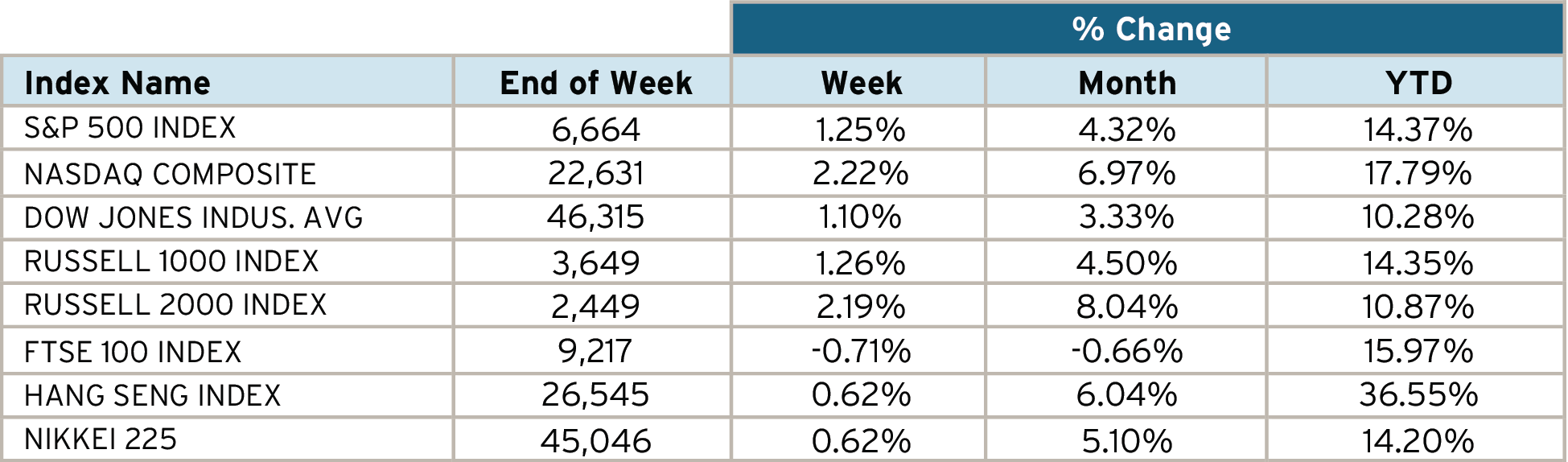
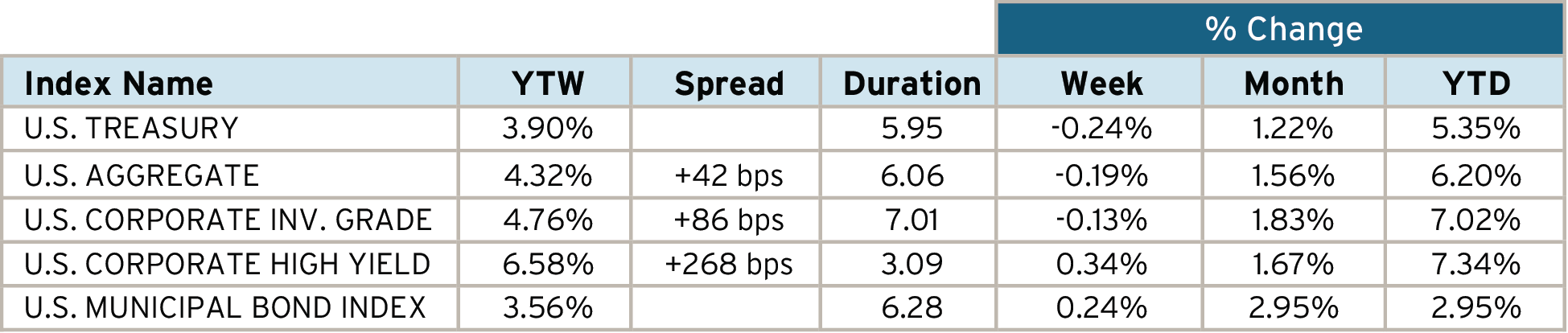
1 Bloomberg, as of September 2025
2 Bloomberg, as of September 2025
3 Bloomberg, as of September 2025
4 Bloomberg, as of September 2025
5 Bloomberg, as of September 2025
6 Bloomberg. As of September 22, 2025.
This material is for general information and educational purposes only. Information is based on data gathered from what we believe are reliable sources. It is not guaranteed as to accuracy, does not purport to be complete and is not intended to be used as a primary basis for investment decisions.
Find answers to your questions about Hightower Signature Wealth
Hightower Signature Wealth is a fiduciary wealth management practice that provides investment management, financial planning, estate strategies, insurance, and banking solutions. We work with families, business owners, professionals, women, and retirees across more than 40 offices nationwide. Our advisors take the time to understand your financial priorities, develop a plan around your goals, and adjust that plan as your life and circumstances evolve.
Hightower Signature Wealth provides a broad range of wealth management services designed to address different aspects of your financial life. Our capabilities include investment management, financial planning, retirement planning, estate strategies, insurance and risk management, banking solutions, and charitable giving strategies. By considering these areas together, our advisors can develop a coordinated approach based on your goals, priorities, financial circumstances, and plans for the future.
Hightower Signature Wealth advisors work with a broad range of clients, including women, families, business owners, professionals, retirees, and high-net-worth individuals navigating major life or financial transitions. Rather than applying a generic playbook, each advisor tailors the plan to a client’s specific goals and current stage of life – from early-career decisions to multigenerational wealth transfer.
Yes. Hightower Signature Wealth advisors serve as fiduciaries, which means they are committed to acting in their clients’ interests when providing investment advice. We offer fee-based advisory services, with fees depending on the services provided and the specifics of your relationship. Your advisor will discuss the applicable fee structure with you so you can understand how you are charged and what services are included.
Hightower Signature Wealth has more than 40 offices nationwide, allowing our advisors to serve individuals, families, and organizations across the country. Depending on your location and preferences, you may be able to work with an advisor locally or connect with a team in another market. Visit our Locations page to explore our office locations, learn more about the teams in each market, and find an office near you.
Getting started with Hightower Signature Wealth is simple. Complete our online contact form with some basic information about yourself and what you are looking for, and we’ll connect you with an advisor who can discuss your needs and financial priorities. That initial conversation is an opportunity to learn more about our approach, ask questions, and determine whether working with a Hightower Signature Wealth advisor may be a good fit.
Your first conversation is an opportunity for us to learn more about you, your financial circumstances, and what you hope to accomplish. An advisor may ask about your goals, current investments, family considerations, business interests, and other priorities that could influence your financial plan. You’ll also have an opportunity to ask questions, learn about our approach, and discuss what working together could look like.