Understanding Qualified Charitable Distributions (QCDs)
What Is a QCD?
If you have investments in pretax retirement accounts (i.e., IRAs, 401(k)s, etc.), the IRS requires you to take taxable required minimum distributions (RMDs) from these accounts on an annual basis once you reach age 73.[1] These RMDs begin as a relatively small percentage of your retirement assets but increase over time as you age, potentially creating a high tax burden and possibly even pushing you into a higher income tax bracket or phasing you out from other tax deductions.
Qualified charitable distributions (QCDs) provide the opportunity for those who are charitably inclined — and don’t need the RMDs for cash flow — to mitigate this tax burden. They are a special provision in the tax code that allows IRA owners to make tax-free gifts of up to $108,000 for tax year 2025[2] (indexed for inflation) to eligible charities.
In addition to reducing your taxable income by up to $108,000, QCDs enable you to potentially make a larger charitable impact, as they don’t count toward the maximum amount deducted if you itemize your taxes.
What Are the Potential Benefits?
Examples
To better understand how they work and their potential benefits, consider the following two scenarios. In both cases, the IRA owner is required to take a Required Minimum Distribution of $100,000 from their IRA and wants to give that entire amount to a qualified charity.
Scenario 1
Donor takes required minimum distribution from IRA, then donates it to charity
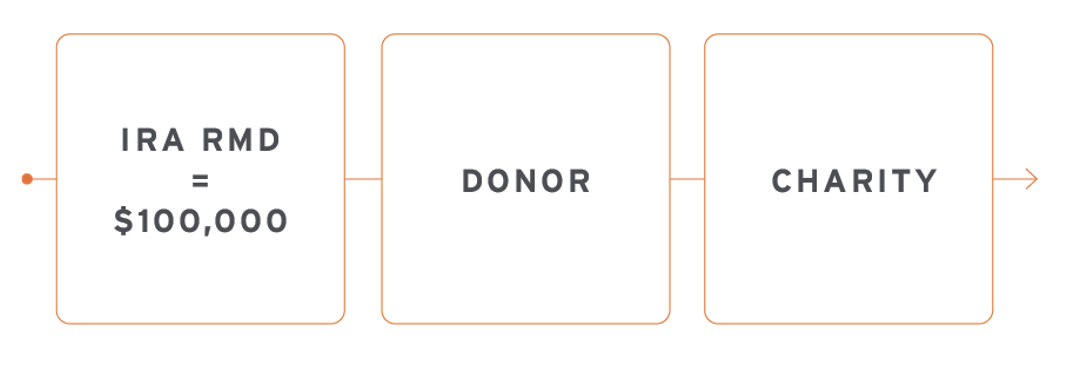
- The RMD is distributed to the IRA owner
- The owner writes a check to charity
- The entire distribution is added to the IRA owner’s gross income for that tax year and can be added to schedule A as an itemized deduction subject to a limitation of 60% of adjusted gross income (AGI)
- If the owner’s standard deduction — $31,500 in 2025 (married filing jointly), plus $1,600 for those over the age of 65 — is greater than the total of all itemized deductions, there is no tangible tax benefit for making the donation
- The IRA owner can still itemize other charitable donations on Schedule A if advantageous
- Certain other deductions may be limited / reduced due to the owner’s higher AGI
Scenario 2
Donor distributes required minimum distribution directly from IRA to charity
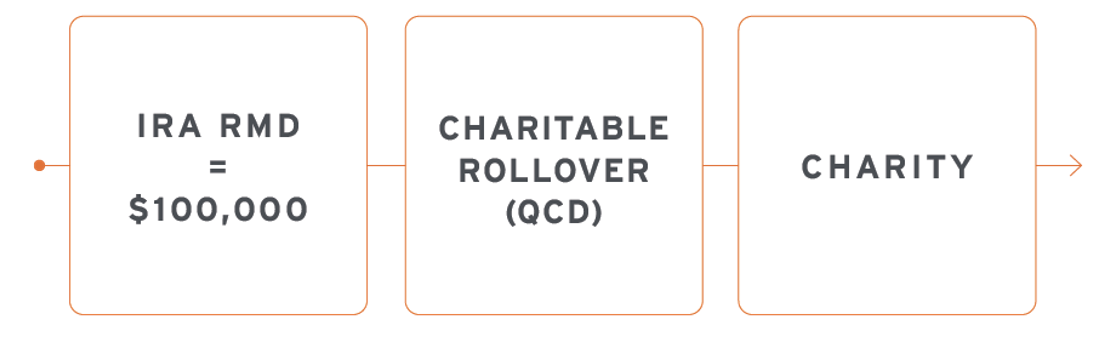
- The RMD is distributed directly from the owner’s IRA to the charity
- The owner’s RMD is satisfied, and the distribution is not included in the owner’s taxable income
- This particular donation is not itemized as a deduction on Schedule A (Form 1040 1040-SR) because it has already been excluded from taxation
- The donation may help reduce taxes on the owner’s Social Security income and prevent the loss or reduction of certain other deductions
- Other gifts to charity may still be itemized on Schedule A if advantageous
One-Time Additional $54,000 QCD
It’s important to also note that, starting in tax year 2023, retirement account owners who are 70 ½ and older may also make an additional one-time $54,000[3] distribution directly from their retirement account to a charitable gift annuity, charitable remainder unitrust (CRUT) or charitable remainder annuity trust (CRAT), which they can treat as a QCD made directly to a charity for tax purposes. And this amount counts toward the owner’s RMD, if applicable.
A charitable gift annuity is a contract you can enter with certain nonprofits, whereby you (the donor) make a large gift to the nonprofit and in return can take a tax deduction and receive a fixed stream of income from the charity for the remainder of your life.
CRUTs and CRATs are gifts you (the donor) can make to a trust that can provide you income for a set number of years, or for the rest of your life, after which a named charity receives the trust’s remaining assets.
For more information about any of these charitable giving structures, talk to your financial advisor.
Who Might Benefit from a QCD?
- Retirees who have pretax accounts and are charitably inclined
- Retirees who potentially stand to lose certain deductions due to the increase in their adjusted gross income caused by their RMD
- Retirees who don’t itemize their deductions because their combined itemized deductions, including charitable donations, are less than the standard deduction
Additional QCD Considerations
Please note that the above applies to federal income tax only. You should also carefully consider state taxes with your financial and tax advisors.
Also, it’s important to keep the following limitations and restrictions related to QCDs in mind:
- As previously mentioned, the distribution must be made directly from your retirement account to the qualified charity.
- You cannot transfer the distribution to donor advised funds or private foundations.
- Other than the one-time additional $54,000 QCD discussed above, QCD distributions cannot be made in exchange for a charitable gift annuity or into a charitable remainder trust.
- Deductible IRA contributions made after age 70½ continue to reduce the amount eligible for Qualified Charitable Distributions (QCDs). While the SECURE Act removed the age cap for making traditional IRA contributions, it also introduced a rule that offsets QCD eligibility by the cumulative amount of post-70½ deductible contributions. This provision remains unchanged under SECURE 2.0.[4]
- As a reminder, QCs cannot be deducted as charitable contributions on Schedule A.
QCDs can be a very effective charitable giving strategy, but they require skilled consideration. Please reach out to us, and we can coordinate with your other advisors, including your accountant and tax attorney, to determine if making a QCD is the right strategy for you.
[1] Retirement plan and IRA required minimum distributions FAQs | Internal Revenue Service. (n.d.). Retrieved August 5, 2025, from https://www.irs.gov/retirement-plans/retirement-plan-and-ira-required-minimum-distributions-faqs
[2] Reducing RMDs with QCDs. (2024, December 13). Schwab Brokerage. https://www.schwab.com/learn/story/reducing-rmds-with-qcds
[3] Qualified Charitable Distributions (QCDs) | planning your IRA withdrawal | Fidelity. (n.d.). Retrieved August 5, 2025, from https://www.fidelity.com/retirement-ira/required-minimum-distributions-qcds
[4] AccountingInsights Team. (2025, June 26). SECURE Act 2.0: Key Provisions and Changes – Accounting Insights. Accounting Insights. https://accountinginsights.org/secure-act-2-0-key-provisions-and-changes/
This material is for general information and educational purposes only. Information is based on data gathered from what we believe are reliable sources. It is not guaranteed as to accuracy, does not purport to be complete and is not intended to be used as a primary basis for investment decisions.
Find answers to your questions about Hightower Signature Wealth
Hightower Signature Wealth is a fiduciary wealth management practice that provides investment management, financial planning, estate strategies, insurance, and banking solutions. We work with families, business owners, professionals, women, and retirees across more than 40 offices nationwide. Our advisors take the time to understand your financial priorities, develop a plan around your goals, and adjust that plan as your life and circumstances evolve.
Hightower Signature Wealth provides a broad range of wealth management services designed to address different aspects of your financial life. Our capabilities include investment management, financial planning, retirement planning, estate strategies, insurance and risk management, banking solutions, and charitable giving strategies. By considering these areas together, our advisors can develop a coordinated approach based on your goals, priorities, financial circumstances, and plans for the future.
Hightower Signature Wealth advisors work with a broad range of clients, including women, families, business owners, professionals, retirees, and high-net-worth individuals navigating major life or financial transitions. Rather than applying a generic playbook, each advisor tailors the plan to a client’s specific goals and current stage of life – from early-career decisions to multigenerational wealth transfer.
Yes. Hightower Signature Wealth advisors serve as fiduciaries, which means they are committed to acting in their clients’ interests when providing investment advice. We offer fee-based advisory services, with fees depending on the services provided and the specifics of your relationship. Your advisor will discuss the applicable fee structure with you so you can understand how you are charged and what services are included.
Hightower Signature Wealth has more than 40 offices nationwide, allowing our advisors to serve individuals, families, and organizations across the country. Depending on your location and preferences, you may be able to work with an advisor locally or connect with a team in another market. Visit our Locations page to explore our office locations, learn more about the teams in each market, and find an office near you.
Getting started with Hightower Signature Wealth is simple. Complete our online contact form with some basic information about yourself and what you are looking for, and we’ll connect you with an advisor who can discuss your needs and financial priorities. That initial conversation is an opportunity to learn more about our approach, ask questions, and determine whether working with a Hightower Signature Wealth advisor may be a good fit.
Your first conversation is an opportunity for us to learn more about you, your financial circumstances, and what you hope to accomplish. An advisor may ask about your goals, current investments, family considerations, business interests, and other priorities that could influence your financial plan. You’ll also have an opportunity to ask questions, learn about our approach, and discuss what working together could look like.